COP17 also explores monetizing biodiversity
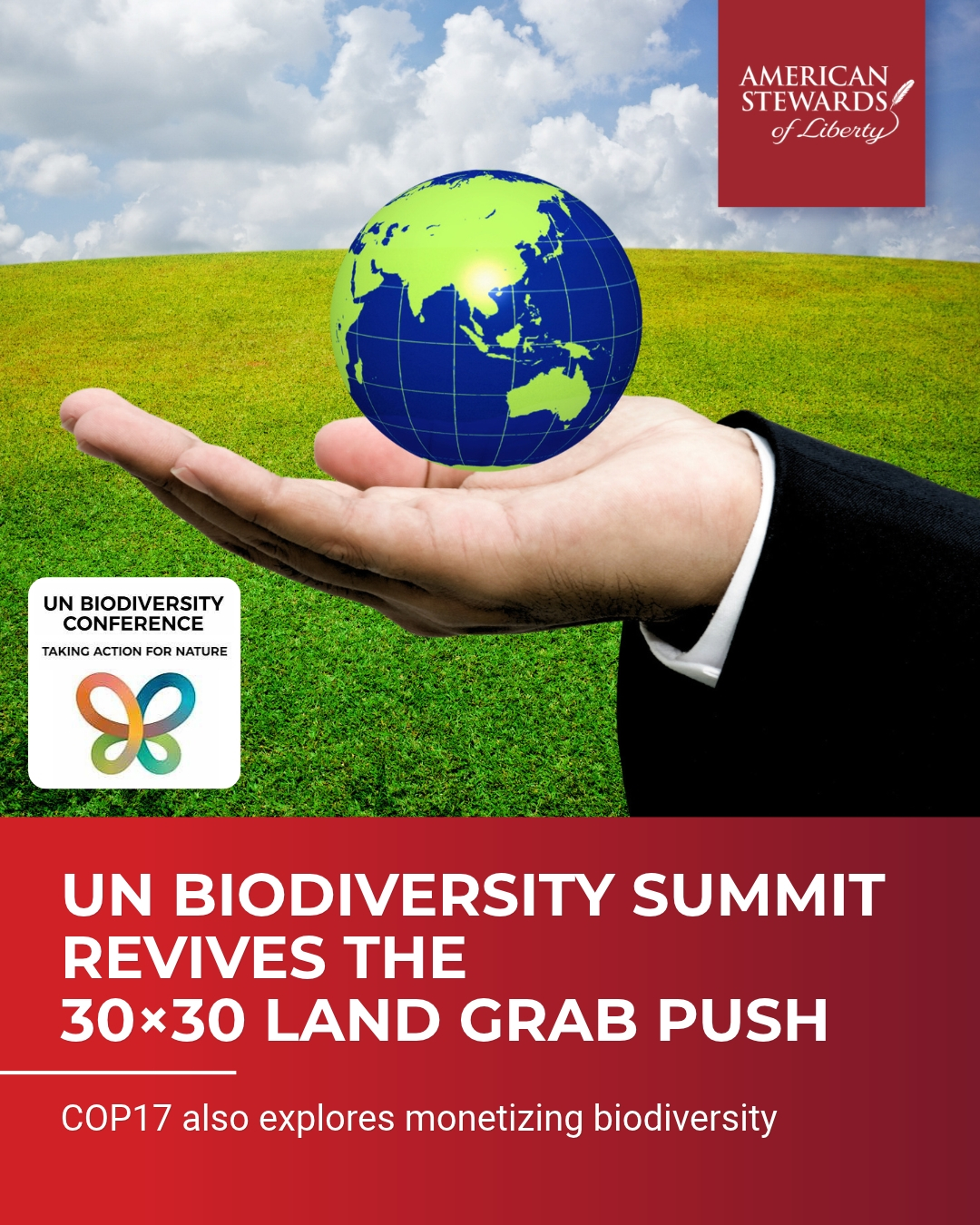
It was and is an international land grab by United Nations-aligned countries, and this month representatives of more than 190 countries gathered in Armenia to plan how to “supercharge” the drive to take ever more control of the world’s land and water.
Specifically, the central goal of the 17th Conference of the Parties to the Convention on Biological Diversity (COP17) is to conserve at least 30 percent of the world’s land and seas and restore 30 percent of degraded ecosystems. The effort is otherwise known as the 30X30 initiative.
Altogether, there are 23 missions on the bucket list to overcome what United Nations’ officials call a “human-driven nature crisis.” The goals envision a major expansion of protected and conserved areas as well as changes in how governments manage land, natural resources, and economic development.
It’s a major effort to rev up the program as UN officials worry that their land confiscation scheme is limping along. According to the United Nations Environment Programme (UNEP), fewer than half of the national biodiversity targets are on track to be achieved by 2030, while the share of land and inland waters under conservation has stalled out at approximately 18 percent.
For UNEP environmentalists, it’s an all-hands-on-deck scenario.
“The reality is that most countries are not on pace to meet their biodiversity targets by 2030,” said Doreen Lynn Robinson, deputy director of UNEP’s Ecosystems Division. “So, COP 17 is a pivotal moment. It’s a chance for countries to supercharge conservation and restoration action by providing the capacity, finance and partnerships that all nations need.”
Other items on the conference agenda include a relatively new effort to attract private investment. Right now, about 90 percent of nature-related financing currently comes from government funding.
Beyond conservation spending, delegates are considering ways to incorporate biodiversity goals into agriculture, trade, finance, and other economic policies. Biodiversity policies are government measures designed to protect and preserve plant and animal species and their habitats through land-use restrictions and regulations governing development, agriculture, and natural resources. A U.S. example of a biodiversity policy is the Endangered Species Act.
UNEP officials are brazen about what they seek.
“Biodiversity policies cannot exist in a vacuum, as they do right now in many countries,” Robinson said. “At COP17, it will be important for countries to figure out how to integrate nature conservation across all aspects of governance.”
In the past, biodiversity protection targets have largely been confined to swaths of government land, such as wildlife refuges and national parks, but at COP17 the agenda has been dramatically expanded. Among other things, the “target” list calls for participatory spatial planning across all areas of governance to reduce biodiversity loss.
As Alex Newman wrote this past week for the Committee for a Constructive Tomorrow, that means more government control over private property: “In practice, that language has repeatedly been used to justify burdensome controls and restrictions limiting what private landowners may do with their own property.”
And Newman wrote that another target takes the scheme even further.
“It calls on governments to ensure the ‘full integration of biodiversity and its multiple values into policies, regulations, planning and development processes,’ among other areas,” he wrote. “It also demands that public and private financial flows—read money—be aligned with the framework’s goals.”
Newman is blunt about the ultimate ambition of COP17.
“The framework sits squarely inside the broader UN Agenda 2030 Sustainable Development Goals, which former UN officials have openly described as the ‘masterplan for humanity’ and the ‘declaration of interdependence,’” he wrote. “The biodiversity targets are meant to mesh with climate goals, land-use planning, subsidy reform, and financing rules. So-called ‘National Biodiversity Strategies’ and ‘Action Plans’ are the delivery mechanism for it all. Governments and dictators are expected to revise them, report progress, and face a ‘stocktake’ that identifies who is ‘behind.’”
At its heart, Newman writes, citing the Vancouver Declaration adopted at the 1976 UN Conference on Human Settlements, it’s a war on private property itself: “Land cannot be treated as an ordinary asset controlled by individuals,” [the declaration stated]. “Private land ownership is … a principal instrument of accumulation and concentration of wealth, therefore contributes to social injustice. Public control of land use is therefore indispensable.”
Of course, Newman observes, that position contravenes a traditional understanding of private property:
“As recently as 2000, the Washington Supreme Court, citing longstanding American legal views, defined property like this: ‘Property in a thing consists not merely in its ownership and possession but in the unrestricted right of use, enjoyment and disposal. Anything which destroys any of these elements of property, to that extent destroys property itself. The substantial value of property lies in its use. If the right of use be denied, the value of the property is annihilated, and ownership is rendered a barren right.’”
It’s the control over the use of the land that is essential and that COP17 wants to see controlled by international governance, Newman observed.
“In other words, the UN’s biodiversity agenda is not merely about setting aside parks or protecting endangered species,” he wrote. “It envisions embedding UN-backed environmental priorities into virtually every aspect of government policy, economic development, and financial decision-making. From farming and housing to infrastructure and investment, the implications for private property, economic freedom, and national sovereignty are enormous. And the machinery to enforce compliance need not be controlled directly by the UN when national governments, regulators, banks, and corporations can do the job for it.”
To say it another way, what is otherwise known as a land confiscation scheme is a liberty confiscation scheme.
The United States is Not Immune
It’s a mistake to think that UN efforts to seize control of land and water are worrisome only to other nations. The collective power of 190 nations and their impact cannot be overlooked, Newman wrote.
“Even governments that never ratified the Convention on Biological Diversity—the United States among them—face soft pressure through subnational governments, financial institutions, and the sheer weight of coordinated international policymaking,” he wrote.
The financial architecture is especially ambitious, Newman asserted.
“Target 19 calls for mobilizing at least $200 billion per year for biodiversity from all sources by 2030, including major international funding from taxpayers in ‘developed’ nations to compliant kleptocrats misruling ‘developing’ countries,” he wrote. “For perspective, that is more than the annual GDP of Arkansas or Nebraska, to be squandered by global bureaucrats on harmful regulations.”
None of this requires a formal world government to constrain sovereignty, Newman asserted:
“The mechanism is more subtle and, in some respects, more effective: a dense web of targets, reporting, peer pressure, financing conditions, and private-sector standards that increasingly ensnare national governments and property owners.”
The resulting matrix of regulation and international corporate and UN power could lead to de facto ownership of land, even within the U.S., without the UN itself holding legal title or authority over the property.
To be sure, at the federal level, President Donald Trump ended participation in the U.S. version of 30X30, also known as America the Beautiful. President Joe Biden had launched the effort through an executive order in January 2021.
That said, despite Trump’s reversal, a number of states are still pursuing state-based conservation strategies that align with the UN program. California, Oregon, Vermont, Massachusetts, and New Mexico are among them, but not all UN-aligned states are blue.
Some red states, like South Carolina, are pursuing conservation goals that go beyond the federal government’s former 30×30 commitment, as Liberty Matters has previously reported. Earlier this year, the Republican-controlled legislature overwhelmingly approved the Protected Lands Act, signed by Gov. Henry McMaster, which established a goal of protecting an additional 7 million acres by 2050, building on approximately 3.2 million to 3.4 million acres already protected. If achieved, the total would approach 10 million acres, or roughly half the state’s land area.
Biodiversity Credits
Beyond expanding the reach of government protected lands, COP17 is examining how private financial markets can help circle the wagons around private property.
One emerging approach involves biodiversity credits, which are financial instruments that assign monetary value to measurable ecological standards, such as restored wetlands, protected habitats and endangered species, or increased biodiversity.
The biodiversity market parallels carbon-credit markets, in which the economic advantages of conservation are separated from legal ownership of the underlying property. Depending on the contractual terms, a landowner who sells biodiversity credits would accept restrictions on development, agricultural activities, or other land uses while retaining legal title.
The double aim is to capture institutional investors while simultaneously restricting the use of the land. At COP17, one conference session titled From compliance to asset class: making compensatory conservation investable examined the potential for habitat banks and biodiversity-credit programs to create financial and regulatory conditions to allow that separation. The quiet part is never said out loud, but it’s there, as if written with invisible ink: Conveyed with the biodiversity contract is the practical ownership of the land.
Another session unveiled a government-led initiative called Friends of Credits for Nature and Biodiversity, while in another the UN Sustainable Stock Exchanges initiative and the Taskforce on Nature-related Financial Disclosures addressed the incorporation of nature-related financial products and market structures into capital markets.
All of which loops back around to the idea of Natural Asset Companies. In 2023, the New York Stock Exchange proposed creating a new class of publicly traded entities known as Natural Asset Companies, or NACs, which would seek to generate financial value by conserving, restoring, and managing ecosystems on federal and private lands.
The proposal envisioned companies whose economic activities would be tied to ecological benefits such as clean air, wildlife habitat, and other so-called ecosystem services. Fortunately, the idea of creating capital out of literally thin air drew sharp backlash and pushback, led by American Stewards of Liberty (ASL).
“This is creating this whole new category and monetizing things that nobody has a right to own,” Margaret Byfield, executive director of American Stewards of Liberty, said in 2023.
ASL warned then that the structure could allow investors, including foreign entities, to obtain economic interests in protected federal lands and in privately owned property subject to conservation easements. It was—and is—a threat to American landownership and national sovereignty.
No less is COP17.
Indeed, while the New York Stock Exchange withdrew its proposed listing rule in 2024, both NACs and biodiversity credits are back on the table. Though COP17 has not formally adopted Natural Asset Companies, a rose is a rose by any other name: The conference is formally enshrining an effort to assign financial value to ecological functions and creating investment opportunities around them.
The problem is that the growth of these markets ultimately shifts control over land use to the profiteers of ecological services, and at COP17 the globalists are urgently calling for the full incorporation of natural assets into those markets. Frank Elderson, a member of the European Central Bank’s executive board and vice-chairman of its supervisory board, gave voice to an urgent call to action in a keynote address at COP17’s Finance and Biodiversity Day.
“Protecting and restoring nature is not simply spending,” Elderson said. “It is investment: investment in the natural capital on which our economies depend, investment in resilience, and investment in our future prosperity.”
Elderson called for substantially greater private investment in conservation and urged governments, financial institutions, and international organizations to find ways to transform ecological benefits into financially attractive opportunities.
“How can governments, financial institutions, international organizations and other stakeholders work together to help turn nature-positive opportunities that are not yet bankable into investments that can attract capital?” he asked.
He had a sobering answer: “Nature-related financial risks need to remain firmly on the international financial agenda, including at the Basel Committee, the Financial Stability Board and the IMF [International Monetary Fund]. … COP17 must help us accelerate the journey. And finance has a central role to play.”