If South Carolina legislators aren’t rushing enthusiastically to protect their state from unregulated data centers, they are far more thrilled with the notion of taking private property through conservation easements.
Here’s the practical difference between a data-center land grab fueled by government incentives and one driven by taxpayer-funded conservation easements: one takes land off the market for subsidized industrial development, the other takes it off the market for development altogether. Either way, government policy is determining the land’s fate rather than the free market.
Consider the South Carolina legislature in the big-government corner. For starters, a predominantly Republican legislature—it isn’t even close—and a Republican governor have embraced a statewide land-protection scheme that resembles the now jettisoned Biden administration’s 30×30 America the Beautiful program. In May, the legislature overwhelmingly passed—with only a couple of dissenters—the so-called Protected Lands Act, which was swiftly signed into law by Gov. Henry McMaster, a Donald Trump ally.
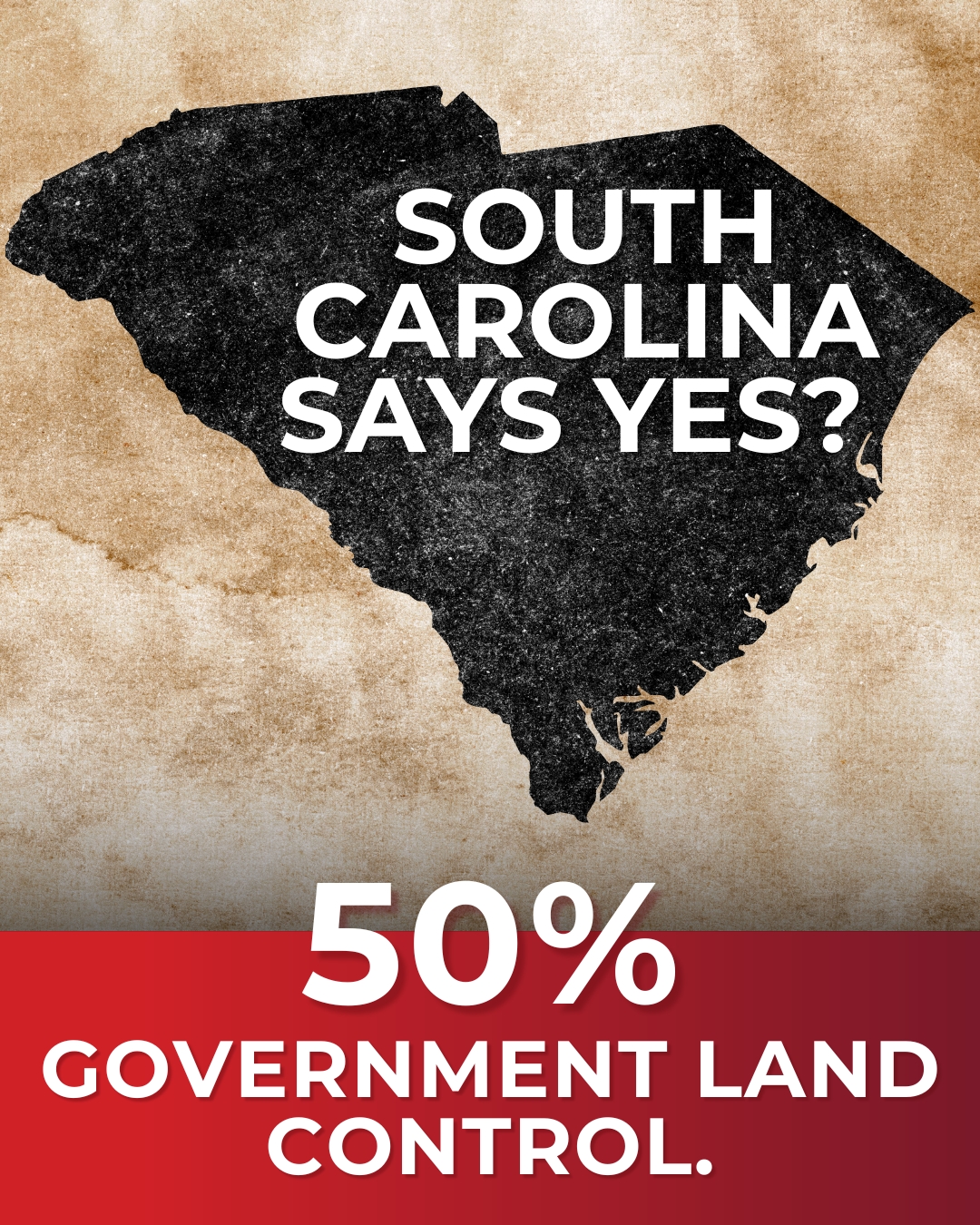
Actually, the South Carolina plan is more ambitious than Biden’s, reaching for the stars, AKA the United Nations’ globosphere. The law codifies an official state goal of adding 7 million acres by the year 2050. That’s about one-third of the state’s total land area right there, but the initiative is meant to be gravy on top of the 3.2 to 3.4 million acres already protected in South Carolina.
All totaled, by adding the Act’s target of 7 million acres over the next 25 years, the total combined footprints would reach the governor’s envisioned total of 10 million acres, or 50 percent. The governor calls it his 10-million acres initiative. The U.N. calls it Half Earth. Either way, it’s the same program and it would be fatal to private property and individual liberty.
What’s surprising is the lack of opposition or discussion of the negative ramifications. The bill sailed through the Republican-controlled legislature with only a smattering of opposition, and McMaster quickly signed on the dotted line.
The bill’s preamble actually targets the state’s own recent success as one of the fastest growing states in the country, complaining that “continued growth and rapid land development in South Carolina place increasing pressure on natural resource preservation and have affected the health of the state’s streams, rivers, wetlands, water quality, wildlife habitats, and working lands, all of which impact the quality of life of the state’s current and future citizens” and that “voluntary conservation easements on private lands provide a cost-effective means of protecting working lands and natural resources and are an important tool for advancing landscape-scale conservation across the State.”
In other words, people seeking to create and grow businesses and enterprises are flocking to the state, bringing unprecedented wealth and prosperity, so government naturally wants to kill the economic engine. And while they are at it, they intend to let government control half the land and water of the state … forever.
Never mind that conservation easements obliterate liberty, as American Stewards of Liberty has explained and shown: “Once a landowner places a CE on their land, it no longer retains the characteristics of private property. … These restrictions bind every generation that follows, and freeze the land use according to today’s practices and societal goals.”
Practices and goals that may well be outdated and counterproductive in 50 or 100 years—and even today.
Maybe South Carolina lawmakers and the governor don’t know any better. In any case, in May, South Carolina leaders, conservation groups, and tribal representatives gathered in Charleston for the Lowcountry Land Conservation Symposium, where McMaster unabashedly touted his ambitious big government agenda and channeled Joe Biden.
“We’ve got to take care of what we have,” he said. “It reminds us who we were, where we came from, and where we’re going to go. … My goal is to see that we preserve and protect it — just leave it like it is. Take care of it. But I’d also advise to be careful with how we do it and don’t do stupid things. Don’t be haphazard with that growth. Be thoughtful and careful about the earth, the waters, and the wildlife. If we can set aside these gorgeous lands, these productive lands, plant and animal life, species, and things that you don’t find anywhere else, we will have done our job. And it’s going to take some leadership, it’s going to take some determination.”
Sadly, as ASL has reported before, McMaster and South Carolina are not alone. Other states are rolling on with their version of 30×30, or 50×50, even after Trump dismantled the federal counterpart.
The truth is, “gorgeous lands” deserve “gorgeous” stewardship, and history shows that the most effective stewardship comes not from distant government control but from private owners who have both a personal stake in the land and a direct incentive to care for it, improve it, and pass it on to future generations.