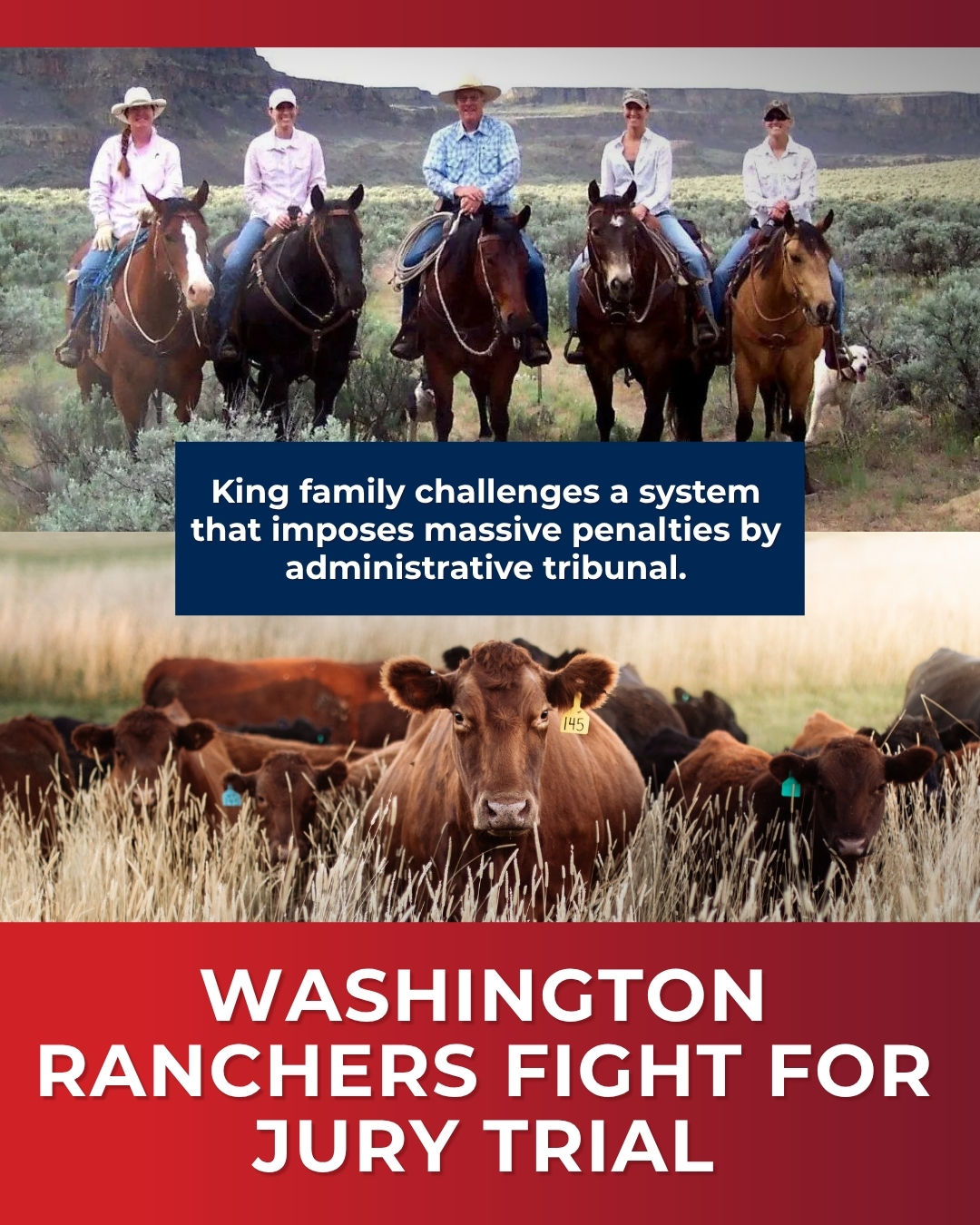
King family challenges a system that imposes massive penalties by administrative tribunal
Wade and Teresa King, whose family has operated King Ranch in Washington state’s Grant and Douglas counties since the 1950s, have appealed an August 19 state Superior Court decision dismissing their constitutional lawsuit against the Washington Department of Ecology.
After the ranchers performed what they say was routine maintenance on historical stockwater ponds on their own land and on acreage they lease from the government, the state Department of Ecology showed up on the scene, accusing them of violating state pollution laws. The agency subsequently not only ordered the Kings to remediate the ponds but slapped them with a $267,540 civil penalty, Pacific Legal Foundation (PLF), which represents the Kings, reports.
Specifically, the Department of Ecology says the stockwater ponds are regulated wetlands and that the Kings’ routine maintenance violated the Washington Pollution Control Act. The total cost of compliance is estimated to exceed $3.7 million.
The Kings, however, say the maintenance was necessary to ensure water for their ranching operation.
Here’s the thing, though, and it is increasingly a lawfare watermark stamped upon routine bureaucratic actions: The merits of the Kings’ arguments have yet to be argued and decided. More immediate is the Kings’ fight for a fundamental due process right, specifically the right to a jury trial. Under Washington law, the Kings can challenge the orders only before the Pollution Control Hearings Board (PCHB), an administrative tribunal with no mechanism for a trial by a panel of their peers.
The idea behind lawfare is to weaponize the legal system to target political opponents and to manipulate it to frustrate due process or other fundamental rights long before bureaucratic reasonableness or necessity can be tested. Internal administrative tribunals are one of the classic mechanisms lawfare embraces, and it has been unleashed on the Kings.
PLF senior attorney Oliver Dunford puts it this way: “The Kings deserve a jury of their peers before the government can fine them hundreds of thousands of dollars. The court dismissed this case without ever asking whether the state can force people into a tribunal that has no power to give them that jury. We’re taking that question to the Court of Appeals.”
In the August 19 ruling, judge Melissa Chlarson determined that the Kings couldn’t file a lawsuit until the administrative process was completed and so did not delve into that process itself. So not only did the judge not address the merits of the case, she failed to consider whether the administrative process itself was unlawful.
“Plaintiffs’ action was improperly brought under the Uniform Declaratory Judgments Act (UDJA), as the UDJA does not apply to state action reviewable under the Administrative Procedure Act (APA),” Chlarson wrote. “The APA is the exclusive means of judicial review of agency action, and Plaintiffs have failed to exhaust their administrative remedies before initiating their action in Superior Court.”
Constitutional guarantee
The Kings say those administrative remedies are unconstitutional because they deprive citizens of their right to a jury trial. In addition to seeking reversal of their lawsuit’s dismissal, the Kings have asked the Washington Court of Appeals to halt the pending PCHB proceeding while the appeal is heard.
In her decision, Chlarson said the statutory process for adjudication was clear, but the Kings say the administrative tribunal isn’t regulating future conduct so much as it is seeking a massive monetary penalty based upon disputed facts, which they say demands the possibility of a jury trial and is unconstitutional without such a possibility.
“The ‘right of trial by jury shall remain inviolate,’” the legal motion to dismiss, filed last April by PLF, stated, quoting the Washington state constitution. “The term ‘inviolate’ connotes deserving of the highest protection. … Accordingly, Washington Courts have long held that, even in close cases, they must err on the side of preserving the right to a jury trial.”
What’s more, the motion continues, because that constitutional provision is a “mandatory” clause, the jury-trial right becomes even more indisputable. Then, too, to determine whether a jury trial is required in an action, the motion explained, courts “look to the right as it existed at the time of the constitution’s adoption in 1889.” That historical standard is used to determine the scope of the right and the causes of action to which it applies, PLF argues.
“Ecology cannot prevail by pointing to modern administrative convenience or legislative preference,” the motion stated. “Instead, it must demonstrate that the type of action it brings—one seeking substantial monetary penalties imposed for alleged statutory violations—falls outside the class of cases historically tried to juries in 1889. It cannot do so.”
Indeed, the motion argues, “the inquiry is not whether the specific cause of action existed in 1889, but rather whether the type of action is analogous to one available at that time.”
That leads the Kings to what they believe is an unassailable historical argument. Specifically, they argue that Ecology’s enforcement action resembles several traditional common-law actions historically heard by juries: an action in debt to collect a monetary penalty, an action for damage to property, and conversion.
“First, Ecology’s enforcement action is fundamentally a claim for money,” the motion states. “Ecology seeks civil penalties from the Kings for alleged harm to (purported) wetlands. The statute authorizes Ecology to seek monetary penalties of up to $10,000 per day for each violation.”
Historically, the Kings argue, statutory penalties of that kind were enforced through actions in debt—common-law actions to recover monetary obligations—and, as the U.S. Supreme Court summarized, “[a]ctions by the Government to recover civil penalties under statutory provisions therefore historically have been viewed as one type of action in debt requiring trial by jury.”
The state had also argued that, because part of the proceedings involved restoration orders, that is, mitigation and repair of alleged damages, a jury trial was not warranted. However, the Kings contested that assessment, saying the order to undertake potentially millions of dollars of work to repair what the agency says they damaged resembled traditional property-damage, nuisance-abatement and trespass claims in which factual questions and damages historically could be determined by juries.
“Ecology seeks to impose a monetary penalty arising out of the Kings’ alleged harm—whether negligent or intentional—to the State’s property (as well as to the Kings’ private property),” the motion states. “That claim, like the DNR’s in Littlejohn, is ‘a type of action defined by the common law and heard by a jury at the time of the adoption of the constitution.’ Indeed, the relief sought is functionally a cost-of-repair or in-kind restitution remedy for negligent or intentional injury to the property of another—the precise category of common-law claim heard by juries.”
The restoration orders reinforce that point, the Kings assert.
“They are not purely equitable,” the motion states. “They closely resemble Washington nuisance-abatement actions … where abatement expenses—including the costs of removal, repair, or restoration—‘can be collected by the officer in the same manner as damages and costs are collected on execution.’ In such actions, the underlying liability facts and the reasonableness and amount of abatement or restoration costs are resolved as part of a legal claim for damages to property.”
Even more directly, the motion continues, the restoration orders parallel Washington timber trespass actions—classic property-tort claims heard by juries at common law.
“In those cases, restoration or replacement costs serve as the primary measure of damages, with the reasonableness of those costs determined by the trier of fact, typically a jury,” the motion states. “These claims all resemble class tort claims, for which juries are required.”
In sum, the motion argued, the scope of the right to a jury trial in 1889 included the jury’s power to weigh and determine questions of fact; and “the type[s] of action” are “analogous to one[s] available at that time.”
Therefore, the Kings are entitled to a jury trial for the claims asserted by Ecology, and the jury-less PCHB proceeding unconstitutionally deprives the Kings of their fundamental right to a jury trial, PLF asserts.
Federally speaking
The Kings separately invoke the federal Seventh Amendment, even though the attorneys acknowledge that the United States Supreme Court, in a case known as Bombolis, has not incorporated the Seventh Amendment’s civil-jury guarantee against the states.
The Kings and PLF want that issue reconsidered, citing justice Neil Gorsuch’s observation that the old precedent is “something of a relic” that can leave Americans saddled with disparate standards between the state and federal levels.
“Importantly, justice Gorsuch noted that Bombolis’s remaining on the books ‘subjects ordinary Americans to a two-tiered system of justice,’” the motion stated. “The Kings will suffer this fate if the Court here concludes that they are not entitled to a jury trial under the Washington Constitution.”
The Kings also cite several other cases.
In Acushnet River & New Bedford Harbor Proceedings Re Alleged PCB Pollution, the court held that Massachusetts’s “claims for natural resource damages and recovery of public nuisance abatement expenses [under both state and federal statutes] present legal issues which must be tried to a jury as a matter of right.”
“In Tull, the U.S. Supreme Court held that the federal government’s claim for civil penalties arising out of violations of the Clean Water Act was analogous to the common-law action debt for which a jury is required,” the motion states.
The Kings’ case “is on all fours” with the Tull decision, the motion asserts, meaning that it essentially presents the same legal issues.
And there’s more. According to the U.S. Supreme Court in SEC v. Jarkesy, one is entitled to a jury under the Seventh Amendment if the claim at issue is legal.
“To determine whether a claim is legal in nature, courts consider (1) the cause of action and (2) the remedy it provides,” the motion contended. “The remedy is the ‘more important’ consideration. The cause of action need not have a precise analog at common law because the Seventh Amendment ‘requires trial by jury in actions unheard of at common law.’”
Finally, in Sofie v. Fibreboard Corp. in Washington state, the court observed that the United States Supreme Court’s analysis of the Seventh Amendment, while not binding on Washington courts, provides “some insight,” the motion pointed out.
“Not surprisingly, then, Washington courts often look to Seventh Amendment cases when considering the scope of the Washington Constitution’s jury-trial guarantee,” the motion concluded.
The Kings are asking the court of appeals to review Chlarson’s dismissal on an expedited basis and, most important, to stay the PCHB proceeding during appeal. Their argument is essentially that forcing them through the jury-less administrative hearing before resolving whether they are constitutionally entitled to a jury defeats the purpose of the constitutional challenge itself.
Meanwhile, the underlying environmental dispute remains unresolved.