How routine ranch work became an exercise in federal bureaucracy
They may not be characters in Samuel Beckett’s famous play Waiting for Godot, kicking around in a pointed demonstration of life’s absurdity, but, given all they have gone through, Becki and Dustin Ross might be able to write their own play—Waiting for Permission—about the absurdity of federal bureaucracies and the relentless need for federal approval just to run their ranch.
The Rosses have spent decades raising cattle and caring for their Arizona ranch, but increasingly, they say, they spend their days waiting for federal permission to do just about anything.
“I’d call it death by a thousand cuts,” Dustin Ross told Liberty Matters in a recent exclusive interview, and Becki Ross wholeheartedly agreed.
“It’s just a whole bunch of little delays,” Becki said. “Whatever the problem is, it just ends up being a delay. When we’re in drought, and one of our stock tanks, like an earthen stock pond, is dry, we need to clean it right then. And it’s a spot that may be a hundred years old and gets cleaned every 10 years, and so we’ve run either a loader or sometimes a bulldozer over this spot, but still they’re insistent [about getting approval again].”
The Ross family has run cattle on their Windmill Mountain Ranch’s U.S. Forest Service grazing allotment in Arizona for more than 50 years. Through drought, wildfire, and changing markets, the family has protected and worked their ranch, not least because they believe that helping feed the nation is a noble and rewarding profession.
To be sure, ranching poses extraordinary challenges just to survive. In 2021, severe drought prompted the Forest Service to cut the Rosses’ authorized Animal Unit Months, or AUMs, by 25 percent. The agency has since restored the grazing numbers, but the Rosses have still been unable to rebuild their herd to full capacity.
Drought has been only part of the reason. They’ve also come up against archaeological-clearance requirements that have delayed repair of wildfire-damaged fences and deteriorating roads and a federal approval process that can turn even cleaning an existing stock tank into a years-long bureaucratic exercise.
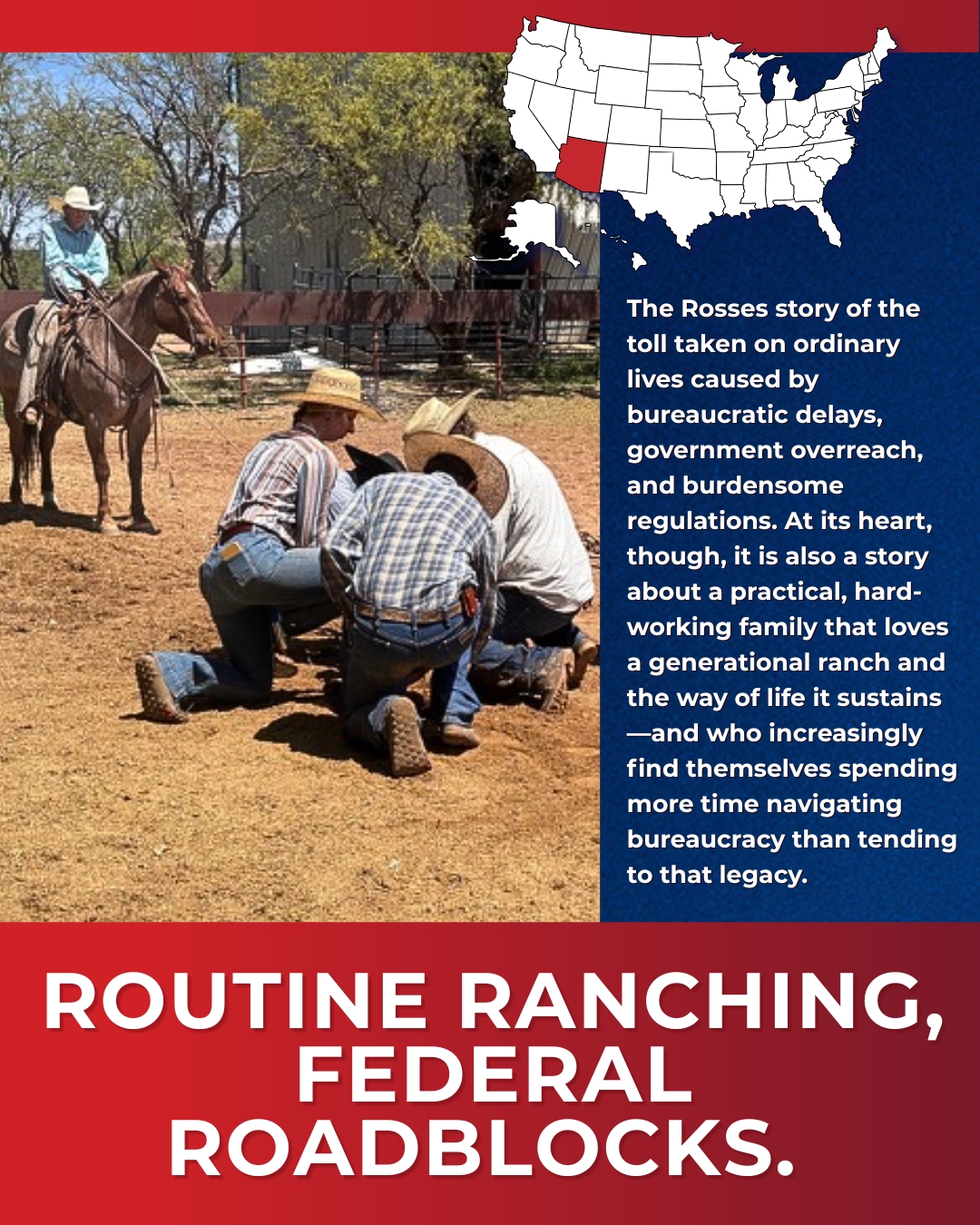
Unfortunately, their story is all too familiar. It is the story of the toll taken on ordinary lives caused by bureaucratic delays, government overreach, and burdensome regulations. At its heart, though, it is also a story about a practical, hard-working family that loves a generational ranch and the way of life it sustains—and who increasingly find themselves spending more time navigating bureaucracy than tending to that legacy.
“The ranch has basically been run the same since we got it in the early ’70s,” Dustin said. “And before that, a family had it for 50 years that ran it basically the same as we do today.”
The ranch’s federal and state grazing lands encompass approximately 125,000 acres. The Rosses are permitted for 565 cows, though they have not had that many for several years because of the drought. Their allotment works out to about 250 acres per cow, Becki said. That may sound enormous to people accustomed to greener parts of the country, but Arizona’s forage is sparse, seasonal, and dependent upon water.
“As long as we’re not in year after year after year of drought, it easily supports the cattle that we have,” she said.
That is, as long as they get federal permission to do what they need to do.
Built around water
Becki Ross said western grazing allotments were designed to help homesteading families survive in country where a standard 160-acre homestead could not support a family.
“The farther west you go, you couldn’t make a living on the 160 acres,” she said. “You couldn’t feed a family. And so the grazing allotments were designed around water, which is obviously a resource that we value in Arizona.”
A homesteader with access to a spring, river, or artificial stock tank could graze cattle across the surrounding country within reach of that water: “You had this water right as a homesteader, and you could graze as far as that water made that land available, like the range of a cow,” she said.
The allotments grew larger because families could not make a living from smaller ones. They also existed within a multiple-use vision that included grazing, timber, minerals, and watershed management.
“When it started, there were no fences or cattle guards or vehicles of any kind,” Dustin said. “It was just a spring or a manmade tank or access to a river. And that’s how the cattle dispersed throughout the land.”
It was difficult country then, and it remains difficult country today, the Rosses say.
“It’s very sparse vegetation and very seasonal,” Dustin said. “It’s a tough way to make a living, especially back then.”
Tough, yes, but it has also been, for generations, a very satisfying way for the Rosses to make a living. What has changed is everything surrounding the work. The Rosses now spend hours attending meetings, applying for grants, coordinating between agencies, and seeking approval for projects performed repeatedly for decades.
“It’s basically turned into a desk job for me,” Becki said. “There’s something every day to either ask the Forest Service about or work on projects or talk to someone like you.”
Here, there, and everywhere
The government’s reach is everywhere, the Rosses say, and so is its impact.
For example, they have invested heavily in improving the ranch’s water infrastructure, including rebuilding approximately 26 miles of waterline originally installed by Dustin’s grandparents.
But the improvements they pay to install on federal land ultimately belong to the government.
“What infrastructure we build or replace is owned by the federal government,” Becki said. “It’s not ours, which is a little strange because you could sell the ranch, and if you had a new waterline, obviously that would make it worth more, but it is owned by the federal government. I think our rights were stronger way back when than they are now. I think they’re getting chipped away.”
Still, the Rosses say, it is not one rule or decision that has made their work so difficult: “It’s just the whole bunch of little delays,” Becki said.
During drought, timing can determine whether a stock tank captures water or remains empty. An earthen stock pond that has filled with silt must be cleaned when conditions allow—not one or two years later. Many of the tanks are a century old and have been cleaned repeatedly, first by horses and later with loaders or bulldozers. Nevertheless, the Forest Service has required archaeological clearance before allowing the Rosses to disturb the same dirt again.
“They have an archaeologist go out to make sure there are no heritage cultural artifacts in this dirt stock tank that cattle have been standing in for a hundred years,” Becki said.
The work may take half a day. Approval can take years.
“Those delays, except for this past year, probably average between a year and two years just to get a dirt stock tank cleaned,” she said.
Other ranchers have waited four or five years on federal land, the Rosses said.
On Arizona state land, Dustin said, officials generally recognize the obvious: “They just say, ‘Go for it. It’s there. It was always there. Clean it,’” he said.
But not so with the federal government. And the same delays affect fences, wells, and waterlines.
“People want to redo wells, all kinds of things,” Dustin said. “They use this as a big hindrance for ranchers who a lot of times are spending their own money or have projects. And in our case with the waterline, we lost $120,000 of funding because of a delay for this kind of thing. We ended up getting it back and making it work, but still at the time it was a huge blow.”
Dustin said they had worked intensely with the Natural Resources Conservation Service to get it done.
“And then the Forest Service says, ‘Wait, we’ve got to do an archeological clearance on the waterline that you’re just replacing,’” he said. “We’re not putting it in a new spot. We’re not doing anything different than it was.”
In that case, the Rosses recovered the funding only after abandoning the original award, reapplying, and risking the possibility that the project would not qualify the second time.
“Luckily we did,” Becki said. “That could have been really devastating, especially on this 50-year-old waterline.”
For Dustin, the experience was particularly frustrating because two federal agencies working toward the same conservation objective could not coordinate.
“We want to raise cows, and we want to work,” he said. “And you’re looking at it from the outside and these are two federal agencies, and they can’t make this work. We’re the ones driving the boat trying to get it done. It’s just heartbreaking sometimes, the inefficiencies that are there.”
Permission to replace what was already there
The obstacles are often most daunting when the project is smallest.
The Rosses have struggled with off-highway vehicles speeding along ranch roads, for example. The city of Sedona helped obtain a solar-powered speed sign, but putting its single pole into the ground required—wait for it—yet another archaeological review. The road was nearly a century old, and another sign had stood in the same location.
“And the funny part about it is, three years prior, there was a sign in the ground,” Becki said. “So I’m pretty sure that the archeo needed to be done for that sign three years ago. And when we talked about this in May—it’s not even over yet—when we talked about it at a meeting in May, the Forest Service’s recreation department said, ‘We’re going to ask the archeology shop.’ That’s what they call each other’s divisions.”
Whether it’s supplying water to wildlife and cattle, or a sign that might slow some people down on the ranch—Becki and Dustin say they are certainly not in the driver’s seat. It’s bureaucratic absurdity, they say, and they also say simple solutions abound.
Among other things, they believe ranchers should have access to records showing which roads, tanks, and other locations have already undergone archaeological review so existing improvements are not studied from scratch every time routine maintenance is needed.
“You shouldn’t have to do archeo on anything existing,” Becki said. “Why isn’t there a database that I could access for every archeo clearance that has been done on our ranch? Because really every road on the ranch should have gotten clearance at one time. If I knew that for certain, then I could just say, ‘Nope, here it is. We need your signature so we can clean the stock tank. We already know that we don’t need a clearance for it.’ That would be a really good idea, because the archeological clearances do stop, delay everything.”
Not the people, but the system
Despite their frustrations, Becki and Dustin do not portray every Forest Service employee as an adversary. They have worked with the same range conservationist (range con) for approximately 17 years and developed a level of trust. Their longtime range conservationist understands the ranch and knows how to move projects through the agency, but other ranchers may not be so fortunate, they say.
“There are people who have a newer range con come in, or maybe even one with a bit of an agenda, and it gets extremely difficult,” Dustin said. “You talk to your neighbors, and they’re allowed to do things, and then the next neighbor who has a different range con isn’t allowed to do those same things. And it gets really out of whack fast if there’s someone misusing their power.”
“There are a lot of inconsistencies forest to forest,” Becki added.
The problem, they say, is a system that relies too heavily upon individual interpretation rather than clear, consistent policy. That was evident in 2021, when the Forest Service cut permitted cattle numbers by 25 percent across the forest despite University of Arizona range monitoring that the Rosses said supported the ranchers’ position.
“It totally proved them wrong, but we still got the cut,” Dustin said. “We battled them on it, but we were unable to win.”
Dustin said ranch families left meetings about the cut knowing their income had effectively been reduced by a quarter: “But the 65 people who work at recreation and range in that office—their paycheck didn’t get cut at all,” he said.
A new fence beneath dead trees
The 2021 Rafael Fire burned a critical boundary fence on the ranch, and Dustin said replacing 11 miles of barbed wire would cost approximately $30,000 per mile. With that number in hand, Becki assembled a combination of state and Forest Service funding, ultimately securing enough for construction of a $300,000 fence.
But not without bureaucratic delay. Turns out some of the fence was in a designated potential habitat for the Mexican spotted owl. A consultation with the U.S. Fish and Wildlife Service delayed part of the work for approximately six months.
“The thing is, we’re building a fence that was already there,” Dustin said. “We were struggling because more of our fence was in a spotted owl pack, a potential habitat. There actually weren’t any owls there. There haven’t been any owls there since the fire and maybe prior to the fire as well, but there’s this identified area by the Fish and Wildlife Service.”
Then, too, the fence could be constructed, but workers could not use chainsaws to cut fire-killed trees standing beside it until another approval was issued.
“You couldn’t run a chainsaw to cut a tree down,” Becki said. “And so we have this brand new, pretty shiny, perfect fence with trees on it that were burned. And burned-up dead trees are falling on this fence until we can get Fish and Wildlife Service permission to cut a tree down adjacent to the fence.”
The Forest Service did suggest it could return later and repair any damage, but the Rosses point out that each falling tree weakens a fence they must rely upon for a long time: “That damages the integrity of the fence that we are going to rely on for the next 50 years,” Becki said. “It just defied logic.”
When a stock tank becomes a wetland
Another dispute centers on a large stock tank built by ranchers before 1900.
The tank sits in a meadow and, when filled, backs water into the surrounding ground. Cattle, elk, and wildlife had grazed it for generations. Approximately a decade ago, the area was classified as a wetland, and so the Rosses were prohibited from grazing cattle there until summer unless they built a fence around it.
“A fence around it to exclude the cattle,” Becki said. “But the elk could just hop right over it, and we have 10 to one elk to cattle. So the elk are okay, cattle aren’t.”
The restriction was based on a biologist’s 2013 visit, when she observed hydric soils and emergent wetland vegetation: “It was one day, one little, tiny glimpse in time, and she determined it,” Becki said.
During recent dry years, Dustin said, the area has often been “dry as a bone.”
The story took an ironic turn after the recent Pocket Fire burned approximately 28,000 acres. Fire crews withdrew about 850,000 gallons from the stock tank, nearly draining it.
“For some reason, it’s not that serious of a wetland that they can’t use it for firefighting,” Becki said.
“Not to mention the vehicles driving across there to pump the water,” Dustin added. “All these things that are completely forbidden to do.”
The episode illustrated another aspect of government regulation: flexibility. The Rosses may have to wait for permission when they need to perform ordinary work, but government can grant itself permission anytime it wants.
What’s more, the Rosses have experienced at least 10 major wildfires in 12 years in their summer pastures. The government lets them burn, seemingly thinking it will clean out the forest, but the opposite is true because they had allowed the forests to become so thick.
“It just devastates the country and you get all the dead fall and then the locust brush grows up in it because the cattle can’t get in there and move around and the elk and stuff because there’s so many trees piled up on top of each other,” Dustin said.
They say the fires leave dead standing timber, fallen trees, and thick brush that make the land difficult for cattle and wildlife to navigate.
“It’s just a mess when it’s done,” Becki said. “It needs mitigation right afterward.”
The disparity in federal spending is particularly frustrating. During a major fire, the government can assemble enormous crews, aircraft, camps, and heavy equipment. But it is a different story afterward and during normal times: “The support is just way different than how the public gets supported with the federal land when there’s not a fire,” Dustin said.
One estimate of the fire’s cost that the Rosses heard was $28 million halfway through the fire. After the flames are out, though, little money remains for restoring roads, removing dead trees or repairing fences.
“Why can’t we spend some of this money on pre-treatment?” Dustin asked. “Let’s get a hundred guys out here to clean some of these thickets up and reduce some of this fire fuel.”
Even prescribed burns have damaged an estimated 10 to 20 percent of the ranch’s fence infrastructure. The heat weakens wire and burns wooden stays and braces. Then the family is told there is no money to replace it.
“There’s your crippled fence,” Becki said. “You’re stuck dealing with that at $30,000 a mile.”
On top of that, they say, the trees will be falling on the fence.
“Control burn guys don’t go back through,” she said. “A lot of times they might, if there’s a tree right on the fence, they might cut it down. Or if there’s a tree that’s already down, that has already fallen on the fence. And there’s no other infrastructure around. This is the only value for a mile or two miles. Even just to have a tree easement, to get the trees away from the fences. It’s like we’re taking a sledgehammer to our own car.”
Every use except ranching
Recreation creates another layer of pressure, particularly near Sedona. Off-highway vehicles race over roads designed for pickups, cattle work, and access to stock tanks.
“The roads are kind of made to putt down in a pickup truck,” Dustin said. “When you’re blazing down them at 75 miles an hour, it’s obviously going to blow the material off the road. Our roads are just shot.”
The damage has forced the Rosses to alter their operation. Semis that once hauled bulls between winter and summer country can no longer travel roads they previously used.
“It’s all degrading,” Becki said.
OHVs, dirt bikes, hot-air balloons and tour vehicles also push cattle away from grazing areas: “If this is supposed to be multiple use, I think we are the only ones being affected by all the other uses,” Becki said.
Dustin estimates that they have lost 30 percent of their ranch for recreation.
“We need law enforcement to match the usage, and we need maintenance to match,” Becki said.
A trip to Washington
The Rosses persistence eventually took them from the ranch to Washington, D.C.
Becki submitted the ranch’s experiences through the USDA lawfare portal recently established to collect examples of regulatory lawfare and government obstacles.
“I just typed up all these things—when we got our numbers cut and the wetlands and whatever I could squeeze onto one page,” she said.
At first, she heard nothing.
Then she drove three hours to a Forest Service listening session. The scheduled three-hour session lasted four hours because so many producers attended. There was a follow-up listening session after that, she says, and by persistently participating she was invited to the Washington lawfare roundtable.
Already the Trump administration had directed the Forest Service to streamline grazing authorizations, reduce unnecessary delays, and improve engagement with ranchers. For the Rosses, the value of those directives will depend upon whether the changes reach the ground.
In addition, they say federal policy needs to prioritize range and grading.
“I think range needs to be prioritized, maybe not as much as fire, but range needs to be prioritized because right now range is the low man,” Becki said. “Recreation is more important and logging is more important. And I guess that’s the only uses that we have. I mean, we’re held to a standard nobody else is.”
Consistency is another important priority, Dustin says.
“It doesn’t matter if you don’t like cattle or you do like cattle—the policy should be the same,” he said. “And you could look at your neighbor and he is doing the same thing. And if there’s a fire, the policy is to come up, clean the dead trees out, and if there’s a road that has over a hundred people a week, it needs to be bladed once a month. It just needs to have some structure to where they can get some stuff done. And I really think as bad as the maintenance and stuff has gotten, they really need to start contracting more things out.”
The bottom line is, Becki says: “We need to take government out of government and run it like a business.”
What the Rosses are seeking is not special treatment, but reasonableness.
“Folks need to understand that when they’re working with the government, it’s a lot of work to try to negotiate and get through all this stuff,” Becki said. “And that’s what we talk about.”
Routine maintenance should not require years of negotiation, the Rosses say. A rancher should be able to consult a policy manual and know what is permitted.
“If you want to clean a tank, we should be able to open the book to page 12, section four, and you can clean the tank if it’s existing or whatever the rule is,” Dustin says. “And we all know it.”
After more than half a century on the Windmill Mountain Ranch, the Rosses know how to raise cattle. They know how to distribute water, repair fences, and respond to drought and wildfire. What they increasingly do not know is how long they will have to wait, like characters in a play, for permission to do it.