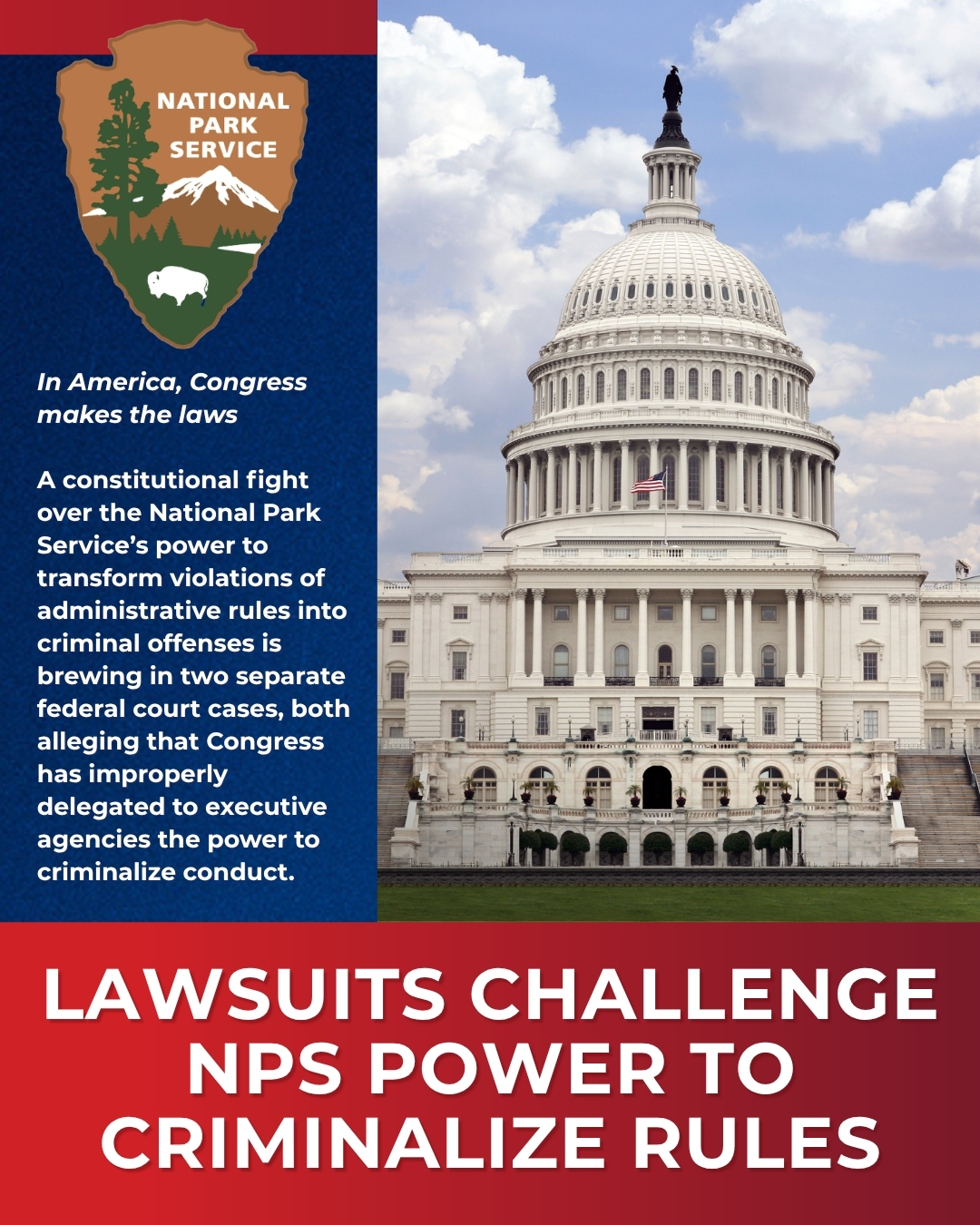
In America, Congress makes the laws
A constitutional fight over the National Park Service’s power to transform violations of administrative rules into criminal offenses is brewing in two separate federal court cases, both alleging that Congress has improperly delegated to executive agencies the power to criminalize conduct.
In one lawsuit, the New Civil Liberties Alliance (NCLA) is asking the Fifth Circuit Court of Appeals to resurrect a lawsuit brought by BASE jumpers challenging the National Park Service’s (NPS) longstanding prohibition on the sport, as well as its criminalization of violations of that prohibition.
BASE jumping is a sport in which participants parachute from fixed objects. The acronym stems from the four types of objects most often used for jumps: buildings, antennas, spans such as bridges, and earth formations such as cliffs. In the case, NCLA says Congress unconstitutionally delegated criminal lawmaking power to the National Park Service (NPS), allowing the agency to decide what constitutes a criminal offense within the 85 million acres of public land it oversees.
“For decades, NPS has used that power to criminalize a variety of activities in the national parks, including some as innocuous as roller skating, using a metal detector, or the entire sport of BASE jumping,” NCLA attorneys state.
NCLA’s lawsuit challenges the criminal scheme, asserting, among other things, that it violates the Vesting Clause in Article I of the Constitution, which reserves criminalization and all other lawmaking power for Congress alone and does not allow legislators to transfer it elsewhere.
The immediate dispute involves the Park Service’s “Aerial Delivery Rule,” a regulation that predates BASE jumping and, according to NCLA, was originally written to regulate unauthorized cargo drops and aerial deliveries from aircraft. NPS subsequently interpreted that rule to prohibit BASE jumping throughout the national park system, NCLA reports, but violators can face arrest, a $5,000 fine, a criminal record, and imprisonment.
The NPS’s interpretations raise two separate issues, NCLA states.
First, Congress delegated criminal lawmaking authority to NPS without constitutionally adequate guidance. Second, NCLA says the NPS transformed an inapplicable regulation into an outright ban on BASE jumping, which it says is a violation of BASE jumpers’ Fifth Amendment right to due process of law and is an arbitrary and capricious action defying the Administrative Procedure Act.
Due Process
As has become increasingly common in litigation, the BASE jumpers have not yet received a ruling on those underlying constitutional claims. Instead, they are fighting for procedural due process rights first.
Specifically, the U.S. District Court for the Southern District of Texas dismissed the lawsuit for lack of standing, mainly because the plaintiffs had not yet been charged with a crime, despite acknowledging that the plaintiffs seriously intended to BASE jump in national parks and faced a credible threat of future criminal prosecution if they did.
“Under established law, that showing of serious intent and credible threat are enough to establish an injury-in-fact,” the NCLA principal brief asserts. “The district court nevertheless denied standing, holding that NCLA’s clients failed to allege an injury-in-fact because they did not claim there is a freestanding constitutional right to BASE jump. That novel, additional requirement for pre-enforcement standing appears nowhere in Article III and cannot be reconciled with controlling precedent.”
In other words, NCLA argues that the district court effectively created a dangerous Catch-22: Americans challenging an allegedly unconstitutional criminal law before they are injured by it must claim an independent and explicit constitutional right to engage in conduct that violates the law before they are even allowed into the courthouse.
Casey Norman, NCLA’s litigation counsel, said the interpretation was dangerous.
“Under the district court’s rule, whenever a criminal law targets conduct that is not independently protected by the Constitution, people must violate that law—committing a federal crime and risking punishment—before a court may even consider whether it is constitutional,” Norman said. “The Fifth Circuit should reject that dangerous theory and let the plaintiffs’ claims be heard.”
NCLS also contends that the district court wrongly characterized plaintiffs’ injury as the inability to BASE jump wherever and whenever they chose, free of any government regulation.
“That is not what plaintiffs seek,” the brief states. “Rather, they challenge the sole legal provisions that expose them to arrest, prosecution, and imprisonment for engaging in an otherwise lawful recreational activity. Because those provisions provide the sole basis for criminal punishment, a favorable ruling would eliminate the criminal threat and directly redress plaintiffs’ injury.”
NCLA cited the Fifth Circuit’s 2008 decision in Roark & Hardee LP v. City of Austin, which involved a criminal smoking ordinance. The court allowed plaintiffs facing a credible threat of prosecution to challenge the ordinance, NCLA pointed out, even though there was no constitutional right to smoke in a bar. NCLA argues that the same principle applies to BASE jumping.
“Roark addressed whether plaintiffs facing criminal enforcement of what they alleged to be an unconstitutionally vague law could establish pre-enforcement standing without identifying a freestanding constitutional right to engage in the proscribed conduct—the same question presented by Plaintiffs’ Fifth Amendment vagueness claim,” the petition states. “Roark found standing because certain plaintiffs had already been charged under the challenged smoking ordinance, and all plaintiffs faced ‘the real potential of immediate criminal prosecution.’ That finding rested entirely on the plaintiffs’ exposure to criminal enforcement and credible threat of future prosecution—not on any independent constitutional right to permit smoking in a bar.”
The brief also calls attention to the Fifth Circuit’s 2026 decision in McNutt v. DOJ, involving people who wanted to distill spirits at home despite a federal criminal prohibition. The court found standing based upon their serious intent to engage in the prohibited activity and the credible threat of enforcement, not because the Constitution contains a freestanding right to make bourbon at home, NCLA argued.
“The plaintiffs there were liquor connoisseurs and enthusiasts who wished to distill spirits at home; federal law criminalized that conduct; and the government’s enforcement history established a credible threat of prosecution,” the brief states. “This Court held that every plaintiff established injury-in-fact. Critically, that holding did not rest on a freestanding constitutional right to distill spirits at home. The plaintiffs’ serious intent to engage in the proscribed conduct, coupled with the credible threat of enforcement, supplied the Article III injury.”
Whether the Constitution enshrines a right to make one’s own home-distilled bourbon was beside the point, NCLA argued.
“Article III does not require plaintiffs to commit a federal crime—and risk arrest, prosecution, and imprisonment—before obtaining judicial review of whether the provisions authorizing that criminal prosecution are constitutional,” the petition states.
Not Anti-Regulation
NCLA also stresses that the plaintiffs are not asking the courts to establish an unrestricted constitutional right to BASE jump anywhere in the national parks. They acknowledge that NPS can lawfully regulate activities on federal property.
“Plaintiffs acknowledge that NPS may regulate park activities through lawful means,” the brief states. “But the government’s authority to impose different, lawful restrictions in the future does not diminish the concrete redress afforded by eliminating the threat of criminal prosecution that plaintiffs today face under the challenged scheme.”
Nor is the government’s proprietary authority a self-executing criminal code, NCLA asserted.
“The government’s general authority to regulate the use of federal land does not authorize Congress to transfer criminal lawmaking power without constitutionally adequate guidance, or to criminalize conduct through provisions too vague to satisfy due process of law,” the brief states. “Whatever lawful land-use limitations the government may impose as landowner, that authority neither cures the constitutional defects alleged here nor alters the fact that invalidating the challenged provisions would eliminate plaintiffs’ existing criminal exposure.”
Plaintiffs are “specifically challenging the criminal element” and neither seeking a “decree that BASE jumping must be affirmatively permitted” nor claiming a “right to jump wherever, whenever they desire,” the brief declares.
Rather, they are challenging the particular legal chain that makes BASE jumping a federal crime, the brief states.
“The threat of criminal prosecution and punishment that they face arises solely through the operation of the three challenged legal provisions: 54 U.S.C. § 100751 supplies the unconstitutional transfer of lawmaking authority under which NPS promulgated the Aerial Delivery Rule; that rule supplies the operative prohibition that NPS construes to criminalize BASE jumping; and 18 U.S.C. § 1865(a) renders violations of all NPS regulations promulgated under Section 100751 federal crimes.”
Each provision is indispensable to the existing criminal prohibition, NCLA asserts.
“Thus, a favorable judgment invalidating any one of those provisions would sever the legal chain and eliminate the resulting threat of criminal prosecution,” the brief states. “… Put simply: the challenged provisions create the criminal threat, and the requested relief would eliminate it.”
Jumping Beyond BASE Jumping
If BASE jumping sounds like an exotic edge case, a separate prosecution in Yellowstone National Park suggests otherwise.
The constitutional challenge is not confined to extreme sports. In the case backed by Pacific Legal Foundation (PLF), Oregon outdoorsman Tate Pulliam found himself facing three federal petty-offense charges after a December 2025 visit to Yellowstone National Park, two for fishing and another for driving his pickup on a road that park officials said was restricted to over-snow vehicles.
“In December 2025, Tate Pulliam took a trip to Yellowstone National Park,” PLF states in its description of the case. “He explored its trails and enjoyed its lakes. A young outdoorsman from Oregon, Tate had no idea his routine time outdoors would end in criminal charges. … The charges are based on restrictions imposed by a park superintendent, a career employee of the National Park Service. The superintendent claimed the authority to decide which activities were permitted within the park’s boundaries—and which were criminal.”
And that, PLF argues, is not how the law is supposed to work.
“But criminal liability cannot rest on rules that were adopted in violation of the Constitution or beyond the authority Congress actually conferred,” the complaint states. “Three independent defects require dismissal. First, the restrictions underlying the fishing charges were imposed by the superintendent of Yellowstone National Park, an official who exercises significant authority under federal law, but who was never appointed in the manner required by the Appointments Clause.”
Second, PLF argues, Congress enacted a statute specifically governing the regulation of Yellowstone, yet the agency relied on the National Park Service Organic Act’s general delegation to promulgate the Yellowstone-specific regulations at issue.
“Where Congress has spoken directly to a subject, the executive may not rely on a broader, more general statute to define the governing rules,” the petition states. “The regulations therefore exceed the scope of the authority Congress actually granted.”
Third, and perhaps most important, the regulations underlying all three charges rest on an unconstitutional delegation of legislative power, PLF asserted.
“The government relies on the Organic Act’s authorization for the secretary of the Interior to issue whatever regulations he ‘considers necessary or proper’ to govern national parks but the same defect persists even if the regulations are instead grounded in the Yellowstone-specific statute,” the petition states. “Neither statute supplies meaningful limits on the secretary’s authority to define criminally enforceable rules. The Constitution does not permit Congress to hand over that core legislative function.”
Both cases are making an essential point that must prevail if lawfare is to be prohibited, and that is, Congress makes the law, and it cannot surrender its lawmaking function to administrative agencies, especially the power to criminalize conduct. Only those elected to Congress can decide criminality; unaccountable bureaucrats must never be allowed to have their fingers on the buttons of the criminal code.
“National parks need rules to ensure that they are properly maintained and continue to be enjoyable to everyone,” PLF states. “But rules are effective and fair only when the punishment is proportional to the crime. The Framers of the Constitution understood that and gave the responsibility to write criminal law to the most deliberative and accountable body in the federal government—Congress. The courts must hold the government to that principle.”