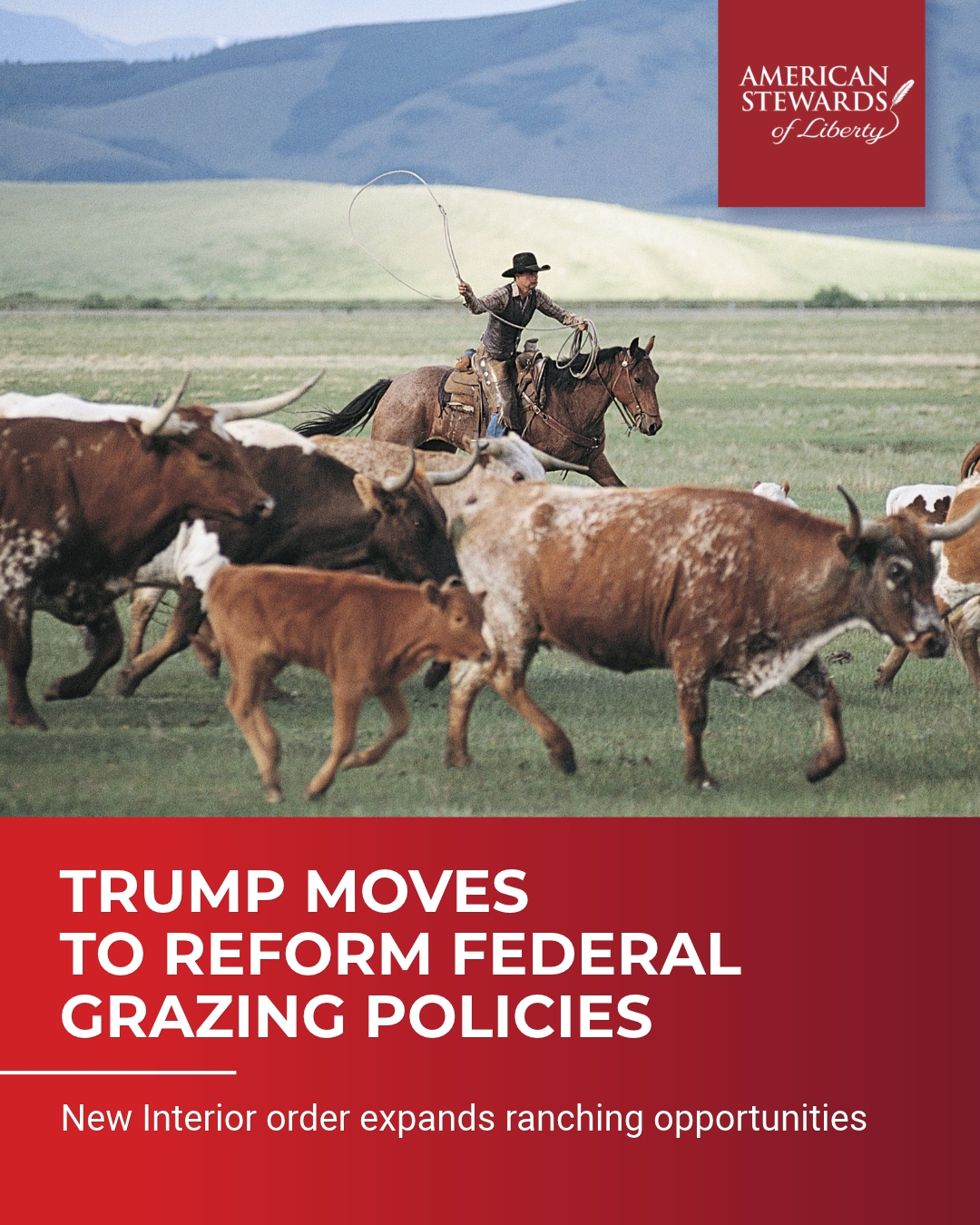
New Interior order expands ranching opportunities
Interior secretary Doug Burgum has signed a new order to expand livestock grazing opportunities on federal lands with the explicit goal of both improving the health of federal rangelands and providing critical support for America’s ranchers.
Burgum’s October 27 order directs the Bureau of Land Management, the Fish and Wildlife Service, and the Bureau of Reclamation to identify lands that can be made available for grazing, to streamline permitting by requiring the renewal of grazing permits for a full 10-year term to provide ranchers with operational certainty, and to reinstate suspended allotments where conditions allow.
The secretary’s order (SO) implements President Donald Trump’s September executive order (EO) on supporting America’s ranchers.
The order also mandates the use of “super intelligence” to expedite the approval process for permits and formalizes the Rangeland Health Initiative, which embraces well-managed livestock grazing as a tool to reduce the risk of catastrophic wildfires and to control invasive grasses.
“This order cuts through bureaucratic red tape to deliver certainty and flexibility for our nation’s ranchers,” Burgum said. “By promoting healthy rangelands and expanding grazing opportunities, we are strengthening our food supply, reinvigorating rural economies, and ensuring the legacy of American ranching continues for generations to come.”
Burgum said the administration was committed to restoring the promise of working landscapes and supporting the American families who depend on them.
More specifically, the secretary’s order sets a 30-day deadline to identify new lands. It also requires the Bureau of Land Management (BLM) to develop a plan within 60 days to eliminate its permit-renewal backlog.
The policy reversal
The administration’s grazing initiatives this year are an about-face from federal land-management priorities in the Biden administration, which moved aggressively to reduce grazing and limit access to federal grazing lands.
In May, the Bureau of Land Management (BLM) slammed the door on those policies by rescinding the Biden administration’s 2024 Conservation and Landscape Health Rule. That rule had elevated conservation to co-equal status in the use of federal lands under the Federal Land Policy and Management Act. The Trump administration contended that it posed obstacles to effective multiple-use management.
In addition, the BLM proposed a substantial revision of federal grazing regulations to update its 1995 livestock grazing regulations that apply on more than 155 million acres of western federal land. The BLM’s new rule seeks to prioritize production-oriented ranching, to streamline permit renewals, and allow flexible terms without separate agency approval for minor adjustments.
The 34-page proposed rewrite would allow ranchers to continue grazing during administrative appeals and, in enforcement, would recognize distinctions between intentional and incidental violations. That proposal has not yet been finalized
U.S. Secretary of Agriculture Brooke Rollins and Burgum have introduced other coordinated actions. In March, they signed an agreement to improve cooperation between BLM and the Forest Service. That’s an important piece of the puzzle because together the two subagencies administer approximately 240 million acres of rangelands across 28 states, territories that include more than 23,000 permit- and lease-holders.
On June 12, Rollins signed her own grazing directive, and on October 5 she sent a letter informing ranchers of the coordinated effort.
“You embody the ethos of our nation’s founding 250 years ago,” Rollins wrote to the ranchers. “For the past 19 months, USDA has worked tirelessly to defend and promote our nation’s ranchers and give you the tools to help rebuild our Great American Cattle Herd. I encourage you to familiarize yourself with the Grazing Directive as we work together to accomplish shared goals on your respective allotments.”
The June grazing directive directs the Forest Service to restore at least 500,000 head-months, or AUMs—animal unit months (AUMs) represent the forage needed to sustain one cow and calf for a month—across National Forest System lands within two years and to implement a policy of no net loss of Animal Unit Months within allotments.
It also orders the Forest Service to make vacant and closed allotments available for grazing; to improve wildfire planning, coordination, and recovery, including the use of virtual fencing; to improve National Environmental Policy Act efficiencies; and to improve coordination and build positive relationships with ranchers.
All those actions preceded Trump’s September executive order, which established a broader government-wide policy supporting ranchers. Trump’s order points to more than 2 million acres of additional grazing land mapped by Interior and nearly 1.6 million acres of vacant Forest Service allotments identified and opened for permit applications.
“Ranchers play a vital role in our Nation’s food supply chain and cultural heritage,” Trump’s executive order states. “These hardworking Americans ensure that our country has a reliable domestic source of high-quality animal protein products, and a secure, plentiful domestic ranching industry vindicates this country’s food security. But the national herd is at a 75-year low, while consumer demand for beef has grown almost 10 percent over the past decade.”
Through the executive order, the administration says it is promoting livestock grazing not only as an economic activity but also as a tool to improve rangeland health and reduce wildfire risks.
The separate actions reflect the different legal responsibilities of federal agencies and the distinction between executive orders, departmental directives, and formal regulatory changes.
The administration’s grazing initiatives are also just one spoke in the wheel of the administration’s larger effort to overhaul predator management, reduce agricultural regulations, and address meat labeling concerns.
For example, Trump’s September executive order directs the Interior Department to determine whether gray wolves and Mexican wolves have met the recovery criteria for removal from or reduced protection under the Endangered Species Act and, if so, to begin the appropriate regulatory process. It also calls for legislative recommendations concerning wolf protections and consideration of changes to predator-removal rules and livestock-loss compensation procedures, including evidentiary standards for investigating wolf depredation.
Beyond predator management, the executive order directs a government-wide review of regulations, guidance, and policies affecting ranchers, with recommendations to improve financial viability and market access.
Separately, it requires a review of federal authority to establish mandatory country-of-origin labeling for beef, potentially leading to new regulations or legislative recommendations. The administration says the broader initiative is intended to strengthen domestic livestock production and ultimately lower prices.