Environmental and other advocacy groups have become deeply embedded in federal park operations, from land acquisition and management to fundraising and messaging
Writing in the Washington Examiner recently, Curtis Schube called on the Trump administration to closely scrutinize our national parks and what he called potentially undue influence by nonprofits over them, particularly when it comes to various interpretations of American history.
Indeed, Schube, the executive director of the Council to Modernize Governance, wrote that many people have noticed distorted messaging by the National Park Service (NPS) in its efforts to present alternative progressive versions of historical events.
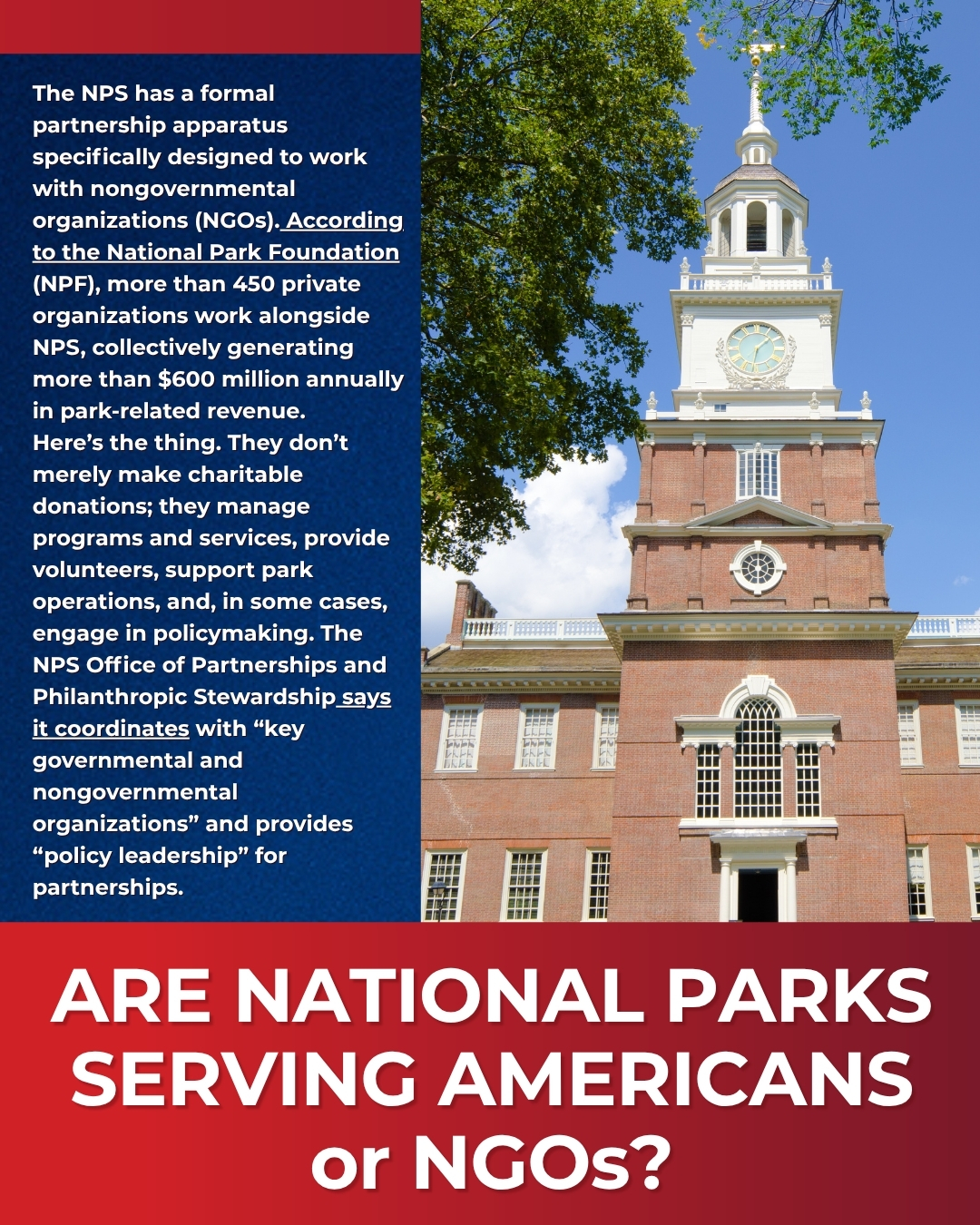
“Some parks, such as Independence Hall in Philadelphia—which is known as the place where the Declaration of Independence was signed, hosted the Second Constitutional Convention, and provided a home to John Adams—have been subverted to contain messaging about the evils of slavery and the women’s suffrage movement,” Schube wrote. “While those are worthy discussions, that specific location should celebrate the significance of the moments that happened there, not be overshadowed by negative messages irrelevant to the site.”
Whatever one thinks about those interpretive disputes, they raise a larger question that receives much less attention: Who besides the federal government is helping to govern America’s national parks?
The answer might (or might not) surprise you: a remarkably large network of private nonprofit organizations.
For example, the NPS has a formal partnership apparatus specifically designed to work with nongovernmental organizations (NGOs). According to the National Park Foundation (NPF), more than 450 private organizations work alongside NPS, collectively generating more than $600 million annually in park-related revenue.
Here’s the thing. They don’t merely make charitable donations; they manage programs and services, provide volunteers, support park operations, and, in some cases, engage in policymaking. The NPS Office of Partnerships and Philanthropic Stewardship says it coordinates with “key governmental and nongovernmental organizations” and provides “policy leadership” for partnerships.
Policy leadership?
That means their NGOs are participating from within a formally constructed partnership system, and that translates into the private lobbying of a public entity from a seat at the decision table. That’s highly troubling.
More specifically, official nonprofit partners can enter long-term agreements with parks and develop annual work plans with superintendents. Most strikingly, NPS says those plans consider both agency needs and “the partner’s judgment about the interest of their donor community.” That means private donor preferences can conceivably take precedence over public interests and priorities.
At Grand Canyon National Park, the park’s own strategic plan calls Grand Canyon Conservancy its “primary and preeminent partner” and says the nonprofit provides education services and promotes “stewardship.” One of the park’s “action items” is to expand the relationship so the Conservancy can “augment parkwide staffing in strategic areas.” The objective, the NPS states, is to relieve pressure on NPS financial and human resources.
The grand relationships of the NGOs with the NPS don’t stop at the edge of the Grand Canyon.
The Sequoia Parks Conservancy is the primary nonprofit partner at Sequoia and Kings Canyon; the NPF has funded long-running wildlife monitoring at Denali National Park and Preserve; and Glacier National Park’s official conservancy funds glacier, snowpack, and climate “science.”
No doubt a lot of this work is perfectly respectable, and no doubt a lot of it—climate science—is tainted by politics. The point isn’t that any particular project is objectionable. The point is that the national parks increasingly rely upon outside NGOs for money, personnel, research, and programs that help them accomplish their missions, which make them vulnerable, over time, to becoming the NGOs’ missions.
That’s called dependency by any other name, and it begs the question: What influence accompanies it?
It’s not a pretty question to ask, given that, as the Trump administration has repeatedly exposed, NGOs are at the very heart of the progressive movement’s funding and activist infrastructure.
It gets even worse. NGOs aren’t merely funding the message—they are helping to shape it.
At Yellowstone, the NPS says Yellowstone Forever, the park’s official nonprofit partner, works with indigenous educators to “vet” and incorporate indigenous perspectives into educational content. It supported the hiring of the park’s Tribal Engagement Manager and helped create the Yellowstone Tribal Heritage Center. The National Parks Conservation Association (NPCA) and other nonprofits participate in related programs. Those nonprofits include the Greater Yellowstone Coalition and Park County Environmental Council.
Whatever one thinks of the substance—this is not to suggest anything improper or inappropriate about incorporating tribal history—the process establishes something absolutely improper and inappropriate: Private NGOs are shaping what visitors are taught inside a national park. That’s influence in every ordinary meaning of the word.
Put simply, private nonprofits are going way beyond providing volunteers and way beyond providing unconditional or content-neutral funding. It means interpretive decisions aren’t being made exclusively inside NPS but in partnership with a nonprofit infrastructure intertwined with its development and delivery.
The question is whether the vetting is fair if the curricula table is loaded with biased donors and there’s no accountability for the content decisions, that is, there’s no vetting of the vetting. Yellowstone National Park these days may have more “inclusive” content; it remains to be seen whether the selection of that content was made by an equally inclusive panel of participants.
Yes, I’m loath to say, it gets even worse. As it turns out, influence extends beyond interpretation to land and resource management. At Hawaiʻi Volcanoes National Park, the Trust for Public Land acquired 16,451 acres at Pōhue Bay for more than $9.4 million, using federal Land and Water Conservation Fund money together with private Wyss Foundation funding. It then transferred the property to NPS, provided another $800,000 toward management, and participated with NPS in discussions concerning the property’s cultural, ecological, and future use.
To be fair, NPS had already identified the acquisition in its 2016 management plan. So neither Wyss nor TPL caused the federal government to pursue the property. It is nonetheless evidence of private organizations providing the money and institutional machinery that enabled a federal land expansion to occur, and with participatory strings attached to its future use. The park manager says the goal is to “explore opportunities for public use with resource protection,” naturally meaning public access is “temporarily restricted.”
Then there’s the Tallgrass Prairie National Preserve. The Nature Conservancy owns most of the preserve and, in NPS’s own words, “manages the preserve in partnership with the National Park Service.” TNC has also worked with NPS on fire-management strategy and broader conservation planning. The arrangement dates back to the National Park Trust’s acquisition of the ranch in the 1990s; TNC acquired the acreage in 2005.
In other words, an environmental NGO is functioning as a management partner inside a National Park System unit. And not just any partner. The Nature Conservancy owns all but about 35 acres of the nearly 11,000-acre preserve, owns the mineral rights, manages the cattle leases, oversees interpretive programs, and jointly manages the entire preserve with the National Park Service. Meanwhile, federal tax dollars can —and do—support the management and preservation of this overwhelmingly privately owned land.
And get this: NPS regulations apply to TNC’s private land only “with the consent of” the private owner. Meanwhile, Congress expressly authorized federal money to be spent managing that private property, which is essentially a privately-owned national park. It was and is a poison pill, and it only adds bitter to the pill to realize that the private organization holding virtually all the property cards is The Nature Conservancy.
Told you so
It might be surprising to learn (and again, it might not be) that the federal government had already recognized the danger years ago. In 2009, the General Accounting Office (GAO) investigated NPS partnerships precisely because of concerns that private donors could exert “undue influence over agency priorities.”
“Members of Congress and others have pointed to various potential risks, such as donors’ raising funds for inappropriately large facilities and leaving taxpayers to absorb the costs of maintaining them, corporations’ unduly influencing agency policy, and parks becoming too commercialized,” the GAO report stated. “They have also raised concerns about how well the Park Service has been managing donations in light of these risks.”
The report found that donations were being used to fund interpretative messaging, education, construction, and cultural-resource management, and GAO found that nonprofit involvement sometimes enabled projects that otherwise would not have occurred. The category most often cited by the partners as types of projects funded by private donations was interpretation and education, not repair or maintenance of facilities, not natural resources management (including endangered species habitat), and not for such things as trail maintenance.
Private groups were focused on the messaging.
In one instance, too, a park partner tied to a construction company developed a project that the park selected before going through the normal process of determining whether the facility was actually needed. Members of Congress questioned whether the nonprofit had exercised undue influence; the project wasn’t on NPS’s national construction-priority list.
For the most part, while exposing a central risk in partner participation—the lack of safeguards against undue influence, especially when policies are not always followed—the report extolled the work the Park Service performed. And yet, the GAO report impaled itself on its own paradox by suggesting that undue partner influence could be curbed by having the park and its private partners develop a joint strategic plan identifying projects and programs.
In other words, one response to the danger of informal private influence was essentially to formalize the influence. The report did not quite urge parks to bake undue influence into the national parks cake. Still, it set the ingredients on the table for them to consider: “For example, through strategic planning, the Park Service could work with its partners to consider questions such as whether the agency wants to encourage more donations in the future, whether it is appropriate to use donations to support core operations, and whether it wants more parks to have friends groups. Once the agency—in collaboration with its partners—has answered some questions like these, it could resolve questions about what resources and actions are needed to achieve the desired vision.”
Whether such formal arrangements to collaborate with private entities to achieve the “desired vision” ever happened in any particular park is unknown; it certainly became a de facto partnership as the widespread collaborations the NPS pursues with its NGO partners attest to.
The bottom line is, nonprofits are embedded in the National Park System through fundraising, joint priority-setting, staffing, interpretation, land acquisition, conservation programs, resource management and even direct management partnerships.
When an agency increasingly depends upon private organizations to perform public functions, how much influence over federal land policy comes with the money, personnel, and expertise those organizations provide? Where does partnership end and influence begin? When does the tail begin to wag the dog, and has it already?
In his Washington Examiner piece, Schube suggested the administration take a look. Without exerting too much undue influence, we second that opinion.