
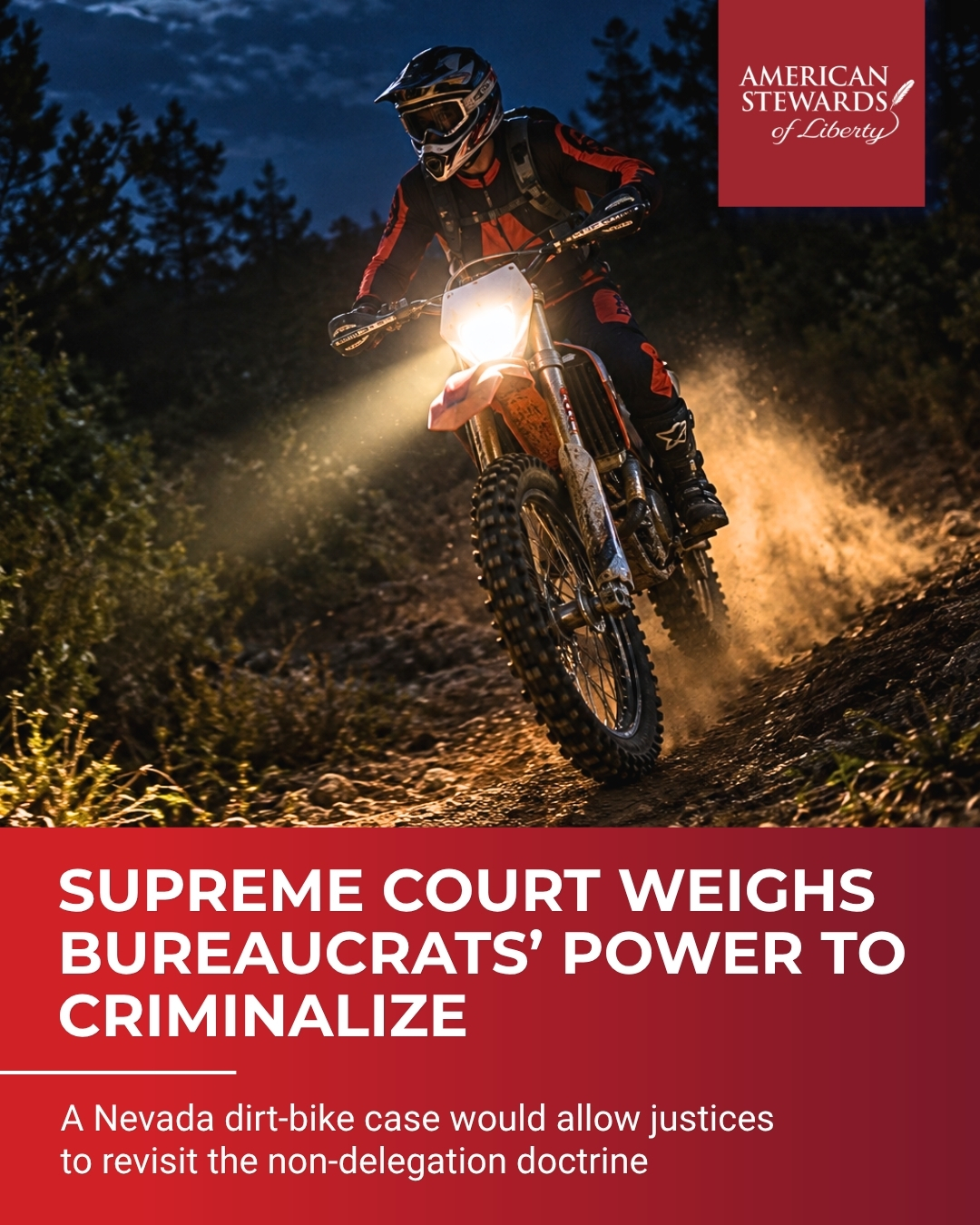
A Nevada dirt-bike case would allow justices to revisit the non-delegation doctrine
The U.S. Supreme Court will decide soon—perhaps this week—whether to hear a case that could decide one of the most important constitutional debates about America’s massive administrative state: whether Congress can delegate its authority to define federal crimes to unelected executive-branch officials.
In other words, can Congress constitutionally empower bureaucrats to decide what is criminal and what is not?
We say constitutionally because, legitimately or not, that’s what Congress has already done, and that delegation is at the heart of United States v. Pheasant, the case the high court is considering for review.
The case challenges the authority of the Bureau of Land Management (BLM) to create criminally enforceable regulations under statutory delegations of that power by Congress. The Ninth Circuit upheld the delegation after a federal district court ruled it unconstitutional, setting the stage for Pheasant’s petition to the nation’s highest court.
For property rights advocates and supporters of limited government, the case presents an opportunity for the Supreme Court to reassert constitutional boundaries on Congress’s broader ability to transfer its lawmaking authority to federal bureaucracies.
But only if the justices decide to hear the case at all.
From Dirt-Bike Violation to Constitutional Showdown
The dust-up-cum-core-constitutional principle began on May 28, 2021, when the BLM charged Gregory Pheasant with three rules violations related to riding a dirt bike at night through Moon Rocks, Nevada, which sits on federal land.
Among other things, one of the charges—violating the BLM’s rule requiring a taillight on dirt bikes—carried a criminal penalty, which the BLM contends was authorized by the Federal Land Policy and Management Act of 1976. That Act empowers the secretary of the Interior to issue regulations governing federally managed lands, including criminal penalties for violations.
Pheasant maintains that Congress unconstitutionally delegated its legislative authority to the executive branch under the statute, and that crimes created by the executive branch pursuant to that power are null and void. In 2024, U.S. district judge Robert Jones agreed. Jones concluded that Congress had effectively bequeathed to the Interior secretary the infinite power to create criminal offenses across millions and millions of acres of federal land without any consequential legislative restrictions.
“In a state like Nevada, these state BLM directors are essentially single-person legislators and governors because they promulgate regulations (laws) and enforce the regulations (laws),” Jones wrote in the decision.
That was constitutionally impermissible, Jones ruled, asserting that such language gave “the secretary of the Interior unfettered legislative authority.” The lack of restraint was not the only problem, Jones found; he also ruled that criminalizing regulatory infractions by bureaucratic fiat was a no-go.
“Beyond the secretary of the Interior’s ability to legislate for whatever they see necessary is the power to write regulations criminalizing behavior,” he wrote. “Allowing executive agencies to create the very crimes they are tasked with enforcing effectively turns them into ‘the expositor, executor, and interpreter of criminal laws.’ Essentially, in the words of the Supreme Court, ‘the nation’s chief prosecutor [gets] the power to write his own criminal code’ on the public lands.”
In this case, Jones continued, the statute did nothing to cabin the secretary of the Interior’s ability to choose what is a crime.
“With no limiting language, the statute gives the secretary of the Interior the authority to promulgate its own criminal code on 68 percent of the land in Nevada, giving the BLM a larger jurisdictional area than the state police,” he wrote. “Essentially, the BLM controls a majority of the land in Nevada and has the authority to write the laws on that area of public land, acting with as much authority as both the state legislature and the governor.”
In fact, Jones continued, the BLM has used that authority to write regulations criminalizing behavior that the state would normally criminalize, like outdated vehicle registration, coal exploration, horse adoption, noisiness, fraud, discrimination, and homelessness.
“If the BLM can promulgate all these regulations under [the statute], then ‘the statute would seem to give the BLM ‘virtually unfettered’ discretion to write crimes on the land it manages,” Jones concluded in dismissing the charges.
Jones warned that such an arrangement effectively combined legislative and executive powers within a single agency, allowing bureaucrats to determine what conduct constituted a crime and then prosecute violations of their own regulations.
The Biden administration appealed, and the Ninth Circuit reversed Jones, finding that the statute satisfied the Supreme Court’s intelligible principle test—a standard that aims to ensure that the agency is executing the law rather than making independent, unconstrained law—and declining to apply a more demanding standard because the regulations carried criminal sanctions.
Pheasant then petitioned the Supreme Court.
About That Intelligible Principle Test
On its face, at least, the constitutional question is straightforward. Article I of the Constitution vests all federal legislative powers in Congress, while executive authority belongs to the president and judicial authority to the courts.
The non-delegation doctrine arises from that division of power. Congress may authorize executive agencies to enforce laws and fill in certain implementation through regulations, but what it cannot do is delegate to anyone or any agency those powers that are strictly and exclusively legislative.
Over time, however, critics say the Supreme Court’s modern non-delegation jurisprudence has enabled Congress to pass off substantial discretion to executive agencies. All they have to have is an “intelligible principle” guiding that discretion.
However, as the Cato Institute, led by counsel of record Thomas Berry, argued in a brief filed in March, the so-called intelligible principle has become so excessively permissive that it isn’t even intelligible.
“[M]ost legislation carries with it a degree of executive discretion,” the Cato brief states. “So long as another branch does not exceed that discretion, its actions are valid under the Constitution. But Congress can only provide the executive (or judiciary) with so much discretion without unconstitutionally delegating away its lawmaking power.”
But that’s just what has happened, Cato argued, and as a result, the intelligible principle test has devolved into an often nonrestrictive standard.
“The Court’s gradual departure from this original understanding has been well documented,” the brief states. “This Court has twice found that a statute lacked an intelligible principle—once where the statute ‘provided literally no guidance for the exercise of discretion,’ and again where the statute ‘conferred authority to regulate the entire economy based on no more precise a standard than stimulating the economy by assuring ‘fair competition.’”
But since then, Cato continued, the non-delegation doctrine has gone under-enforced.
And even if it was enforced, Cato argued, the statute at the heart of the Pheasant case would fail even under the court’s current version of the test.
Berry’s amicus brief also emphasized the geographical reach of that authority, observing that the Interior secretary exercises regulatory power over approximately 244 million acres of federally managed land nationwide, including approximately 48 million acres in Nevada.
“This means that, on a member per acre basis, the secretary possesses more geographic lawmaking power than either Congress or the Nevada state legislature,” the brief states. “The secretary of the Interior thus functions as a one-man super legislature, wielding Congress’s broad police powers over federally managed public lands solely based on personal convictions and judgments, rather than enacting regulations determined strictly ‘by law.’”
Even under the intelligible principle standard, the Act does not adequately set forth a discernible congressional policy or reasonable restraints upon the secretary, Cato’s brief argues.
Government Without Meaningful Consent
In addition, the lawsuit has called into question how such delegate criminal authority can be countenanced in a representative government. If elected legislators do not actually decide what conduct constitutes a crime, how can voters hold them accountable for the laws governing their lives?
In a brief submitted when the case was before the Ninth Circuit, the New Civil Liberties Alliance (NCLA) argued that the delegation of legislative power threatened the principle of consent of the governed.
“That is because legislative delegation collides with the constitution’s most important principle: consent of the people,” NCLA senior litigation counsel Kara Rollins wrote. “Without consent, a government would be illegitimate, and its laws would be without obligation. Consent of the people was essential not only for the original adoption of the constitution but also for enacting statutes. Such consent must come through the election of representatives to the legislature—the body vested with legislative power.”
As such, Rollins argued, the displacement of legislative power to administrative agencies, not least in the statute under consideration and the crimes created by regulations promulgated under it, threatens that self-governance.
“It deprives Americans of their freedom to rule themselves through their elected representatives,” she wrote. “… If legislators misused this power, the people could respond, and respond swiftly.”
The transfer of legislative powers to a less accountable branch necessarily undermines consent, Rollins argued.
“To be sure, the dislocation of legislative power does not deny anyone’s right to cast a ballot,” she wrote. “But shifting legislative power out of the legislature and into agencies diminishes the value of suffrage. The form remains, but in reality the currency of voting is debased.”
That is to say, Rollins asserted, if violations of voting rights are worrisome even at a retail level, as the mantra to ‘count every ballot’ attests, there should be at least as much concern about a wholesale assault on the franchise by transferring lawmaking power from elected representatives to unelected bureaucrats, particularly when that transfer occurs in the criminal context which is predicated in part on a concept of moral condemnation by the community.
“The transfer of legislative powers to agencies also weakens accountability by allowing an evasion of bicameralism and presentment,” she wrote. “Bicameralism makes lawmaking difficult by design—to limit corruption and unjust passions and encourage prudence. Presentment ensures that laws are subject to the possibility of a veto. Together, the requirements ensure that lawmaking responsibilities reside in the two elected legislative bodies and in an elected president—all of whom are personally accountable to the people.”
To be sure, Rollins observed, citing other cases, Congress has an incentive to insulate itself from the consequences of hard choices by transferring those choices to the executive branch. But that, too, is subversion, Rollins argued.
“When Congress transfers its legislative power to an administrative agency, ‘the people lose control over the laws that govern them. … [T]he public loses the right to have both its elected representatives and its elected president take personal responsibility for the law,’” she wrote. “Indeed, ‘the citizen … can perhaps be excused for thinking that it is the agency really doing the legislating.’”
In this case, Rollins asserted, there is little doubt that it is BLM—not Congress—doing the legislating.
“‘By shifting responsibility [to enact criminal laws] to a less accountable branch, Congress protects itself from political censure—and deprives the people of the say the framers intended them to have,’” she wrote, again citing case law. “Because this shift is the product of collusion between legislative and executive branches, the people must rely on the judicial branch to prevent unconstitutional delegations of legislative power.”
Skepticism about the validity of criminal delegations is warranted, Rollins contended, not only because criminal sanctions invade liberty interests but also because criminalization of behavior is a uniquely legislative act.
Cato’s newer argument adds an additional dimension to the case, contending that the Supreme Court should resolve an inconsistency between two constitutional doctrines intended to restrain arbitrary government power.
Under the void-for-vagueness doctrine, Cato observed in its March brief, criminal statutes may be invalidated when they fail to provide sufficiently definite standards to guide police, prosecutors, judges, and juries. Yet when Congress gives executive agencies broad discretion to write criminally enforceable regulations, courts generally employ the more permissive intelligible principle test.
Both doctrines are intended to address the danger of government officials outside Congress exercising excessive discretion over criminal law, but Cato argues that applying the more lenient standard when federal agencies are involved has no justification in the constitution.
“This standard [void-for-vagueness] amounts to an even stricter form of what the intelligible principle test requires in the rulemaking context—more definitive guidelines on how executive officials may enforce criminal laws,” the Cato brief stated. “The strictness of the vagueness standard is demonstrated by its statistics. Courts have struck down far more laws as impermissibly vague than as lacking an intelligible principle.”
Vagueness principles are not limited to cases against individual agents of the state, Cato asserted.
“Courts have employed the vagueness doctrine to strike down grants of criminal lawmaking power to municipal administrative boards,” the brief stated, citing a case in which a statute delegated the creation of movie-rating standards to an administrative body, with criminal penalties attached. The court struck it down.
Cato argues that agency rulemaking can pose an even greater threat because regulations can apply broadly to millions of people, rather than arising from individual enforcement decisions.
“A vague criminal regulation enforced by an agency should not face less scrutiny than a vague criminal statute enforced by the police,” the brief states. “For example, if Congress were to make it a crime to ‘behave on federal property in a manner annoying to persons passing by,’ the law would be struck down as impermissibly vague,” the brief stated. “Such a statute would vest far too much discretion in the officers charged with enforcing the law.”
But if Congress instead added that “the Attorney General shall have the power to pass regulations that specify what behavior is annoying,” the brief imagined, a court might uphold the law under a non-delegation challenge if it applied the intelligible principle test.
“Both scenarios present the same constitutional problem, the only difference is that one gives too much discretion to the police and the other too much discretion to rulemakers,” the brief stated. “Both should use the same standard. Otherwise, vague laws imposing criminal sanctions through federal regulators will be scrutinized less than vague laws enforced by police and prosecutors, granting Congress a backdoor by which they may grant too much criminal lawmaking power to the executive branch.”
That imbalance is particularly pernicious because the latter hypothetical delegation to the attorney general presents a greater danger to individual liberty, the brief asserted: “The police act case by case, but the Attorney General may enact regulations that govern universally.”
The Supreme Court’s immediate decision is whether to accept Pheasant’s petition, not whether the underlying delegation is unconstitutional. But granting review could provide the justices with an opportunity to reconsider how much legislative authority Congress can transfer to the administrative state.
In sum, Pheasant is not seeking to render executive agencies unable to administer federal law. Rather, he is arguing that Congress must remain responsible for the fundamental legislative decisions that define crimes and restrict or protect individual liberty.
Ultimately, the controversy circles back around to the separation of powers and its foundational insistence that no single branch of government can possess unchecked authority to make, interpret, and enforce the laws of the nation.