State sets goals for massive land grab, partners with environmental financiers
Henry McMaster, South Carolina’s outgoing Republican governor, put the cherry on top of a massive government land grab last week, signing an executive order to create a commission to coordinate conservation activities among state agencies, local governments, private landowners, NGOs, and other institutions.
Specifically, McMaster is putting state government at the center of an effort—long in the works—to block development forever on half the state’s land by 2050.
The commission will be charged with identifying and prioritizing targets for easements, wildlife refuges, hazard mitigation restrictions, and outright purchase, as well as identifying and developing funding opportunities and assisting local governments in carrying out and reaching conservation goals.
“South Carolina’s natural beauty and rich history are an important part of what makes our state unique,” McMaster said in announcing the commission last week. “As our state continues to prosper, we must be thoughtful and think broadly about how we preserve the land, historic sites, and cultural heritage that define South Carolina.”
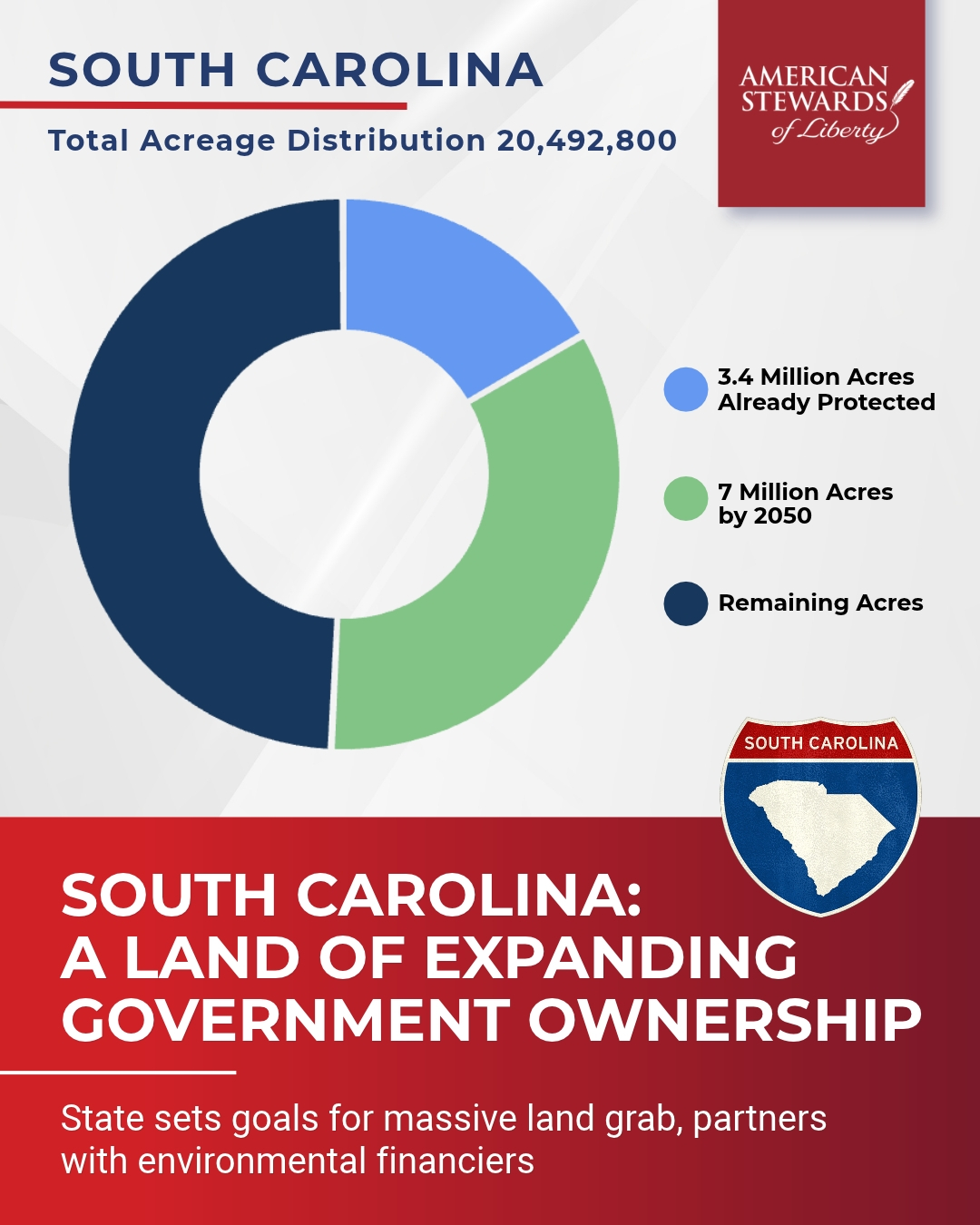
The governor has apparently been thinking very broadly, and so has the state legislature. With McMaster’s urging, the legislature passed a bill this past May establishing a statewide goal of restricting 7 million acres by 2050, approximately one-third of the state. With approximately 3.4 million acres already off limits to development, reaching that benchmark would require restricting land use on another 3.6 million acres.
There was practically no opposition to the governor’s hubris: The Republican-dominated legislature passed the measure by 110-2 in the House and by 41–2 in the Senate.
Meanwhile, McMaster has separately advocated conserving 10 million acres, or about half the state’s land area. That goal exceeds the official United Nations 30×30 target but is aligned with the ambitions of various globalists, such as former UN biodiversity chief Cristiana Pașca Palmer, as well as the Half-Earth project, a group that believes sequestering half the world’s land and water from most productive use is the only way to stave off a mass extinction crisis.
The state is halfway to its statutory target, but its extensive network of players already has its sights set on a long list of specific lands, with envisioned and expansive boundaries. The South Carolina Conservation Bank has identified approximately 7.1 million acres of medium- and high-priority conservation land statewide, creating a geographic framework for future conservation efforts.
South Carolina joins a handful of states with similar goals that are also statutorily defined: Vermont, Maryland, California, and New York all have codified goals to restrict 30 percent of their states’ land by 2030. Vermont goes even further. It has set a legal target of 50 percent by 2050, matching McMaster’s ambitions.
Lowcountry, high stakes
Many people in South Carolina’s coastal areas like to go crabbing; the state government likes to go land-grabbing. So much so that a brazenly visible conservation movement has proclaimed its extraordinary goals to the public, in the process revealing both how the movement operates and how much territory it seeks to restrict permanently.
For starters, the state’s Open Land Trust reports that more than 320,000 acres have been closed to development in the ACE Basin, one of the largest undeveloped wetland and estuarine ecosystems on the Atlantic Coast. The move to restrict the land through conservation easements and purchases started more than 30 years ago, when large plantation landowners, including such out-of-state titans as Gaylord and Dorothy Donnelley and Ted Turner, bought old plantations within the boundary and began to grant easements in perpetuity.
These days, a similar conservation effort is underway along the Savannah River, where landowners have restricted access to more than 200,000 acres. This effort is part of a broader conservation campaign in the South Lowcountry–Savannah River region, which the Open Space Institute identifies as a 450,000-acre conservation landscape. The Open Space Institute is a nonprofit that, among other land confiscation schemes, works to connect restricted properties in that region with those in the ACE Basin.
Beyond those two major conservation initiatives, the Francis Marion National Forest takes in approximately 263,909 acres in Berkeley and Charleston counties. Another 62,220 acres were permanently restricted through conservation easements in the Pee Dee Basin, while easements in the Coosawhatchie region have connected approximately 25,000 acres of private-in-name-only properties.
At Chelsea Plantation, a 2,700-acre conservation transaction was completed in August when the property was transferred to the South Carolina Forestry Commission for a future state forest.
Not to be outdone—though we will report more in depth on this in next week’s newsletter—the U.S. Fish and Wildlife Service is proposing to expand the acquisition boundaries of four existing South Carolina wildlife refuges within the 120,000-acre South Carolina Lowcountry Refuges Complex by up to 300,000 acres.
And finally, the Department of Natural Resources’ 2025 State Wildlife Action Plan separately identifies 450,714 protected acres in a Coastal Zone ecoregion and approximately 1.28 million protected acres in a larger Coastal Plain ecoregion.
It’s quite a wish list for the environmental movement. But if South Carolina’s government has its way—and that includes both parties—the Palmetto state may just be the place where their wishes come true. What is already on the table, formally mapped and marked with boundaries and endorsed by the legislature and the governor, is a vast landscape-scale system in which acquisitions and easements increasingly form extensive corridors linking expansive regions of permanently restricted land.
Following the money
None of these plans can succeed without money and lots of it, of course, and in South Carolina an extensive financing system combines progressive foundation support, corporate contributions, state tax incentives, and nonprofit grant funding to finance the land-taking enterprise.
OSI lays claim to sequestering more than 2.5 million acres across the eastern United States, including more than 50,000 acres in South Carolina since 2014. According to its 2024 IRS filing, it reported $27.3 million in government grants, or about 37 percent of its annual revenue. Financial supporters include the Frances P. Bunnelle Foundation, Butler Conservation Fund, Ceres Foundation, Gaylord and Dorothy Donnelley Foundation, Duke Energy’s Water Resources Fund, and the National Park Foundation.
Those funding sources have deep ties to either progressive programs or explicit conservation goals. The Frances P. Bunnelle Foundation, for example, engages in community philanthropy with environmental protection, equity, poverty reduction, and economic development among its priorities. The Gaylord and Dorothy Donnelley Foundation is explicitly conservation-oriented, framed by political commitments to equity, inclusion, and climate resilience.
The Ceres Foundation champions environmental, social, and corporate governance (ESG) initiatives and, in addition to its land acquisition advocacy, pushes companies to adopt aggressive net-zero and equity policies. Ceres’s reported grants from 2020–2025 include approximately $545,000 to the Open Space Institute, $150,000 to the Lowcountry Land Trust, and $210,000 to The Nature Conservancy of South Carolina.
In addition, OSI receives contributions through donor-advised charitable funds. Reported grants to OSI between 2019 and 2024 included $4.8 million from the National Philanthropic Trust and $1 million from Fidelity Charitable.
The state also lends a hand with tax credits and incentives.
During the 2025–26 legislative session, Republican Rep. Patrick Haddon sponsored a measure to increase the state conservation tax credit cap even more, from $250 to $1,000 per acre and the maximum annual conservation tax credit from $52,500 to $150,000. Those measures did not pass by the session’s end, but Republicans reportedly aim to pass the measure in 2027.
As they do across the country, federal grants boost financing of large landscape easements. In South Carolina, the Pee Dee Basin project, which permanently restricted more than 62,000 acres through four conservation easements, received a $50 million federal Forest Legacy grant, while the South Carolina Forestry Commission became responsible for holding and enforcing the easements. Corporations further infuse cash into the bid to take half the state. One example is OSI’s Fairlawn Plantation acquisition near the Francis Marion National Forest, where Boeing financed the restriction of approximately 6,000 acres.
Grant and foundation funding, wealthy progressive individual donors, state tax credits and incentives, federal grants, corporate donations—taken together, all these provide robust funding for a system in which public agencies and private partners pay for permanent restrictions on land that effectively remains private in name only.
The SC Office of Resilience
In recent years, the heart of the government’s overactive entry into land acquisition beats in the South Carolina Office of Resilience (SCOR). Peak behind the conservation curtain in the state, and standing there will almost certainly be the SCOR.
In July 2024, for instance, SCOR announced its participation in the Atlantic Conservation Coalition, a four-state partnership involving The Nature Conservancy and other organizations. The Environmental Protection Agency announced a $421.2 million grant for the coalition, with $50 million designated for SCOR to acquire working lands in South Carolina for carbon storage and flood reduction.
The grant awarded $200 million to the Nature Conservancy for projects across the region, including forest management in South Carolina’s coastal plain. The grant itself represented a new wrinkle for environmentalists—the use of disaster mitigation and flood protection as excuses for limiting land use to conservation priorities.
The relationship among SCOR, the Conservation Bank, and private organizations such as OSI are particularly relevant to the state’s interconnected conservation infrastructure. Indeed, SCOR was established in 2020 not as a conservation agency but as a disaster relief and prevention agency. Its defined mission was to coordinate disaster recovery, flood mitigation, and long-term efforts to reduce damage from hurricanes and other natural disasters.
But, as the South Carolina Priority Conservation Action Plan lays out, the agency has morphed into a conservation agency by defining disaster mitigation as land restriction: “SCOR lessens the impact of disasters on the communities and citizens of South Carolina by planning and coordinating statewide resilience, long-term disaster recovery, and hazard mitigation. SCOR has developed a conservation priority model to identify areas where conservation will reduce the impact of flooding on the citizens and communities of South Carolina.”
SCOR finances its mitigation projects through the state’s Disaster Relief and Resilience Reserve Fund, routing much of that funding through the South Carolina Conservation Bank, other state agencies, private land trusts, and nonprofit conservation organizations to acquire and permanently restrict properties. The stated purpose is to preserve natural landscapes that reduce flood risks; the unstated purpose is to strip away as much development and multi-use possibilities as they can.
It’s not that South Carolina doesn’t face substantial hurricane and flooding risks. It’s that, in South Carolina, flood resilience is becoming an additional funding and policy mechanism for expanding permanent land conservation across areas far larger than those traditionally associated with disaster mitigation.
Then, too, on October 15, the SCOR announced another $10 million in state-funded mitigation grants, this time including voluntary residential buyouts as the conservation-through-flood-mitigation effort rolls into residential neighborhoods to clear a path for buyouts and restrictions.
But the agency has also become involved in major land-conservation initiatives that extend beyond the purchase of frequently flooded residential properties. Its statewide resilience plan contains 54 recommendations addressing environmental risks and future development, with land conservation among its implementation priorities.
The bottom line is, conservation’s sphere is no longer confined to traditional parks, wildlife refuges, or land-trust programs but has become integrated into disaster planning, carbon storage, forestry, watershed management and statewide development policy.
South Carolina’s conservation experiment
All of this is occurring as South Carolina experiences substantial population and economic growth, particularly in its coastal communities.
According to the latest U.S. Census Bureau estimates, South Carolina is the fastest-growing state in the nation, with its population increasing 1.5 percent between July 2024 and July 2025. Nearly 80,000 net new residents started calling South Carolina home in that one year alone. About 15 percent of those people landed in the Charleston metropolitan area, which is the lowcountry’s economic hub but is also ground zero for the state-supported land grab, sitting smack in the middle of the lowcountry.
That begs the question: Can the nation’s fastest-growing state continue accommodating that growth while permanently restricting development across millions of additional acres? That growth has created pressures on housing, transportation, infrastructure, and undeveloped land, especially in the lowcountry.
Conservation advocates such as McMaster argue that preventing development on large landscapes is essential to preserving the resources that support prosperity, but South Carolina’s expanding conservation ground game also represents a long-term risky experiment in land-use policy.
With approximately 3.4 million acres already protected, a statutory goal of 7 million acres by 2050, and a governor advocating 10 million acres to be taken off the multi-use and development table, the state is seeking to bind future property owners in perpetuity on half of its total land at the same time that its rise to prosperity needs land for economic growth, housing, and adequate roads. So a collision is coming. South Carolina’s economy is booming and demanding new spaces for housing and industry at the same time that government, nonprofits, and wealthy globalists are conspiring to make sure that growth cannot happen.
Sadly, so far the latter have virtually unanimous support from both political parties to make South Carolina the land of government land. Whether the state wakes up in time is anybody’s guess.