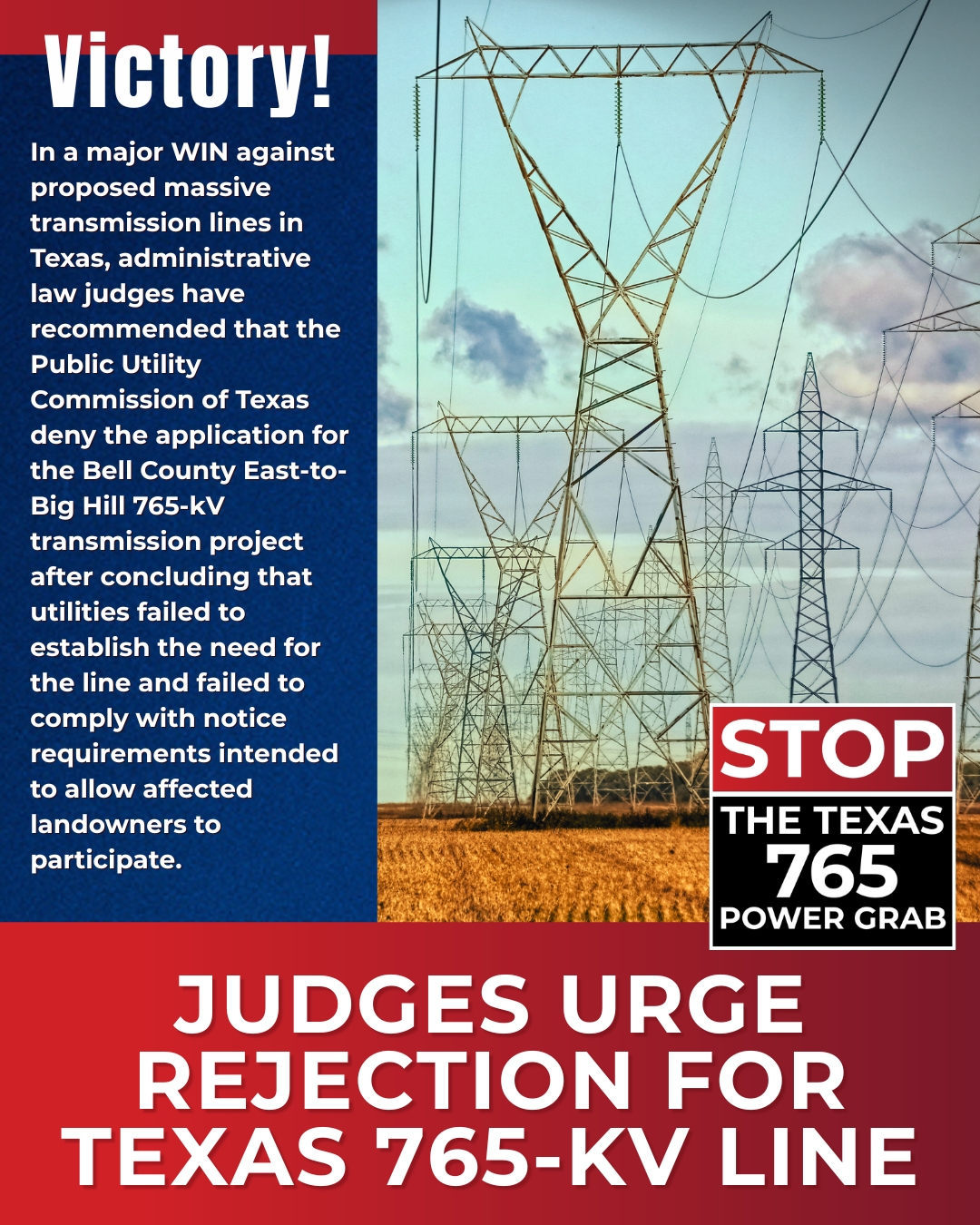
Administrative law judges with the Texas State Office of Administrative Hearings have recommended that the Public Utility Commission of Texas deny the application for the Bell County East-to-Big Hill 765-kV transmission project after concluding that utilities failed to establish the need for the line.
The judges also found that utilities Oncor and the Lower Colorado River Authority Transmission Services Corporation failed to comply with notice requirements intended to allow affected landowners to participate.
The proposed Bell County East-to-Big Hill line, along with the Big Hill-to-Sand Lake line, form what is known as Import Path 2, the middle of three proposed 765-kV transmission pathways into the West Texas Permian Basin. The latter line is being considered in part in a separate proceeding, but the question of whether it was needed was consolidated into this Bell County East-to-Big Hill proceeding, rendering this past week’s decision a determination of need that encompasses the entirety of Import Path 2.
Margaret Byfield, executive director of American Stewards of Liberty (ASL), said the recommendation by the State Office of Administrative Hearings (SOAH) marks a significant milestone for the thousands of Texas landowners affected and for the broader debate over the proposed 765-kV transmission buildout.
“After months of testimony, thousands of pages of evidence, and countless hours of participation by Texas landowners, the administrative law judges concluded that the applicants failed to show the project meets the legal standard for approval,” Byfield said. “They found the applicants failed to establish that the project is necessary to serve the public convenience and necessity and recommended that the Public Utility Commission (PUC) deny the CCN (Certificate of Convenience and Necessity) applications.”
Texas law requires proof, not assumptions, Byfield said.
“Before billions of dollars are spent and private property is permanently burdened, applicants must demonstrate that a project is necessary,” she said. “The administrative law judges found they failed to meet that burden.”
American Stewards of Liberty is the only organization to have intervened in all five pending 765-kV Certificate of Convenience and Necessity proceedings. The PUC still has the final say, but, as Byfield said, the recommendation could inform and influence the broader debate over the entire 765-kV transmission buildout.
“Thousands of Texas landowners have raised serious concerns about these applications, including through extensive testimony before the Legislature,” Byfield said. “Texas lawmakers have echoed those concerns, and the administrative law judges have now independently reached the same conclusion based on the evidentiary record.”
The Bell County East-to-Big Hill transmission line—the eastern half of Import Path 2—would run between 214 and 244 miles, depending on the route, with an estimated cost ranging from $1.6 billion to almost $1.9 billion, plus $395 million in station costs for work at Oncor’s Bell County East switch.
Import Path 2’s western half is the proposed Big Hill-to-Sand Lake 765-kV transmission line. It would run between 197 and 222 miles, depending on the route, with an estimated cost of between $976 million and $1.3 billion, plus an estimated $728 million for substation facilities. The two projects would connect at the Big Hill substation.
Overall, Import Path 2 is part of the 765-kV Strategic Transmission Expansion Plan (STEP), which is a key component of the Permian Basin Reliability Plan (PBRP). STEP envisions three major 765-kV pathways spanning more than 1,200 miles and increasing the ability to transfer electricity between eastern Texas and the Permian Basin.
A study by the Texas Public Policy Foundation has estimated capital costs for the 765‑kV STEP projects approved through December 2025 at about $33 billion, along with lifetime costs of. almost $100 billion, and the transmission corridors would cross enormous amounts of private property.
SOAH: No proof the line is needed
The judges concluded that the utilities did not establish that Import Path 2 is necessary.
The Electric Reliability Council of Texas (ERCOT) and the utilities have justified the Permian Basin transmission expansion based on forecasts of rapidly increasing electricity demand from oil and gas operations, data centers, cryptocurrency mining, and other large loads. But the judges concluded that the evidentiary record did not substantiate the demand forecast necessary to justify Import Path 2.
“The ALJs conclude Applicants failed to show that Import Path 2—a $4- to $5-billion infrastructure commitment—is necessary for the service, accommodation, convenience, or safety of the public,” the recommendation states.
Among other reasons, the ALJs concluded that changed circumstances had undermined projections for underlying loads. More specifically, the judges found flaws in the methodology of a 2022 S&P Global study used to forecast oil and gas electrification demand in the region.
“The 2022 study built its projections on surveys of unconstrained ‘wish list’ scenarios and corporate pledges—speculative and unconfirmed load, which led to the study’s core premise that the producers had to electrify immediately to drop their absolute greenhouse gas profiles,” the judges wrote. “That has proven incorrect by S&P Global’s own later analysis. That the oil and gas operators were able to drop their absolute greenhouse gas profiles substantially without additions to the grid renders the study’s projected forecasts overstated and outdated.”
The judges also say the utilities never made their case for project reliability by establishing that Central Texas would have sufficient generation to meet rapidly growing local demand from data centers while simultaneously exporting large amounts of electricity westward over Import Path 2.
“Applicants concede they are unaware of any ERCOT study modeling whether central Texas data-center growth would absorb the generation otherwise available for westbound export,” the ALJs wrote. “And they admit that no sensitivity analysis was performed on project viability if the central Texas generation base proves insufficient to serve both functions. A 765-kV transmission line authorized to transmit bulk power into the Permian Basin cannot be shown to be needed for reliability when the record establishes that the analysis of whether the grid can actually deliver that reliability has not been done.”
This week, Byfield underscored that point.
“American Stewards of Liberty has consistently argued that Texas needs a stronger electric grid, but more transmission is not the same as greater reliability,” she said. “Transmission lines move electricity; they do not create it. The administrative law judges found the applicants failed to demonstrate that this project would provide the claimed reliability benefits because they failed to establish the project’s underlying need.”
The burden is on the applicants to prove that need, Byfield said.
“Private property should never be condemned for a project that has not been proven necessary,” she said. “The burden of proof belongs to those seeking to condemn private property—not to the families defending it. The Administrative Law Judges have confirmed that this project did not meet that burden.”
The ALJs also concluded that intervenors submitted findings that new and planned gas generation in the Permian Basin could reduce or eliminate the need for Import Path 2. Their analysis faulted the planning process for failing to adequately account for that generation as an alternative to the massive transmission investment.
“In short, a review of the 24 now 25 natural gas generation projects in the Permian Basin shows that conventional generation is actively being developed in the basin at a scale that rivals or exceeds the PBRP’s projected load,” the ALJs wrote. “As such, the intervenors have submitted credible evidence of an alternative analysis justifying the Commission’s consideration of this new and planned generation to determine if it could ‘reduce or eliminate the need for such unprecedented transmission expansion.’”
Failure to properly notice
The entire transmission project has also been fraught with due-process issues, and the Bell County East-to-Big Hill proceeding was no exception. The judges found that the applicants failed to satisfy requirements designed to allow affected landowners to participate in the public meeting and community input process.
During that process, the ALJs found that the utilities expanded the study area and added about 400 miles of new route links, bringing some 1,400 additional landowners into the class entitled to receive direct-mail notice of the application. Those newly affected landowners, however, had not been given the opportunity to participate in the public-meeting process.
“None of those later-affected landowners were invited to a public meeting to give their input on the ‘filed’ routes,” the ALJs observed. “As intervenors put it, ‘Applicants only provided opportunity for community value input to about two-thirds of affected property owners.’”
Intervenors argued that the expansion of the project scope warranted another public outreach meeting, especially because approval of the project would ultimately give utilities the ability to obtain easements across private land through eminent domain.
“When a project of this scale and complexity adds—after a public meeting—hundreds of miles of new route links and roughly 1,400 new landowners entitled to application notice, a utility cannot force newly affected landowners entitled to application notice out of the community input process if there are 25 or more,” the ALJs stated. “An applicant controls when it files its application and can perform an additional public meeting as the minimum requirements of [the rule] demand.”
After the recommendation was released, Byfield urged the Public Utility Commission to adopt the recommendation and deny the application.
“The Commission should also carefully consider the Proposal for Decision as it evaluates the remaining 765-kV applications, which raise many of the same fundamental questions about need, reliability, and private-property protection,” she said.
As the only organization that has intervened in all five pending 765-kV Certificate of Convenience and Necessity proceedings, Byfield says ASL has argued that the projects are interconnected and therefore cannot sensibly be treated as completely independent transmission segments to be approved one segment at a time.
The Import Path 2 recommendation underscores an important regulatory reality: ERCOT’s approval of the broader Permian Basin Reliability Plan does not relieve applicants of their statutory burden to prove that the transmission projects are necessary.
That makes the Import Path 2 recommendation especially relevant to the remaining proceedings.