
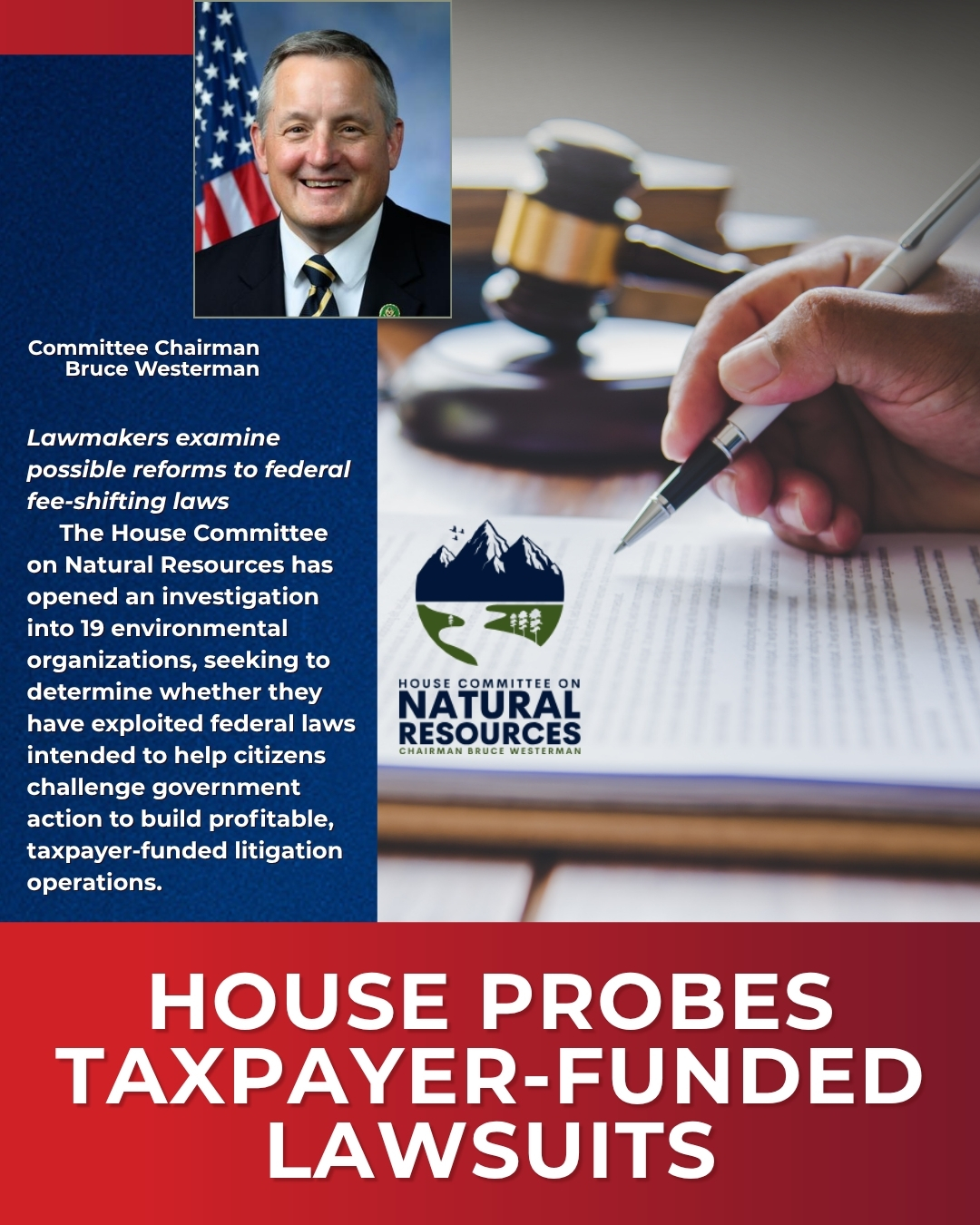
Lawmakers examine possible reforms to federal fee-shifting laws
The House Committee on Natural Resources has opened an investigation into 19 environmental organizations, seeking to determine whether they have exploited federal laws intended to help citizens challenge government action to build profitable, taxpayer-funded litigation operations.
The groups include heavy-hitting organizations like the Center for Biological Diversity (CBD), the Alliance for the Wild Rockies, Earthjustice, Sierra Club, the Natural Resources Defense Council, and others.
Committee chairman Bruce Westerman (R-Arkansas), Oversight and Investigations Subcommittee chairman Paul Gosar (R-Arizona), and 15 other committee members sent letters demanding records and in-person testimony concerning the organizations’ litigation practices and recovery of attorney’s fees. The investigation follows two earlier hearings and aims to develop legislative reforms.
“The House Committee on Natural Resources is conducting oversight related to the outsized influence preservationist environmental nonprofit organizations wield over the federal government, law, and natural resources policy,” the letter to the organizations stated. “The committee is particularly concerned with the organizations’ coordinated capitalization on misleading and emotive messaging to build powerful and profitable litigation machines funded by taxpayer dollars through the exploitation of statutory fee-shifting provisions. In order to ensure compliance with Congress’ legislative intent for statutes with fee-shifting provisions and inform legislative reforms to prevent abuse by radical environmental groups, Congressional oversight of the organizations’ lawfare campaigns and subsequent fee awards is imperative.”
As the letters indicated, this particular probe is homing in on statutory fee-shifting provisions, including those in the Endangered Species Act and the Equal Access to Justice Act (EAJA). Congress enacted those provisions to reduce financial barriers for people who challenge government action, particularly those unable to afford expensive litigation. At a committee hearing last December, Gosar described efforts by nonprofits to transform EAJA into what he called “a taxpayer-financed ATM to pursue political litigation that has little to do with justice and everything to do with advancing their agenda.”
Gosar also said he is concerned that financial incentives may encourage litigation that obstructs energy development, resource management, and other federal actions, while shifting costs to taxpayers. The letters sent this week echo those concerns.
“These extremist environmental organizations function as taxpayer-funded law firms,” the representatives said in announcing the investigation. “They employ a simple yet lucrative profit model built on the backs of hardworking American families. They collect taxpayer-funded reimbursements for their attorneys’ fees to fund litigation often brought before activist judges and aimed at blocking pro-growth and pro-natural resource management activities. After American taxpayers pay their legal bills, they use their tax-exempt status to turn their courtroom antics into fundraising appeals.”
An American rule of thumb
The committee’s September 4 letter to the groups explains that the American Rule generally requires litigants to pay their own legal costs.
“Fundamentally, the American Rule aims to prevent ‘losing litigants [from] being unfairly saddled with exorbitant fees for the victor’s attorney[s],’ experts, and other litigation costs,” the letter to the Center for Biological Diversity stated. “However, primarily to ‘diminish the deterrent effect of seeking review of, or defending against, governmental action,’ particularly for those prospective plaintiffs who are indigent or otherwise unable to afford expensive legal representation, Congress enacted fee-shifting statutes allowing the award of attorney’s fees and other litigation expenses in several types of judicial and administrative proceedings.”
Today, the letter observed, most environmental litigation is brought under statutes with embedded fee-shifting provisions, like the Endangered Species Act (ESA) or statutes covered by the Equal Access to Justice Act (EAJA) and the National Environmental Policy Act (NEPA), enabling prominent environmental nonprofits already flush with cash to recover the litigation costs of their “vexatious lawfare campaigns.”
“As currently written and implemented in legal practice, statutory fee-shifting provisions exempt nonprofit organizations from net-worth and size caps,” the representatives wrote. “Within the committee’s jurisdiction, these fee-shifting provisions currently permit CBD and similar organizations to effectively function as law firms funded by taxpayer dollars, employing a simple but lucrative profit model: sue to block federal actions in friendly courts, collect taxpayer-funded attorney’s fees and costs whenever prevailing or able to settle in court, and fundraise on the back of courtroom victories.”
In many cases, nonprofit plaintiffs do not even need to fully “win” a case to recover fees, the representatives continued.
“For example, under EAJA, ‘prevailing’ plaintiffs can recover attorney’s fees with ‘even a partial victory or procedural settlement . . . regardless of the lawsuit’s broader merit or public benefit,’” they wrote. “Under ESA, the standard is even more ambiguous: courts may award fees and costs ‘to any party, whenever the court determines such award is appropriate.’”
Worse yet, the representatives wrote, fee-shifting provisions within environmental statutes fail to set effective upper limits on hourly rates.
“For example, EAJA, which covers statutes like NEPA, the Marine Mammal Protection Act (MMPA), and the Magnuson-Stevens Fishery Conservation and Management Act (MSA), caps reimbursable attorney’s fees at a rate of $125 per hour, unless the reviewing court or agency determines that ‘an increase in the cost of living or a special factor, such as the limited availability of qualified attorneys for the proceedings involved, justifies a higher fee,’” the representatives wrote. “EAJA, however, does not sufficiently define ‘special factor,’ allowing many environmental lawyers to avoid the $125-per-hour fee cap by claiming that their expertise is ‘specialized.’ Consequently, environmental nonprofit organizations have been reimbursed under EAJA for attorney’s fees at rates as high as $500 per hour. Other statutes, like ESA, have seen even higher recoveries, exceeding $650 per hour.”
Of course, those rates almost always far exceed the value assigned to attorneys working on cases by their own employing nonprofit organizations, the representatives contended.
“In fact, rather than seeking to make a prevailing party whole with an award that compensates for costs incurred, courts award fees and costs in amounts ‘far more than necessary to reimburse a prevailing plaintiff,’” they wrote.
When courts award fees, they do not look at the actual amounts paid to the attorneys in the case, the representatives asserted.
“Rather, courts ‘set a hypothetical hourly rate for each attorney and then multiply that rate by the number of hours each attorney reported working on the case,’” they wrote. “In fact, attorneys from environmental nonprofits, seeking fees and costs, often propose their own ‘reasonable’ rates that courts rubber-stamp.”
What’s more, the representatives assert that the federal government has an incentive to settle disputes rather than contest the fee award to reduce the overall attorney’s fees that may accrue.
“This is because settlements often result in somewhat smaller awards and, under most statutory fee-shifting provisions, prevailing parties can recover the fees and costs associated with time spent contesting fees and costs,” they wrote. “This allows plaintiffs to ‘prevail on process instead of substance.’ And, because the U.S. government often fails to adequately contest fee awards and regularly concedes prevailing party status to nonprofit groups in settlement agreements, taxpayer dollars effectively fund these nonprofits’ sue-and-settle tactics.”
An inside move
Lawmakers discussing the probe say they are not so much interested in amounts awarded as they are the practices behind the lawsuits. Using the letter to the Center for Biological Diversity as an example, the committee requested records concerning decisions to sue federal agencies, the selection of plaintiffs with legal standing, intervention in other lawsuits, venue selection, and coordination among environmental organizations.
They are also seeking information about staffing, attorney and expert billing rates, timekeeping, fee negotiations, write-offs, and the distribution and accounting of awards. Some say the broad scope of the requests suggests that the committee is investigating whether litigation and fee recovery operate as a coordinated organizational strategy.
“One fundamental role of Congressional oversight and investigations is to root out waste, fraud, and abuse of taxpayer dollars,” the representatives wrote. “The committee’s work thus far suggests that oversight mechanisms typically built into an attorney-client relationship, like the ability for a client to review and dispute detailed time logs for which they are billed before they pay any invoice, do not exist in adequate form to protect taxpayer dollars awarded to radical nonprofit organizations through litigation.”
Moreover, the letter continues, contrary to their original legislative intent, statutory fee-shifting provisions have incentivized radical environmental nonprofits to build a business model focused on siphoning taxpayer dollars by weaponizing litigation awards and settling lawsuits.
“As the government’s authority to settle in these cases is ‘unmediated and unreviewable’ and can be used to ‘appease repeat litigants,’ environmental activists have warped the justice system and burdened agencies with lawsuits that divert personnel and resources from core missions,” they wrote. “In fact, agencies are not able to even provide estimates of costs related to litigation reflecting staff time and resources.”
The letter specifically pointed to CBD specifically.
“As one of the most active litigating environmental nonprofit organizations driving the exploitation of statutory fee-shifting provisions, CBD is uniquely positioned to provide the Committee with information necessary to conduct meaningful Congressional oversight and enact necessary legislative reform to safeguard responsible management of our natural resources, and ensure unscrupulous organizations cannot unjustly continue to implement their litigation-focused business model at the expense of American taxpayers,” the lawmakers wrote.
In addition to CBD, the lawmakers sent the letters to Alliance for the Wild Rockies, Cascadia Wildlands, Defenders of Wildlife, Earthjustice, Great Old Broads for Wilderness, High Country Conservation Advocates, Montana Environmental Information Center, Native Ecosystems Council, Natural Resources Defense Council, Oregon Wild, Rocky Mountain Wild, San Juan Citizens Alliance, Sierra Club, Western Watersheds Project, WildEarth Guardians, The Wilderness Society, Wilderness Watch, and Wilderness Workshop.
The letter requests complete, unredacted electronic records by September 18. It also requests an in-person transcribed interview and warns that failure to respond, participate voluntarily, or cooperate in good faith could force it to evaluate the use of compulsory process.
The investigation follows a December 10, 2025, hearing examining alleged abuse of the Equal Access to Justice Act and a May 2026 hearing on the broader use of fee-shifting statutes by environmental nonprofits. The new investigation represents the logical next step—obtaining the internal records needed to substantiate those claims.