Fifth generation rancher Casey Murph and his family are literally staring into the sun
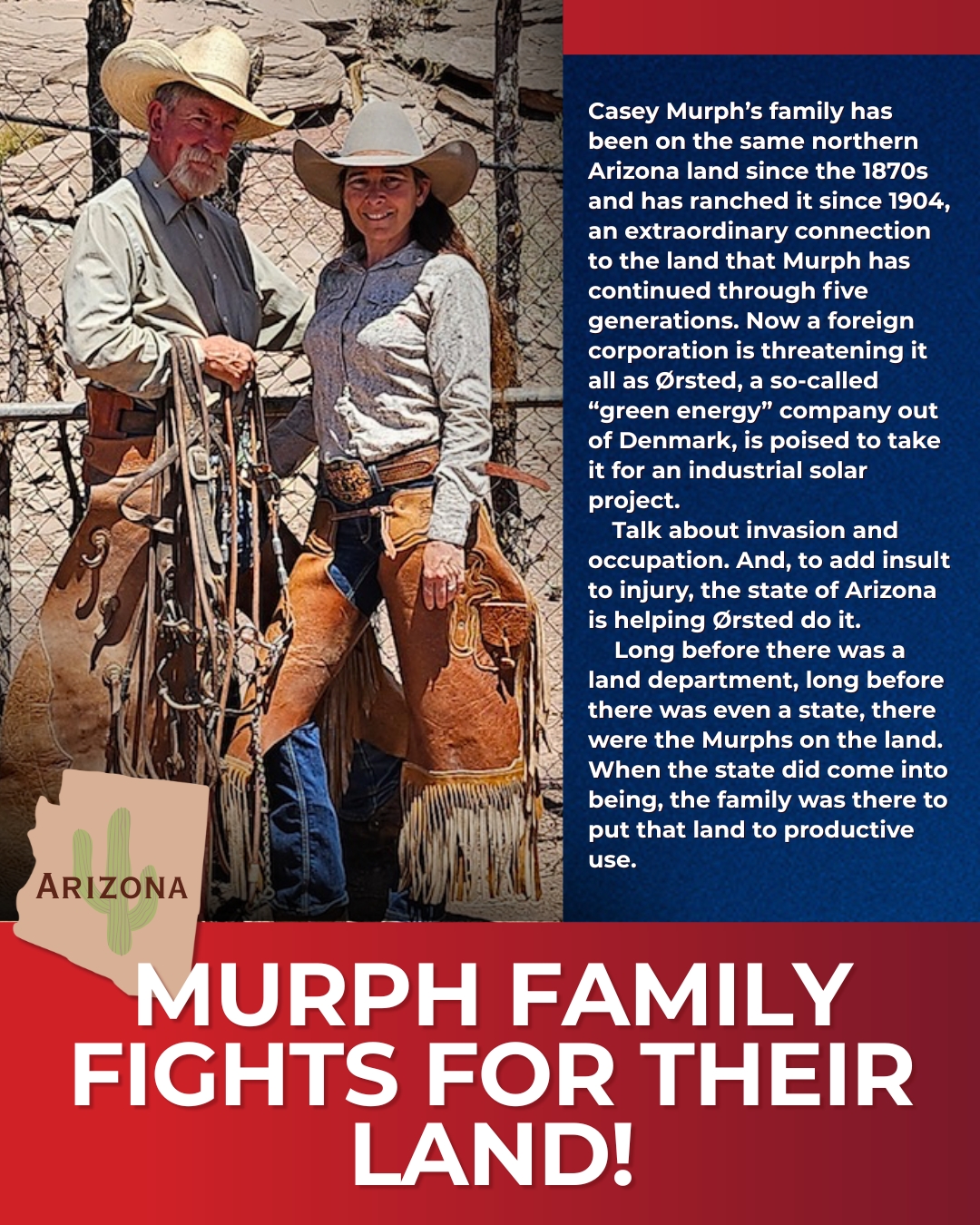
Casey Murph’s family has been on the same northern Arizona land since the 1870s and has ranched it since 1904, an extraordinary connection to the land that Murph has continued through five generations. Now a foreign corporation is threatening it all as Ørsted, a so-called “green energy” company out of Denmark, is poised to take it for an industrial solar project.
Talk about invasion and occupation. And, to add insult to injury, the state of Arizona is helping Ørsted do it.
Here’s the skinny on what has become a very elephantine problem in the United States: the taking of valuable ranch land and farmland—heck, land period—by foreign corporations for renewable energy scams. In Murph’s case, the problems started in 2022, when he began receiving notices from the Arizona State Land Department (ASLD) that renewable-energy developers were interested in state sections within his grazing allotment. What had, for generations, been a fairly stable arrangement suddenly was not.
“My family started coming to Arizona in the 1870s,” Murph told Liberty Matters in a recent interview. “And the particular ranch that we’re on, my family started ranching on it in about 1904. They were freighters before they were ranchers. And so we’ve been on this same piece of country since 1904.”
That was before Arizona was a state: “There was my great-grandfather’s private land and government land that was checker-boarded out in it,” he said. “Back then they used to call it public domain.”
Murph and his H-Y Cattle Company in Navajo County lease about 4,000 acres from the state, a fraction of the nine million acres of state trust land managed by the ASLD. Under Arizona’s trust-land laws, ASLD generally must award state trust land sales and qualifying leases to the “highest and best bidder,” consistent with its fiduciary duty to maximize financial returns for trust beneficiaries, principally Arizona’s public schools.
Things took an uglier and more threatening turn nearly a year ago, in September 2025, when Arizona Governor Katie Hobbs signed an executive order directing ASLD to identify and facilitate large-scale energy infrastructure development on state lands, including renewable energy infrastructure leases. The order also directed the ASLD to cut red tape for solar, wind, storage, and transmission projects, and to report within 30 days on streamlining the process. The order explicitly funds dedicated ASLD staff through the federal State Energy Program to accelerate project delivery.
“Her task force created a map of all the state lands throughout the state and color coded those lands according to solar favorability,” Murph said. “The lands within my allotment were color coded yellow, which is green being the best, yellow being better, red being unsuitable. So it all was given that designation as suitable for agriculture or for renewables instead of agriculture.”
Those designations upped the ante for his land, Murph says.
“And since then, I started receiving notifications through the mail by the Arizona State Land Department saying these different renewable companies had applied for these state sections to be transferred to them, which the state allows under their guidelines,” he said.
As for Ørsted, according to NS Energy and the company itself, it’s no stranger to solar development projects in Arizona. It originally owned the Eleven Mile Solar Center in Pinal County near Coolidge—it retains a 50-percent stake—a project composed of 857,000 solar panels that the company says would produce enough electricity to power 65,000 homes annually.
The ASLD 2024 annual report shows the overall math produced by such projects. Grazing across 8.32 million acres generated $3.014 million last year. A single solar auction—the upcoming Grand Verde Energy lease in Maricopa County, covering 3,900 acres—carries a minimum appraised bid of more than $43 million for a 30-year commercial lease. One solar deal, then, produces 14 times the annual grazing revenue across the entire state trust system.
In this equation, which deletes heritage, food production, and local control from the calculation, ranching never has a chance. It just took one solar build-out to make that apparent, and now Hobbs, with the executive order, has put the state’s pedal to the metal.
Treating people right
Long before there was a land department, long before there was even a state, there were the Murphs on the land. When the state did come into being, the family was there to put that land to productive use.
“So we’ll fast forward to statehood,” he said. “In 1912, Arizona was made into a state, but I think it was sometime after that that Arizona actually set up their state land commission. But my great-grandfather’s initial Arizona state land lease allotment was one of the earliest ones that was set up.”
Fast-forward again to the 1930s.
“Great-granddad had borrowed quite a bit of money from the banks and ended up losing about a third of his land to the banks because of the Great Depression—stuff that’s illegal for banks to do now,” he said. “But he was able to retain ranching because he still had those Arizona state leases. So since then, the way the ranch has been made up is about one third our deeded property, about one third Arizona state leases, and about one third adverse property.”
The adverse property was the land his great-grandfather had owned but lost to the bank.
“Nobody ever did anything with it because it’s not developable,” he said. “It’s very remote. There’s water. There’s not anything out there. So we’ve been using that along with the state leases. Our state lease actually gives us legal rights to be on that land.”
But there’s a caveat, Murph said. They have a legal right to be on the land, but it’s not absolute.
“But not to the exclusion of somebody like a solar farm that wants to come in and fence us out,” he said. “… As I understand it, the Arizona state constitution has an amendment in it that was written up at the time that these state lands were transferred from the government—the federal government over to the state—and the way the amendment reads is that these lands are to be used for the highest and best use.”
Of course, Murph said, determining highest and best use is a subjective proposition.
“It seems like that subjective wording has been used,” he said. “It must have been used to deny a lot of applications in the past because I’m not familiar with any widespread sale of state lands that’s ever taken place with the exception of some state lands that are in the vicinity of big cities like Phoenix. But up here, I’m not familiar with it ever happening, and you would just know that if it was something that was.”
Some have suggested that the state is required to sell or lease the lands to the highest bidder whenever that comes up, but Murph says that makes no sense, either.
“It’s just counterintuitive to think that that’s actually happening on a wide scale,” he said. “We would know about it. It would be just pandemonium with people trying to get rid of nuclear waste and everything else. It would just be total pandemonium out here. So I do think the state does have some judgment that they can exercise with regards to the way these are worded.”
If it does come to pass, Murph said it is the end of his enterprise.
“So in addition to the state lease that we’re looking at losing, we’re looking at losing a couple of thousand acres of those grazing rights lands [on what he refers to as the adverse property],” he said. “Altogether, that puts me out of some of my best winter country.”
That would be catastrophic, Murph says.
“And then I won’t have enough country after that, if this were to happen, to be able to remain sustainable,” he said. “I would be reduced to just like a hobby operation. And that’s concerning and distressing to me at 58 years old with the ranch being my retirement. I’ve invested all my savings into cattle ranching as my retirement income.”
And so, the bottom line is, a fifth-generation rancher can disappear without anyone physically taking the Murphs’ house or deeded acreage. All the state has to do is remove enough of the land to make the ranch economically unviable. And, while the state has the right to cancel the lease at any time they want, Murph says he’s never seen the state act in such a ruthless way.
“Every rancher that I know that’s got state lands has always been able to have them renewed every 10 years when they come up, unless somebody has demonstrated that they have blatantly disregarded the terms of the lease, like some type of damaging action that they’ve done, or disturbed Indian relics, things like that,” he said. “But with few exceptions, every rancher in this area has always renewed their leases and many of them over multiple generations.”
Now it’s different, Murph said, and he’s not the only rancher in his situation facing such grim repercussions.
“There’s one rancher directly across the river from me that was basically put out of business by this,” he said. “There are other ranchers. There are four of them that I know of that have been threatened with this. I don’t think any of them have had any action taken on them yet, as all the activity has been on the property that was formally leased by those ranchers across the river.”
According to the Arizona Daily Independent, the neighboring family had ranched on state land for more than 100 years until ASLD leased the land for an Invenergy solar project in 2024. The family lost a lawsuit and was required to sign a nondisclosure agreement that prevents them from discussing the loss of their grazing allotment, the newspaper reported.
Arizona: Following the Money
For its part, the ASLD disputes any accusations that it favors solar, saying in a May 28 statement that it does not prioritize solar over other uses.
“We’re seeing discussion about solar projects on State Trust Land and grazing leases,” the statement reported. “To be clear, ASLD has no policy prioritizing solar over any other use. We manage a perpetual trust and have a responsibility to evaluate every application based on its benefit/impact to the trust. Arizona’s history is deeply tied to ranching. Families came west, raised cattle, managed the land, and helped build the communities that define rural Arizona today.”
Murph vociferously contests the state’s position.
“I say that that’s demonstrably not the case,” he said. “I mean, we can look to the fact that she [Hobbs] created the task force, that she created the parcel maps, prioritizing land for solar. I think it’s real easy to demonstrate that that’s not the case at all.”
From Murph’s perspective, all of the governor’s actions—the executive order, the renewable-energy directives, the task force, the mapping, and other efforts to streamline renewable development—make it difficult to accept the claim that solar, and Ørsted in particular, is merely another bidder at the table.
“Ørsted is out of Denmark, and as I understand it, they are also partially owned by the Danish state,” he said. “So we’re talking about a company with a whole lot of power and a whole lot of money even compared to the state of Arizona.”
In fact, the state holds a 50.1 percent stake in the energy company, ensuring majority control while the remaining shares are publicly traded on Nasdaq Copenhagen. So it’s not just corporate power that is challenging Murph’s heritage; it is state-owned corporate power. Murph contrasts that state-corporate nexus with a ranching operation whose continued existence depends upon keeping enough grazing country together to sustain the cattle herd.
And all for what? Murph wonders. It’s certainly not going to help the community writ large, he asserts.
“What we have seen with these developments is they don’t provide very many permanent jobs like they advertise,” he said. “They provide temporary jobs in construction and only a handful of permanent jobs. And we’ve also seen that the temporary jobs are all people that the companies bring in. They’re really avoiding hiring local people to the greatest extent that they can.”
Murph says he knows of only a couple of local people who have been hired on the projects.
“So we’re not really seeing a lot of positive economic growth because of this, other than just some of these temporary workers are buying things at the store and going to the bars,” he said. “But that will be gone. It’ll be like when the carnival moves out.”
Murph says he has retained an attorney, but the attorney is upfront that his legal prospects look bleak, especially for any takings or other land-use claims.
“So far he has not presented that there’s an avenue like that for me,” he said. “There have been a few other cases in Arizona with regards to ranchers losing state lands to solar, and so far all the ranchers have lost. So my lawyer feels like precedent’s been set. I don’t really have a case given precedent and all that. And he was the one that actually told me your solution here might be political rather than to go through the legal system.”
Bringing the heat on global conglomerates
By that, Murph means public pressure.
“I think the reason why a lot of these state lands weren’t wantonly auctioned off in the past is because the state knows that the public isn’t really aware of this and the public kind of thinks these state lands are public lands that they can have access to for recreation and hunting,” he said. “And they’re afraid that if they start just wantonly auctioning all these lands off, the public’s going to rise up and demand an amendment to that constitution to change the way it’s worded to protect these lands for the public access.”
Nonetheless, the word has been getting out about what the state is doing, and Murph says that helps his situation.
“There’s been an awful lot of people who have contacted the State Land Department over this issue, enough that the State Land Department decided to release a statement about it,” he said. “And so public pressure, the more people that see this and might put pressure on the state to maybe reconsider doing this, I think the more that helps me.”
The America First Policy Institute (AFPI) has also weighed in, urging the state in a June 16 letter to deny the Ørsted solar project. In the letter to the ASLD, AFPI’s Leigh Ann O’Neill and Jason Hayes said the proposal should be evaluated not simply on the revenue it could generate for the State Land Trust, but on its broader impacts on ranching, ratepayer costs, and grid reliability, as well as the cost of eventually restoring the land.
“Ultimately, the sacrifice of state trust lands, currently and historically used for agricultural operations, should be considered only in exchange for a greater return to all Arizonans, and never for the benefit of foreign companies seeking US federal government subsidies,” O’Neill and Hayes wrote. “Indeed, short-term revenue for the state trust cannot justify destroying current and future productive agricultural use of the land. Ranching and farming are key economic interests in Arizona that should be protected.”
Not least, AFPI wrote that prospective developers should be required to demonstrate that evicting long-term grazing leaseholders and transitioning the land to solar is the best alternative when other areas, such as disturbed lands, brownfields, or mining lands, could be used. The organization also urged the state to require a decommissioning and remediation plan backed by a bond to ensure that the land is restored.
“An analysis should be made of a proposed project’s impact on the soil, water, and ranchland restoration efforts after the project is removed from trust land,” they wrote. “Specific attention should be given to the potential for glass and metal shards, leachate from damaged solar panels, and the remediation plans necessary to address these issues.”
From his standpoint, Murph says the best way to resolve the situation is to get Ørsted and any other solar conglomerates interested in his land to abandon the project voluntarily before they have invested anything. Murph says he believes there are several reasons why that might be possible, in addition to the bad press and the headlines the state and the company almost certainly don’t want, including actual access to the land.
“These lands are very remote,” he said. “There are no permanent roads anywhere in the vicinity. And the only decent road to get up there to that area is a ranch road that you have to go through my property to get to it.”
Even that road wouldn’t hold up to a lot of big, heavy industrial use that they would need to install the project, Murph said.
“They’d have to bring in hundreds of semis and heavy equipment and all that,” he said. “And my road wouldn’t hold up to that. It’s an ace in the hole that I have hard-to-access land. They’re going to have to either go through me or figure out how to go around me. But I worry, too, that they’re going to get [the state] on board with some eminent domain use.”
If they are going to take the land, Murph says, one solution would be to make the property owner whole so that anytime an auction came up, the renewable company would be expected to make that rancher whole so that they could continue operations and acquire some other property somewhere.
“At the risk of sounding like I’m whining, which I really don’t like to do, but at the very least, it would have been reasonable at the get-go for the governor and the State Land Department to have a condition that if you’re going to put one of our ranchers out of business here, you’re going to have to make that person whole,” he said.
Conglomerates such as Ørsted can afford to do that, Murph says.
“One of these installations is more than a billion dollars to install,” he said. “So if they gave me $5 million to go buy a ranch somewhere else, if they just absolutely have to have my place, it would be a small piece of their overall investment.”
Last month, U.S. Agriculture secretary Brooke Rollins highlighted Murph’s case in a post on X after he submitted his situation through USDA’s agricultural lawfare portal.
“The President and our administration have been clear: we’re not letting radical green energy scams steamroll our ranchers, our beef supply, or our way of life—and we are on top of this,” Rollins wrote. “Reliance on solar threatens our national security by making the United States dependent on supply chains controlled by foreign adversaries.”
We have your back, Rollins posted to Murph: “ America’s ranchers feed this nation— they come first.”
In the end, Murph says, what’s at stake is his future.
“I think it’s pretty important for your readers to know that I didn’t just inherit this ranch,” he said. “After five generations, there was a lot of extended family that all had an interest in the land. And when I took over, I had to use my retirement savings to buy them all out. And so if this happens, this is really destructive to me personally in a way that I think a lot of people can relate to and perhaps sympathize with.”
The Murph ranch survived the Depression. It has thrived for generations of family succession. It existed before Arizona statehood. What may finally make it economically unsustainable isn’t drought, cattle prices, or the failure of the family to keep ranching. It may be an arbitrary government decision that another use of the land is worth more.
Such a decision should not be a government bureaucracy’s or a governor’s to make unilaterally.