A congressional push to permanently repeal the controversial 2001 federal Roadless Rule gained momentum on May 21 as witnesses told a House subcommittee that the Clinton-era policy has contributed to catastrophic wildfire conditions, restricted active forest management, and cut rural communities off from the responsible use of federal lands.
The House Natural Resources Subcommittee on Federal Lands held a public hearing on a package of forestry and public lands bills, including legislation by Rep. Harriet Hageman (R-Wyoming) to permanently repeal the federal rule, thereby preventing future administrations from reinstating it through executive action.
Subcommittee chairman Tom Tiffany (R-Wisconsin) said the legislative package is part of a broader initiative to reverse what he described as decades of federal paralysis on wildfire management and forest stewardship.
“For too long, the topic of active wildfire management has been viewed as controversial, leading to a delay that has been catastrophic to our public lands and the communities built around them,” Tiffany said. “We can no longer treat responsible management like public enemy number one. Today, the Subcommittee on Federal Lands reaffirms its commitment to restoring health and resiliency by prioritizing healthy forests, safer communities, reliable infrastructure and practical stewardship.”
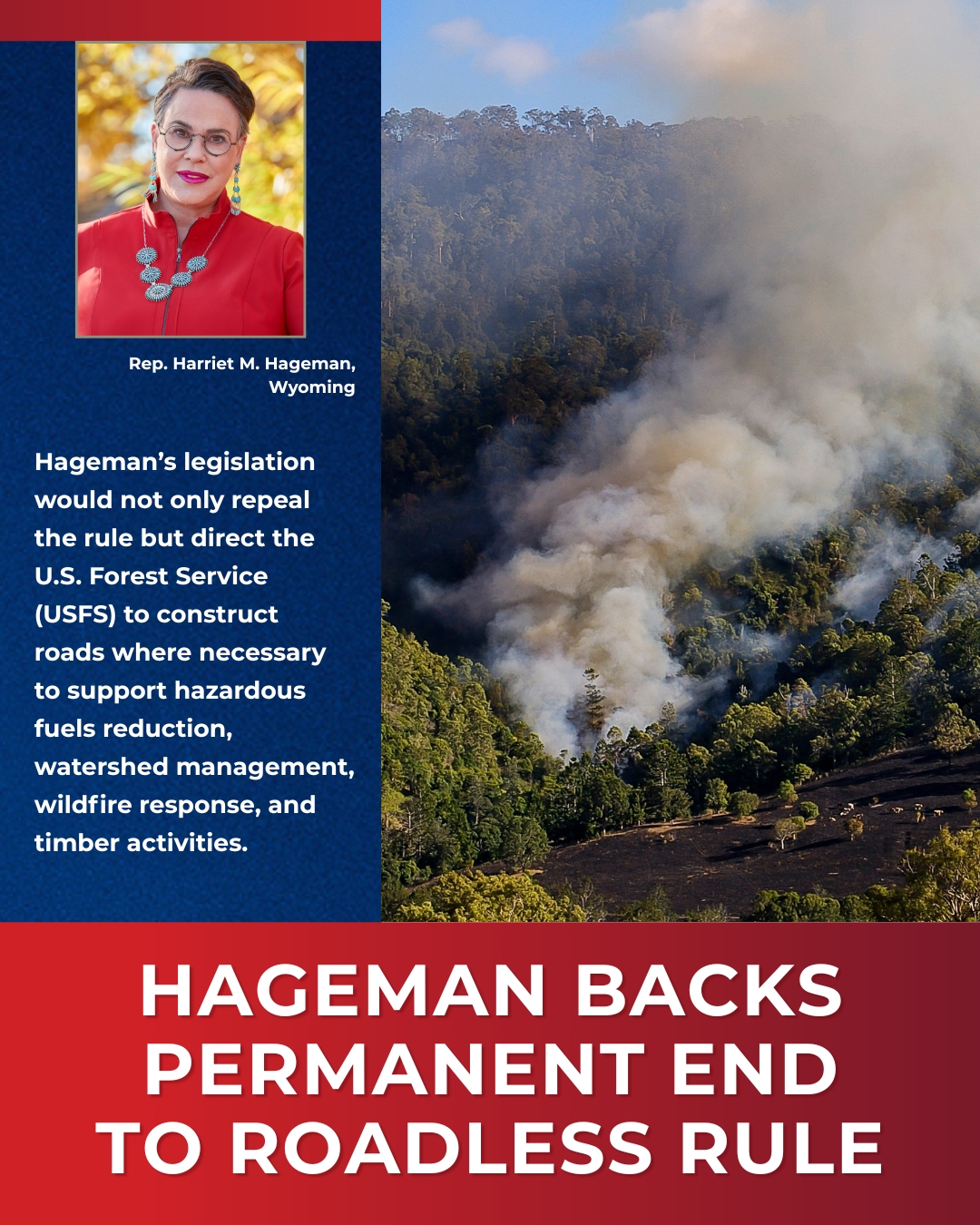
Hageman’s legislation would not only repeal the rule but direct the U.S. Forest Service (USFS) to construct roads where necessary to support hazardous fuels reduction, watershed management, wildfire response, and timber activities.
Supporters argue that the Roadless Rule effectively transformed millions of acres of national forest into de facto wilderness areas without congressional authorization. The rule imposed broad restrictions on road construction, road reconstruction, and timber harvesting across approximately 58 million acres of National Forest System lands.
According to research by subcommittee staff Angela Butler, Brandon Miller, and Hannah Devereaux, those lands account for almost a third of all U.S. Forest Service acreage, with most of it in western states.
What’s more, 40 percent of inventoried roadless areas carry “high or very-high wildfire hazard potential,” while another 15 million acres are located in or near so called wildland-urban interfaces, where fires threaten nearby homes and communities.
“USFS manages roughly 58.2 million acres of National Forest System (NFS) lands (or approximately 30 percent of all USFS lands) as ‘inventoried roadless areas’ (IRAs), which are roughly equivalent to Wilderness Study Areas on BLM lands,” the staff report stated. “While IRAs are not part of the National Wilderness Preservation System, certain activities, such as road construction and timber harvesting, are similarly restricted, with limited exceptions. However, there are no comprehensive data that demonstrate these exceptions are being utilized, leaving timber harvesting and road construction as de facto banned in IRAs.”
More than 96 percent of IRAs are located in just 12 western states.
“When combined with the 111 million acres of land classified as wilderness, this means that more than 169 million acres of USFS land are off-limits to active management,” the researchers wrote.
The research also showed that roadless areas have experienced proportionally greater fire damage than roaded areas, despite generally occurring in cooler, wetter landscapes.
Hageman has argued that the rule itself has become part of the wildfire problem.
“For decades, the Roadless Rule has blocked access, prevented active management, and increased the risk of catastrophic wildfires across the West,” Hageman said when introducing the legislation earlier this year. “This outdated administrative rule contradicts the will of Congress and undermines the U.S. Forest Service’s mandate to sustain the health, diversity, and productivity of our nation’s forests and grasslands. My legislation brings forest policy back in line with the law, restores active management, reduces wildfire threats, and supports the rural economies that depend on responsible timber production and land stewardship.”
Unconstitutional
Among those testifying was Mark Miller, director of environment and natural resources litigation for the Pacific Legal Foundation, who argued that the Roadless Rule represented an extraordinary assertion of executive branch authority over public lands.
“In the Roadless Rule, the secretary not only designated some 60 million acres of forestland as roadless, he also claimed the extraordinary power to impose sweeping restrictions in whatever manner he deemed best for any of the additional 140 million acres of national forests,” Miller testified. “Neither the Roadless Rule nor the Secretary’s asserted authority can be sustained under a fair reading of the laws governing federal forest management.”
Miller said Congress, not federal agencies, holds constitutional authority over federal lands policy, and he argued that the rule bypassed Congress by administratively imposing wilderness-style restrictions without legislative approval.
“Congressional action is needed to make clear not just to this administration but also to future administrations, as well as to the courts, that the national forests are designed principally for productive use, and that policies, like the Roadless Rule, designed to stymie such use, merit no role in federal public lands law,” he testified.
In addition, Miller testified, the rule itself is fraught with constitutional infidelity. Put simply, it’s unconstitutional even if Congress did delegate authority to the executive branch to declare tens of millions of acres to be roadless and thus off-limits to productive use.
“The Constitution charges Congress, not the Secretary, with ‘mak[ing] all needful Rules and Regulations respecting the . . . Property’ of the United States,” he testified. “‘All the public lands of the nation are held in trust for the people of the whole country”; and, as to how those lands are to be administered, ‘[t]hat is for Congress to determine.’ Although Congress may delegate limited rulemaking authority to the Executive Branch, the Constitution prohibits Congress from delegating a blank check. Congress must instead provide a governing ‘intelligible principle’ to cabin and channel the exercise of executive authority over the public lands.”
Through the Roadless Rule, Miller asserted, the secretary asserted unilateral power to cut off meaningful access to vast swaths of public land, claiming that it was within his “fundamental discretion” to weigh “competing interests” in deciding whether and how national forests should be used: “This claim finds no support in the Constitution, which assigns such ‘fundamental discretion’ to Congress, not the Executive Branch.”
And while the Trump administration has taken steps to repeal the rule, that won’t stop future administrations from reinstating it absent legislation, Miller continued.
“The current administration correctly recognizes that the Roadless Rule is bad policy and therefore has announced that it intends to administratively rescind the rule,” he testified. “This is a step in the right direction, but it won’t definitively resolve the problem of the secretary and the Forest Service’s entrenched misinterpretation of federal forestry law. Whether it’s the Clinton, Bush, Biden, or Trump administration, all have asserted that the Executive Branch has the discretion to decide whether to impose a Roadless Rule on the national forests.”
The current administration might free the Tongass next year from the scourge of roadlessness, Miller observed, but he asked lawmakers to consider the future:
“What about five years from now? Or ten? Lamentably, administrative flip-flopping on roadlessness is the norm, especially in Alaska; this has produced the predictable, and very undesirable, result that regulated entities … cannot make needed, long-term plans for infrastructure development, even during an energy-friendly administration.”
The Roadless Rule has been the subject of repeated political and legal battles over the years. Developed during the Clinton administration, the Bush administration attempted to amend it. Courts subsequently reinstated major portions of the original restrictions. The Trump administration rescinded portions of the rule, including in Alaska’s Tongass National Forest, while the Biden administration restored protections in some areas. The Trump administration has again moved toward repeal.
Hageman says that such policy instability creates significant uncertainty for rural communities, timber operations, utilities, and local governments planning decades into the future. What’s more, as Rep. Pete Stauber (R-Minnesota) put it, the Roadless Rule was never about conservation.
“In reality, it was a dangerous backdoor attempt to lock up our public lands,” he said.
Whether Congress codifies repeal or not, the May 21 hearing was the latest call in a growing chorus to move major public lands policy out of the realm of executive discretion and back into statute, where future administrations cannot simply reverse course with the stroke of a pen.