
Washington is building a government investment portfolio one company at a time
Just two years ago, Republicans would have greeted any proposal by the federal government to buy ownership stakes in private companies with open scorn, but, under the second Trump administration, it’s not only happening but becoming routine.
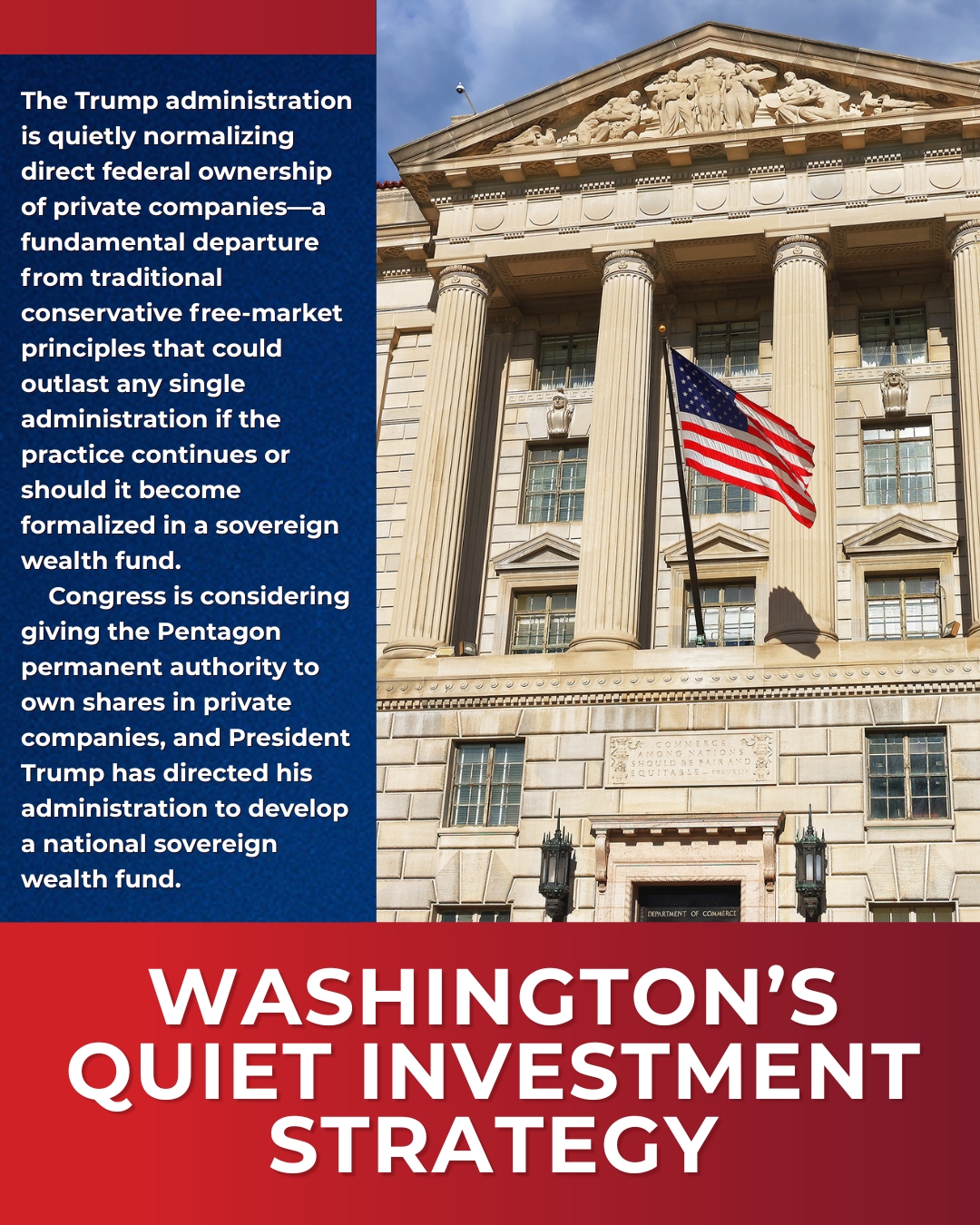
Specifically, the administration is quietly normalizing direct federal ownership of private companies—a fundamental departure from traditional conservative free-market principles that could outlast any single administration if the practice continues or should it become formalized in a sovereign wealth fund.
The Commerce Department is now routinely conditioning federal awards on receiving minority equity stakes, and the Defense Department has also become an investor in strategic industries. Meanwhile, Congress is considering giving the Pentagon permanent authority to own shares in private companies, and President Trump has directed his administration to develop a national sovereign wealth fund.
So far, the administration has explained each separate purchase of private equity as necessary for national security or as a benefit to taxpayers. Collectively, though, they represent something much larger: the sanctioned and legitimized government ownership of the private economy.
The Commerce Department announced the latest round of equity stakes last week, signing seven letters of intent to provide $874 million in federal incentives under the CHIPS and Science Act. The Department will receive a minority, non-controlling equity stake in each company as a condition for receiving the funds, the administration says, to enhance the return for U.S. taxpayers.
Among the recipients, Kepler will receive up to $245 million for R&D to develop a new class of high-performance AI memory technology; Multibeam Corporation will receive up to $140 million to develop advanced packaging technology; Extropic will receive up to $75 million to develop thermodynamic sampling units (TSUs) to solve complex AI problems at a fraction of the energy consumed by conventional computing approaches; Thintronics will receive up to $50 million to develop ultra-low-loss inter-layer dielectrics for next-generation semiconductor interconnects; OBSIDIA Semiconductors will receive up to $34 million for R&D to deliver malicious component identification systems to enhance secure supply chains for AI and advanced electronics; and Aeluma will receive up to $30 million to develop technologies used to fabricate photodetectors and lasers.
With the investments, the administration’s portfolio in the private sector now totals at least 30 companies. Since December alone, reports Tad DeHaven of the Cato Institute, the CHIPS Research and Development (R&D) Office has moved forward with 19 final or proposed company awards to 18 companies totaling up to $3.8 billion.
The funding marks a turn. Not long ago, the administration’s purchase of shares in private companies looked far more random, though, to be fair, Trump had signaled his desire for a sovereign wealth fund early on and seemed to be assembling a de facto one.
Since mid-2025, though, the administration has moved rapidly to acquire ownership stakes over strategically important companies. In 2025, Trump approved Japan’s Nippon Steel acquisition of U.S. Steel in exchange for a “golden share” that gives the federal government veto power over major corporate decisions. In July, the government became the largest shareholder in MP Materials, a producer of rare-earth minerals. That was followed rapid-fire by the government’s acquisition of a 10-percent stake in Intel, along with investment deals involving Lithium Americas, Trilogy Metals, Westinghouse, and rare-earth magnet manufacturer Vulcan Elements.
Margaret Byfield, executive director of American Stewards of Liberty, says the recent trend echoes one of the central concerns that shaped the nation’s founding.
“America’s Founders greatly feared a government that owned the resources and had the ability to self-fund,” Byfield said. “As a result, they established a system where the people would own the land and the government’s source of revenue was primarily taxation, which required approval from those governed. Two-hundred and fifty years later, instead of protecting these principles, we are allowing the government to quietly erode these essential limitations.”
Government as shareholder
Critics have warned about the government’s plans to assert government ownership of a significant share of the economy since Trump’s February 2025 executive order directing the Treasury and Commerce departments to prepare a plan for establishing a U.S. sovereign wealth fund.
“It is the policy of the United States to maximize the stewardship of our national wealth for the sole benefit of American citizens,” the executive order states. “To this end, it is in the interest of the American people that the Federal Government establish a sovereign wealth fund to promote fiscal sustainability, lessen the burden of taxes on American families and small businesses, establish economic security for future generations, and promote United States economic and strategic leadership internationally.”
A sovereign wealth fund (SWF) is a government-owned investment fund that uses public money to buy financial assets—such as stocks, bonds, real estate, and obviously ownership stakes in private companies—to earn profits over time. It is by any other name a national investment portfolio, usually funded with revenues from oil and gas, budget surpluses, foreign currency reserves, or profits from state-owned enterprises.
At first, it appeared that Trump would seek congressional approval for the SWF. But with no such legislation coming to fruition, the administration instead began pursuing government ownership interests through existing channels. Most notably, the Commerce Department requires recipient companies of CHIPS-related funding awards to provide the federal government with minority, non-controlling equity stakes as a condition of funding.
That said, the Republican Congress isn’t entirely out of the government ownership picture. The now-stalled Senate version of the National Defense Authorization Act would establish a permanent Defense Equity Investment Account within the Treasury and expressly authorize the Pentagon to buy ownership interests in private companies involved in critical minerals, batteries, and strategic manufacturing. Government investments would be limited to a 50 percent stake, non-voting shares, and a dollar cap of $500 million.
The conservative argument against
While congressional Republicans have appeared mostly willing to back the president’s approach—or at least have not mounted any significant public pushback—some prominent conservative voices outside Congress have been sharply critical.
Ryan Young, a senior economist at the Competitive Enterprise Institute, puts it bluntly: Sovereign wealth funds are a way for governments to own the means of production. Young points out that more than 100 such funds exist, managing an estimated $13 trillion in assets:
“Norway has the largest sovereign wealth fund, now worth $1.7 trillion after earning a 13-percent return last year,” Young wrote in 2025. “More than 20 US states have sovereign wealth funds, most famously Alaska, which gives each of its residents an annual check from the returns, usually between $1,000 and $2,000.”
The question is, what are the downsides?
Young pointed to a few after Trump’s initial inclination to have the U.S. government buy a 50-percent stake in TikTok: “A US government-owned social network is unlikely to appeal to teenagers, and the privacy concerns are obvious and ongoing. Still, a Trump-directed investment would buy TikTok’s loyalty to Trump—which itself may limit TikTok’s appeal. And if TikTok displeases Trump somehow, he could yank away the lifeline.”
In other words, this scheme attempted to circumvent China by becoming its own version of China. What teenager is going to trust a government-owned social media platform? Heck, what adult is going to trust it, given the government’s censorship and surveillance machinations during Covid and even before? Young also cast real-world doubts on the benefits to taxpayers of a profitable government investment portfolio:
“Congress is unlikely to actually spend sovereign wealth fund investment returns paying down entitlements,” he wrote. “More likely, it will find new spending projects instead. It has already done this with the Social Security trust fund, which consists entirely of IOUs from previous government spending binges, which taxpayers will eventually have to cover.”
No guard rails in the universe would be able to stop the congressional spenders, Young argued:
“Spending advocates, who are just as well-meaning on behalf of their favored programs, will find ways around those guardrails,” he wrote. “Congress has the power of the purse. If it creates the rules around a sovereign wealth fund, it can also change them. So can presidents, unless courts stop them, which is no guarantee.”
Of course, there are deeper problems than more debt and a public skeptical of anything the government touches, much less owns. It’s the government’s role in the markets and in the economy that gives rise to philosophical angst. With ownership stakes, the government would no longer be merely a regulator or customer but regulator, customer, owner, and bank. It would be able to press its thumb on the scales during contract negotiations, in trade talks, and in permit applications, not to mention in doling out corporate subsidies. It’s state corporatism, in which capital is socialized even if not quite down the road to socialism.
It might not be the Democratic Socialists of America’s brand, but, with the government gaining veto power over major corporate decisions in a company like U.S. Steel/Nippon, it could well put us on the road to Hayek’s Road to Serfdom if we aren’t careful.
What’s more, capping the government’s shares at a minority level eliminates neither capital socialization nor the government’s influence. Meanwhile, future administrations will inherit the same tool and can use it to assemble portfolios reflecting their own political priorities.
Last October, writing in the opinion publication The Fulcrum, in a piece entitled Nationalization By Stealth, Imran Khalid argued that the administration’s embrace of government ownership stakes marked a sharp departure from traditional free-market conservatism:
“What once would have been denounced as creeping socialism in Washington is now unfolding under Donald Trump, a president who boasts of his devotion to private enterprise but increasingly embraces tactics that blur the line between capitalism and state control,” Khalid wrote. “The word ‘nationalization,’ for decades associated with postwar Britain, Latin American populists, or Arab strongmen, is suddenly back in circulation—but this time applied to the citadel of capitalism itself. Trump justifies the intervention as a matter of national security and economic patriotism.”
Indeed, Trump’ press secretary Karoline Leavitt put it this way: “It’s a creative idea that has never been done before to ensure that we’re both reassuring these critical supply chains while also gaining something of it for the American taxpayer.”
SMU professor Carliss Chatman agreed telling the Epoch Times: “If taxpayers are assuming significant financial risk to help develop strategically important industries, an equity stake allows the public to participate in the upside if those investments succeed.”
Officials argue that taxpayers deserve an ownership return when government invests billions, and, instead of grants that disappear, equity allows taxpayers to benefit if companies succeed.
When is the free market no longer free?
Conservatives who support government equity stakes in the private sector or sovereign wealth funds should pause for a second to think about the future. If Republicans are comfortable giving this authority to Donald Trump, would they be equally comfortable giving it to the next Democratic president?
Or, as Dimitri Burshtein writes in the Wall Street Journal, if BlackRock’s ESG focus is controversial, imagine the potential for politicians to use an American SWF as a political tool:
Even if this now appeals to some Republicans, they should picture what it would mean under a Democratic administration,” Burshtein wrote. “The rapid fluctuations in mandates alone would cause dangerous market instability and uncertainty. Every four years could bring new demands, leaving investors and businesses with limited ability to make medium- or long-term plans.”
In the end, we should all think about what it means to be conservative. It’s because we are devotees of capitalism and private property—government ownership robs the people of the foundations of economic prosperity, political democracy, and individual liberty. And, as Kevin Stockton wrote in The Epoch Times, buying ownership stakes in private companies opens a door to personal control over daily life that should forever stay shut:
“Critics, however, say this is a slippery slope to more government control over Americans’ private lives. They point to attempts by the Biden administration to pressure private companies to censor Americans and to fire employees who refused Covid-19 injections, as well as the Canadian government’s use of private banks and insurance companies to crush truckers’ protests of that country’s Covid-19 policies.”
Stockton quoted Jeffrey Degner, a policy expert at the American Institute for Economic Research: “Consider the Biden administration’s pressure applied to social media firms during the Covid lockdowns. Imagine the silencing of free speech if the government had already taken ownership stakes in these firms.”
Lastly, supporters of extensive government holdings in the private sector should remember that when government purchases private equity it is no longer private. Ever more equity now belongs to the government, and there is a striking parallel to the array of private land grabs that put private real estate in government hands. Each represents the diminution of private property. Milan Adams, appearing in Zero Hedge, put it this way:
“There are periods in history when societies begin to discover that the liberties they believed to be permanent were, in reality, conditional arrangements tolerated only while they remained politically convenient. Across the Western world, governments are quietly expanding the legal and administrative mechanisms through which private land can be reclassified, restricted, absorbed, or transferred in the name of infrastructure, sustainability, industrial security, climate adaptation, and economic modernization. Entire farming regions are now being surveyed for carbon pipelines. Rural communities are facing unprecedented redevelopment pressure linked to energy transitions and semiconductor expansion. Financial institutions are purchasing strategic agricultural land at historic levels while policymakers openly discuss the restructuring of urban life around centralized digital systems. Officially, these transformations are described as progress. Unofficially, an increasing number of citizens have begun to suspect that the modern definition of ownership itself is being rewritten in real time.”
Indeed. So let’s leave the schemes of government ownership to the dead-end ideological alleys of the DSA, so that dreams of private ownership, of economy and land, can flourish in the rest of the USA.