
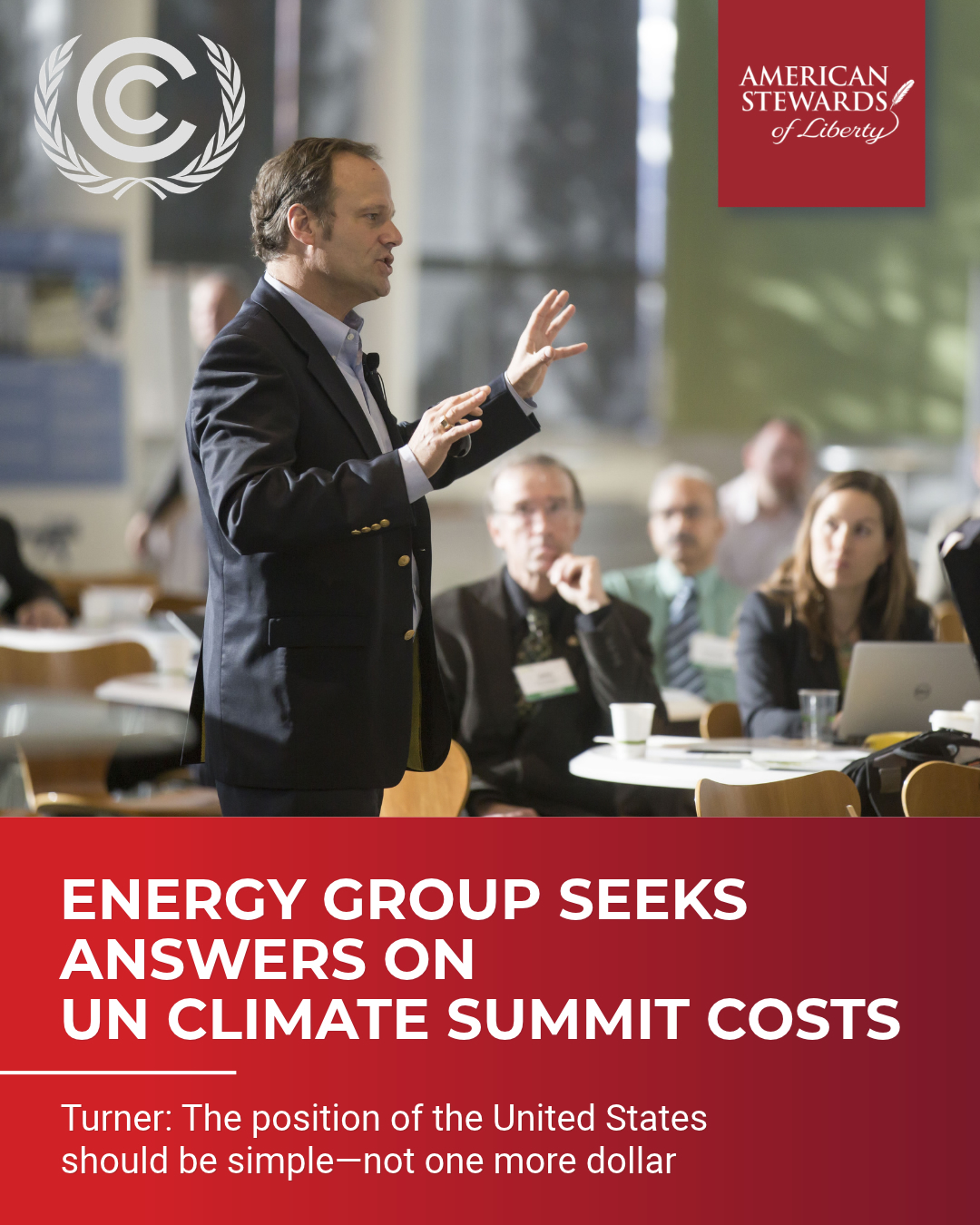
Turner: The position of the United States should be simple—not one more dollar
An American energy advocacy organization is calling on Vice President JD Vance to conduct a comprehensive audit of taxpayer spending related to United Nations climate conferences, raising questions about whether federal tax dollars continue to support international climate activities despite President Donald Trump’s decision to withdraw the United States from the process.
In a November 5 letter to Vance, Daniel Turner, founder and executive director of Power the Future, requested an accounting of American participation in last year’s COP30 conference in Brazil and this year’s COP31 gathering in Antalya, Turkey. The group contends that taxpayers deserve to know whether federal agencies, employees, contractors, or grant recipients have continued to finance climate-related activities inconsistent with the administration’s policies.
“With the United Nations 31st Conference of the Parties (COP31) set to convene in Antalya, Turkey on November 9, we are writing to respectfully request a full audit of any United States participation in COP30 and any planned participation in COP31,” Turner wrote. “We believe the American people have a right to know about how their money is spent or committed in connection with these summits.”
The Trump administration has declined to participate officially in any of the conferences, but Turner argued that withdrawing from the formal proceedings was insufficient unless the administration also established that federal funding and commitments had ended.
What’s more, Democratic members of Congress and other American political figures—including former secretary of state John Kerry and former Vice President Al Gore—did attend the proceedings, and Turner says there are still questions about whether any bureaucratic mechanisms within federal agencies have kept some money flowing.
“President Donald Trump has been clear that the United States will no longer bankroll the global climate agenda,” he wrote. “In 2025, the administration declined to send high-level representatives to COP30 in Brazil, and earlier this year, the President directed the United States to withdraw from the treaty under which these conferences are held. These are the correct decisions. But the American people deserve confirmation that these principles extend to every level of the federal government, and that taxpayer dollars are no longer flowing into the COP process.”
Turner says the concern is not hypothetical.
“Under the previous administration, participation in the COP process extended beyond the multi-week summits,” he wrote. “In October 2022, former secretary of state John Kerry, then serving as President Biden’s Special Presidential Envoy for Climate, traveled to Kinshasa, Democratic Republic of the Congo, for a ‘Pre-COP’ preparatory meeting ahead of COP27, then continued to Abu Dhabi for the One Planet Sovereign Wealth Fund Summit. This was taxpayer-funded travel to a meeting held to prepare for another meeting.”
The full cost of these preparatory events, side summits, staff, and travel across the Biden years has never been fully accounted for, Turner asserts.
“Any remaining commitments, offices, or contracts that survived the transition should be identified and disclosed,” he wrote.
To that end, Turner requested an audit to examine spending, contracts, and international climate commitments. Specifically, the requested audit would determine whether any federal employee, contractor, or grantee attended or supported COP30 or any related pre-COP side event, and at what cost to taxpayers; and whether any federal funds have been spent, obligated, or committed for COP31, its pre-COP meetings, or related events.
The group also wants the total amount of taxpayer money sent to the COP process and associated international climate funds since 2021, and what measurable results, if any, it produced, as well as whether any grants or contracts remain in place that route taxpayer dollars to non-governmental organizations or foreign entities participating in the COP process.
“The excess surrounding the COP process abroad shows what American taxpayers have been asked to underwrite,” Turner wrote. “Australia’s Minister for Climate Change and Energy, Chris Bowen, recently hosted a pre-COP31 summit in Fiji and Tuvalu. Its contracted cost has reached $34.6 million, nearly $15 million more than the $20 million figure his government previously cited. Australian reporting has documented that the summit struggled to draw major world leaders, while Australian families face rising power bills at home.”
Rather than entertaining new demands, Turner wrote, the federal government should examine the resources American taxpayers have already committed to finance the international climate agenda and determine whether any of them were lost to fraud.
“The White House Task Force to Eliminate Fraud was charged by President Trump with rooting out fraud, waste, and abuse and ensuring that American tax dollars are protected,” he wrote. “The same principle should apply when taxpayer money leaves our shores. International climate spending has long operated with little transparency and even less oversight, and it deserves the same scrutiny your Task Force is bringing to federal programs here at home.”
Democrats galore, and Al Gore, too
Days after the midterm elections, the environmental group Sustainable Energy and Environment Coalition Institute (SEECI) announced that a delegation of 19 members of Congress would travel to the COP31 conference. SEECI said it was organizing members to meet with international policymakers, advocates, activists, and experts to explore opportunities for renewed U.S. engagement on climate, energy, and economic policy.
Eventually, 18 Democratic members of Congress participated.
“American voters just went to the polls to demand a Congress that helps families get ahead and takes climate change seriously,” Max Frankel, executive director of SEECI, said. “That’s a mandate, and our Thriving Economy Project offers a blueprint for meeting it. We’re bringing 18 members of Congress to COP31 ready to get to work, because the challenges we face don’t stop at our borders.”
The Thriving Economy Project is an environmentalist blueprint containing more than 800 recommendations covering climate policy, energy, and economic competitiveness. Its recommendations unsurprisingly contend that long-term economic growth and the creation of good-paying jobs depend on transitioning to a clean energy economy, protecting ecosystems, and improving the delivery of federal programs.
In addition to the congressional delegation—and Al Gore—state and local politicians and climate activists attended the proceedings, if the administration did not.
Trump, however, was not the only world leader to skip the conference. Leaders from nations such as Germany, France, Italy, Denmark, Sweden, Ireland, the Netherlands, Canada, and Japan also skipped the summit. British Prime Minister Andy Burnham was the only leader from a G7 country scheduled to address the summit.
COP31 underscores funding demands
The conference itself demonstrated why Power the Future is concerned about the financial commitments associated with international climate policy.
“Despite rising global energy costs, the financial demands of leaders of COP31 continue to grow,” Turner wrote in the letter to Vance. “Turkey’s environment minister and COP31 President-designate, Murat Kurum, said at the Fiji meeting that wealthy countries should spend ‘much more’ on climate than the 5 percent of GDP that NATO members have pledged for defense. In other words, the host of this year’s summit is asking nations like ours to put the climate agenda ahead of our own national security.”
The position of the United States should be simple, Turner wrote: not one more dollar.
But United Nations secretary-general António Guterres was on a completely different page. He called for governments to increase emissions reductions and to provide substantially more financial assistance to developing countries. Poorer nations, Guterres said, could not transform their energy systems without access to affordable capital. That would be our tax dollars.
Specifically, Guterres urged governments to impose windfall taxes on oil and gas companies, and he warned that global emissions must fall ~6 percent annually to avoid crossing irreversible warming thresholds.
“We need an extraordinary acceleration,” Guterres said. “Our planet is heating up. The clock is winding down. It’s make-or-bake time. So excellencies, we must move faster.”
Climate justice is the defining challenge of the next decade, Guterres asserted.
“We cannot demand that countries transform their economies while denying them the means to do so,” he said. “Emerging and developing economies outside China are home to nearly two-thirds of humanity, yet they receive less than one-fifth of global clean-energy investment. Most pay two to three times more to borrow. If they cannot access affordable clean energy, fossil fuels will fill the gap—locking in emissions for decades.”
And if vulnerable communities cannot adapt, Guterres said, instability will spread across borders.
“We need a new Climate Justice Compact based on shared responsibility, shared security and shared benefits,” he said. “The principle of common but differentiated responsibilities must apply, and all countries must do their part. And those who profit most from fossil fuels must help foot the bill for the damage they have caused. It’s time for governments to tax these windfall profits, and use them to help vulnerable countries recover. Polluters must pay.”
But, in his letter to Vance, Turner said it was actually average Americans who were paying.
“Two years ago, the American people did not vote to fund luxury climate summits or to send their hard-earned money overseas to satisfy foreign climate demands,” he wrote. “President Trump has put America’s energy workers and taxpayers first, and a full audit would ensure that commitment is honored across the entire federal government.”