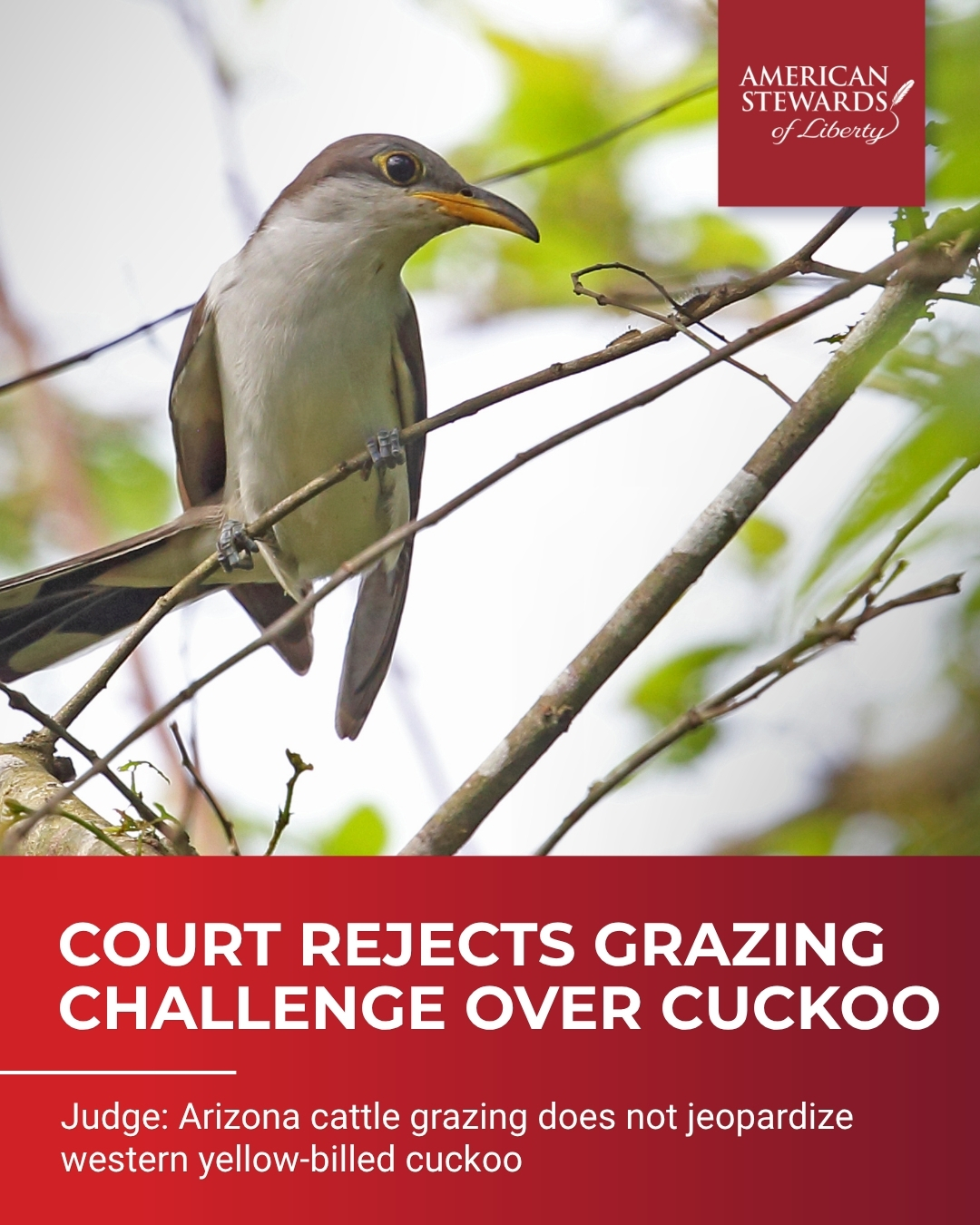
Judge: Arizona cattle grazing does not jeopardize western yellow-billed cuckoo
A federal judge has rejected a major challenge to continued livestock grazing across nearly 1.5 million acres of Arizona’s Coronado National Forest, upholding the Fish and Wildlife Service’s conclusion that grazing would not jeopardize the threatened western yellow-billed cuckoo.
The decision against the Center for Biological Diversity (CBD) reinforced American Stewards of Liberty’s (ASL) past efforts to delist the bird, in part by echoing arguments ASL and its coalition partners have made since petitioning to delist the bird in 2017.
In her decision, judge Angela Martinez cited the U.S. Fish & Wildlife Service’s (FWS) description of the cuckoo as “relatively widespread and somewhat plastic” in its habitat selection, recalling ASL’s previous arguments that the government had underestimated the western yellow-billed cuckoo’s amount of suitable habitat.
The August 18 decision in Center for Biological Diversity v. Moore arose from a challenge by CBD and Maricopa Audubon Society to the Forest Service’s ongoing livestock grazing program in the Coronado National Forest. The grazing program encompasses 177 grazing allotments covering 1,466,424 acres.
This lawsuit’s journey dates back to a 2019 Forest Service biological assessment that grazing was “likely to adversely affect” eight federally listed species, including the Sonora chub, Chiricahua leopard frog, and the western yellow-billed cuckoo. That finding prompted formal consultation with the FWS.
After a two-year consultation, however, FWS issued a biological opinion (BiOp), in which it concluded that the grazing program did not either jeopardize the continued existence of the species at issue or adversely modify their critical habitat. For the cuckoo specifically, FWS said it did not expect grazing to result in incidental take of the bird.
CBD and Maricopa Audubon subsequently challenged that opinion under the Endangered Species Act and Administrative Procedure Act, while the Southern Arizona Cattlemen’s Protective Association intervened to defend the agencies and represent its members’ interests in the grazing program.
In the lawsuit, CBD attacked the cuckoo determination mostly on two fronts. It argued that FWS had inadequately considered the effect of grazing on the bird’s recovery and that the agency had failed to use the best available science concerning climate change. Judge Angela Martinez rejected both arguments.
“Plaintiffs assert the BiOp is impermissibly ‘backward-looking’ because it unduly emphasizes the species’ historical ‘persistence,’” Martinez wrote in the August 18 decision. “Defendants acknowledge the recovery-requirement but argue the BiOp appropriately considers the species’ recovery and therefore its analysis is entitled to deference.”
Martinez agreed, finding that the FWS’s no-jeopardy findings adequately considered the grazing program’s effects on the recovery of the chub, frog, and cuckoo, and on their critical habitats.
“For example, the BiOp explains that although the cuckoo’s ‘tipping point’ is difficult to ‘definitively determine’ without a recovery plan, the grazing program is unlikely to reduce the cuckoo’s potential for recovery because the cuckoo is ‘relatively widespread and somewhat plastic (in terms of habitat selection)’ and grazing appears not to be measurably influencing the species’ distribution or abundance,” she wrote.
Likewise, Martinez continued, the biological opinion found that the grazing program’s effects on the frog and its critical habitat would not move the species past a ‘tipping point’ based on its assessment of the program’s effects and the recovery criteria.
“Also, regarding the chub, the BiOp finds that the grazing program will not ‘preclude [the chub’s] recovery tasks’ or ‘appreciably reduce’ the ability of the chub’s critical habitat to support its recovery,” she wrote. “FWS’s findings are adequately supported by evidence and entitled to deference.”
Next, Martinez continued, CBD argued that FWS’s no-jeopardy findings failed to rely on the “best available science” and disregarded “countervailing conclusions” about climate change’s effects on the species, and that the group cited a 2019 Supplement to the chub’s 1992 Recovery Plan and a Biological Opinion in another case, Rosemont Copper Mine.
“They assert the BiOp’s jeopardy analysis is arbitrary and capricious because its findings ‘fail to confront—or outright ignore—warnings from FWS’s own resource experts about the capacity of these species to withstand foreseeable, rapidly worsening climate conditions,’” she wrote.
That argument was problematic on several fronts, Martinez determined.
“First, to the extent the BiOp does not cite the 2019 Supplement or the Rosemont BiOp, such studies are not binding on FWS,” she wrote. “Further, FWS is entitled to weigh evidence based on its expertise. Moreover, while plaintiffs discuss at length the 2019 Supplement and Rosemont BiOp, they fail to identify any specific climate change evidence therein that would change the BiOp’s no-jeopardy analysis.”
For example, Martinez continued, neither the 2019 Supplement nor the Rosemont BiOp provided evidence about climate change that was “reasonably certain” to be intertwined with the grazing program’s effects.
Martinez cited case law holding that “an effect is reasonably certain to occur if its occurrence is based on ‘clear and substantial information,’ not ‘speculation or conjecture.’” CBD’s evidence failed to meet that standard, Martinez concluded.
“The record reflects that both the 2019 Supplement and the 2021 BiOp rely in large part on the same study (i.e., the 2013 5-year Review), and their climate change analyses are largely consistent,” she wrote. “In the 2019 Supplement, FWS acknowledges that ‘[c]limate change represents the most serious, and to date unmitigated threat (and mechanism of habitat degradation) to [the] chub.’”
However, Martinez pointed out, the supplement concluded that because the 1992 Recovery Plan’s objectives were not fully implemented, it lacked data on the chub’s biology and habitat, “render[ing] it not practicable to develop objective, quantifiable Recovery Criteria at this time.”
“Consistent with that evaluation, the BiOp also finds that climate change is a threat to the chub but determines that more data is necessary to know how it will specifically affect the species or its habitat,” Martinez wrote. “Likewise, although the Rosemont BiOp anticipates ‘that climate change will degrade [the cuckoo’s] habitat to the point of being incapable of supporting’ the species, plaintiffs fail to identify specific climate data showing how such degradation is likely to occur.”
Whatever broader threats the western cuckoo faces, the government concluded that cattle grazing across the Coronado was not jeopardizing the bird, and the court found the record sufficient to sustain that conclusion.
The decision was not a complete defeat for CBD. Martinez sided with the environmental groups over protections for two species on incidental take: the Sonora chub and the Chiricahua leopard frog. Martinez found that the habitat-based standards used as surrogates for actual take were too vague to determine unacceptable levels of incidental take. The court noted that all chub within 1.2 stream miles potentially could be taken as a result of grazing without triggering renewed consultation, concluding that the standards were arbitrary and capricious.
Martinez likewise found the Chiricahua leopard frog’s incidental-take standard inadequate because it did not specify which agency would determine whether habitat effects were attributable to livestock grazing, what metrics would be used to measure causation, or how much causation would be required to require renewed consultation.
The court thus granted CBD summary judgment on the incidental-take provisions for those two species but denied the remainder of its motion, while otherwise granting summary judgment to the federal defendants and the intervening Southern Arizona Cattlemen’s Protective Association.
The court directed the parties to brief the appropriate remedy on those two issues alone.
A Familiar Argument About the Cuckoo
While the judge’s decision does not include delisting, it does underline the argument ASL has made in its past efforts to delist the bird. ASL was among a coalition of ranching, industry, and local government interests that petitioned the FWS in 2017 to remove the western distinct population segment of the yellow-billed cuckoo (YBCU) from the endangered species list.
In addition to ASL, petitioners included the National Cattlemen’s Beef Association, Public Lands Council, Arizona Cattlemen’s Association, Arizona Mining Association, two Arizona natural resource conservation districts, WestLand Resources, and Arizona rancher Jim Chilton.
The FWS subsequently issued a positive 90-day finding and undertook a status review, ultimately finding in 2020 that delisting was not warranted.
Still, the petition challenged the validity of treating western cuckoos as a distinct population segment (DPS) in the first place, pointing to genetic and morphological evidence that petitioners said failed to establish the required biological distinction between eastern and western birds.
“The YBCU is a neotropical migrant bird that winters in South America and breeds in North America during the summer,” ASL reported. “When the YBCU migrates north in the summer months, it splits into two groups—one to the west of the Rocky Mountains and one to the east. It’s the group that flies west the Service erroneously determined was a ‘distinct population segment,’ giving it the ability to make a ‘threatened’ determination.”
According to the Service, ALS asserted, the western DPS could be found in 12 western states.
The petition included new genetic and morphological data as well as new analyses of older data supporting the conclusion that the western segment of the YBCU was not a discrete and significant population segment that met the requirements for listing under the Endangered Species Act (ESA), ASL reported.
“The Obama administration’s analysis of the genetic and habitat data was believed to be in error at the time of listing,” Margaret Byfield, executive director of ASL, said at the time. “However, the new data we have today leaves no doubt that the listing decision needs to be corrected.”
That conclusion is just as pertinent today, and so is the petitioners’ finding that subsequent research had undermined one of the ecological premises of the original listing. The 2014 listing emphasized the cuckoo’s dependence on expansive riparian vegetation along major river systems and the loss of that habitat as a threat to the bird. However, later surveys documented cuckoos breeding in smaller, drier, and more sparsely vegetated drainages, including habitat that FWS subsequently incorporated into its broader understanding of southwestern cuckoo habitat.
The petitioners contended that the discovery showed suitable habitat was substantially more widespread and varied than FWS understood when it listed the western population.
That makes the language underlying Martinez’s 2026 decision particularly relevant. Years after ASL and its coalition allies argued that federal officials had underestimated the amount and variety of suitable cuckoo habitat, FWS itself defended its no-jeopardy determination by describing the bird as “relatively widespread and somewhat plastic” in its habitat selection.
Martinez concluded that FWS’s findings were adequately supported by the evidence and entitled to deference.
Those findings should be especially encouraging not just for ASL and its coalition partners, but for people such as Jim Chilton, a southern Arizona cattleman and one of the ranchers who joined ASL and other organizations in the 2017 petition to delist the western cuckoo.
For Chilton, the battle predates even the cuckoo listing. He previously sued the Center for Biological Diversity for defamation over its portrayal of grazing conditions on his 21,500-acre federal grazing allotment and won a $600,000 judgment. An Arizona appeals court upheld that judgment in 2006.
Two decades after that courtroom battle, Chilton remains in the middle of many of the same disputes—over grazing, endangered species, and who ultimately determines how the West’s federal lands are managed.