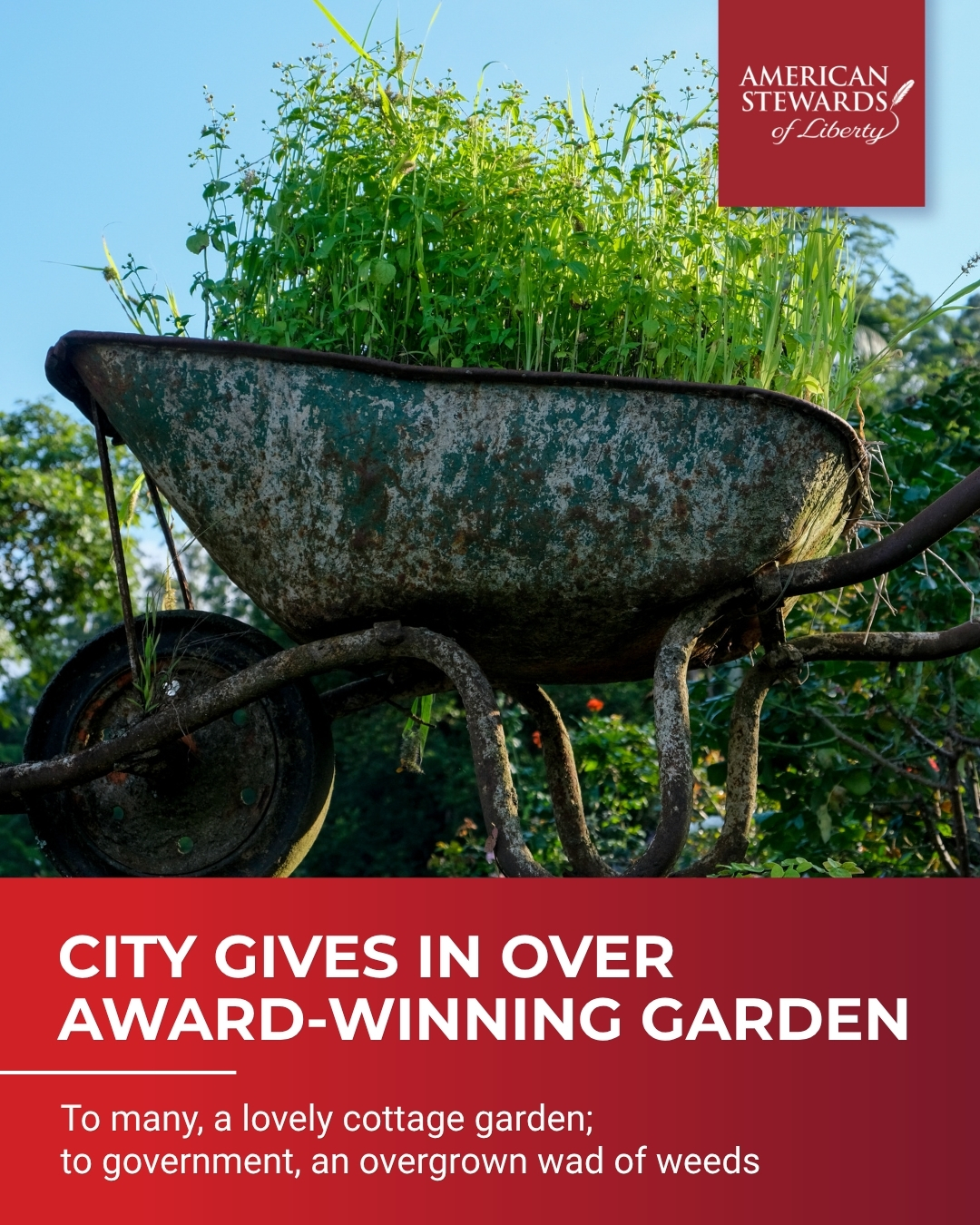
To many, a lovely cottage garden; to government, an overgrown wad of weeds
Local gardeners Jeremy Boggess and Kristi Church won a huge victory last week in the city of Danville, Illinois, with the city deciding not to pursue an enforcement action against—of all things—their award-winning garden.
In the government’s eyes, the garden, which just two years ago won an Old Town Preservation Legacy award, was suddenly preserving a bit too much. This year, Danville cited Boggess and Church under an ordinance aimed at overgrown vegetation and threatened that, if they did not remove their plantings, the town would come onto the property, raze the garden, and send them the bill.
Unfortunately for the city, its ordinance runs afoul of state law, in particular Illinois’s 2021 Garden Act, which guarantees that any person may cultivate vegetable gardens on their own property and which prohibits municipalities from enacting rules that specifically regulate them. After they were cited, Boggess and Church reached out to the Institute of Justice (IJ), which in turn warned the county of its own precarious position, and now the city has backed down.
For now, the tomatoes and the blueberries, the cucumbers and peppers are safe.
To many, the fight might seem minor or inconsequential—what with data centers, transmission lines, eminent domain skirmishes, and attempts to use direct democracy as an excuse to take people’s property—but it is anything but. For what Church and Boggess were defending was way more than a garden. It was an important constitutional principle, namely, that government cannot deny a property owner the reasonable use of his or her property simply because the government doesn’t like that use.
If a government can weed-whack a small garden merely because it offends its aesthetic sensibilities, what can’t it weed-whack, or bulldoze, legally and literally?
To be sure, Boggess and Church were ecstatic after the city conceded their compliance in a public hearing.
“We never thought we’d have to fight code enforcement to keep an award-winning garden,” Boggess said. “Now we can finally focus on our end-of-season cleanup and planning for next year.”
IJ Litigation Fellow Ben Marsh said the law could not have been clearer.
“People have the right to grow food and pollinator plants on their own property,” Marsh said. “We’re glad the town reached the only reasonable conclusion in this case, and we hope other Illinois municipalities take note before sending out their next notice.”
The Background
According to IJ, over the course of a few years, Jeremy Boggess and Kristi Church had transformed a difficult patch of property in Danville into a working cottage garden filled with vegetables, fruits, flowers, and pollinator plants. The garden’s essential purpose was to feed neighbors and provide habitat for pollinators, and Boggess and Church designed it in part to recreate the sort of cottage gardens historically associated with the neighborhood.
Then Danville suddenly decided it was no longer going to be a sanctuary city for award-winning gardens. If this were anybody but government officials, such a command would seem absurd, given that the city was threatening to destroy the same garden the community had honored two years earlier, and apparently still adored.
Then, too, the garden transcended aesthetics.
“The garden is designed to give something back to a neighborhood that needs it,” IJ said in describing the case. “Danville is a high-poverty community, and Kristi’s property sits in a light-industrial pocket a half-block from a Salvation Army. Watching pedestrians walk past on their way to get food, Jeremy and Kristi planted a ‘snacking sidewalk’—strawberries, blueberries, and grapes that anyone is free to pick. Neighbors have thanked them for the fruit, and especially for the mustard and collard greens.”
It was also not merely a hobby garden. For Boggess, whom IJ says has suffered two traumatic brain injuries from rear-end collisions and has cerebral palsy, gardening provides physical activity and relief from migraines. According to IJ, no neighbors had complained about the property.
“We forget how much nature contributes to our physical and mental health until it isn’t there,” Boggess said. “We’re on a busy road with trains nearby, but the sound of crickets and cicadas and toads makes everything feel calm.”
Not least, the back of the property is an ongoing native reforestation project, with hundreds of native plantings tended weekly to pull invasive species, clear blown-in litter, and cut back overgrowth, IJ reports.
Danville Didn’t Get the Memo
There was an immediate problem with Danville’s enforcement threat: Illinois lawmakers had already told municipalities they could not do that.
The state enacted its Vegetable Garden Protection Act in 2021. The statutory definition is broad, encompassing not merely vegetables but herbs, fruits, flowers, pollinator plants, leafy greens, and other edible plants, IJ states. And while the law still permits generally applicable local regulations, municipalities cannot specifically regulate vegetable gardens.
In a September 21 letter to Danville officials, IJ argued that the city was trying to enforce its weed and nuisance-vegetation ordinance against plants the Garden Act specifically protects.
“The Act provides any person a statutory right to ‘cultivate vegetable gardens on their own property,’” Marsh wrote in the letter. “It prohibits any regulation or local ordinance that purports to ‘specifically regulate vegetable gardens.’ However, the Danville Code of Ordinances defines ‘weeds and nuisance vegetation’ to include ‘weeds or tall grass exceeding an average of height of 6 inches,’ which the code then prohibits.”
Because the city’s threatened action against Church under those sections appeared to include “flowers” and “pollinator plants”—the very same plants that are explicitly protected—the threatened action violated the plain language of the Act, Marsh wrote.
The statutory violation was the easiest argument, but IJ’s September 21 letter made a broader case, and one that is more important for property rights. Enforcement against the garden potentially implicated both the Illinois and the United States Constitutions, Marsh argued.
“Second, to the extent that the city’s application of [the ordinance] includes any of Ms. Church’s strawberry, blueberry, grape, tomato, cucumber, pepper, broccoli, onion, brussels sprouts, or other fruit, vegetable, or leafy green plants, such application would not only violate the Garden Act, but it would also violate Ms. Church’s federal and state constitutional guarantees of substantive due process and equal protection to grow food on her own land,” the letter stated.
What’s more, Marsh wrote, enforcement of the ordinance against Church could constitute a taking under the Fifth and Fourteenth Amendments to the federal Constitution and Article I, § 15 of the Illinois Constitution.
“The Supreme Court of Illinois ‘has defined a taking as a physical invasion of private property or the radical interference with a private property owner’s use and enjoyment of the property,’” he wrote. “Thus, the city’s destruction of Ms. Church’s garden for the purported purpose of enforcing its constitutionally and statutorily defective weed ordinance would likely constitute a taking without just compensation.”
The latter claims are what turn an apparently quirky fight over a residential garden into a significant property-rights dispute. If ownership means anything, it must encompass the ability of the owner to make ordinary, harmless, and lawful use of that land without obtaining the government’s permission. And growing food in a vegetable garden in a neighborhood historically known for them is about as ordinary and harmless a use of land as can be imagined.
Illinois has chosen to protect that use explicitly by statute, but IJ correctly argues that government’s power over private property has constitutional limits even apart from the statute.
The principle matters precisely because the dispute appears small, but in reality is not. Here, Danville had threatened more than a fine to dress the property in a government-appropriate outfit. The city warned that its agents could simply enter Church’s private property, destroy the plantings, and then bill the owners for the destruction.
Once upon a time, people would be tempted to call that plundering and pillaging.
Sadly, constitutional protections are easiest to knock down when the immediate controversy seems too insignificant to justify a stand. But allow government to trivialize those boundaries in localized cases and the precedent for dismissing them as unimportant in consequential ones has already been established.
Even more than precedent, the ongoing trampling of rights in everyday situations conditions the public to surrender them without resistance if allowed to occur routinely.
The question raised in Danville, therefore, is not ultimately whether officials like the appearance of Church’s garden. It is where government’s regulatory authority ends, and the owner’s constitutional rights begin.
Danville was not even IJ’s first Illinois garden dispute this year.
Earlier in 2026, IJ says it sent a nearly identical warning to officials in Millstadt after they threatened to bulldoze the garden of botany instructor Laura Schaefer. Millstadt also abandoned its enforcement action.
The issue extends beyond Illinois. IJ previously reported representing homeowners Hermine Ricketts and Tom Carroll after Miami Shores, Florida, prohibited their front-yard vegetable garden. That fight helped lead to statewide legislation in Florida protecting residential property owners’ right to grow food. IJ subsequently developed model legislation that was used in Illinois and in a similar law in Arkansas.
Danville’s retreat saved one more garden, but local governments have enacted increasingly explicit and onerous regulatory codes that govern what owners may do with their property. Most disputes never become constitutional test cases because governments retreat, or the financial stakes are too small to justify litigation, or, worst of all, property owners simply comply.
But the size of the garden does not determine the size of the principle.
If the right to private property protects anything, the ability to grow food on your own land is a pretty good place to start the list.