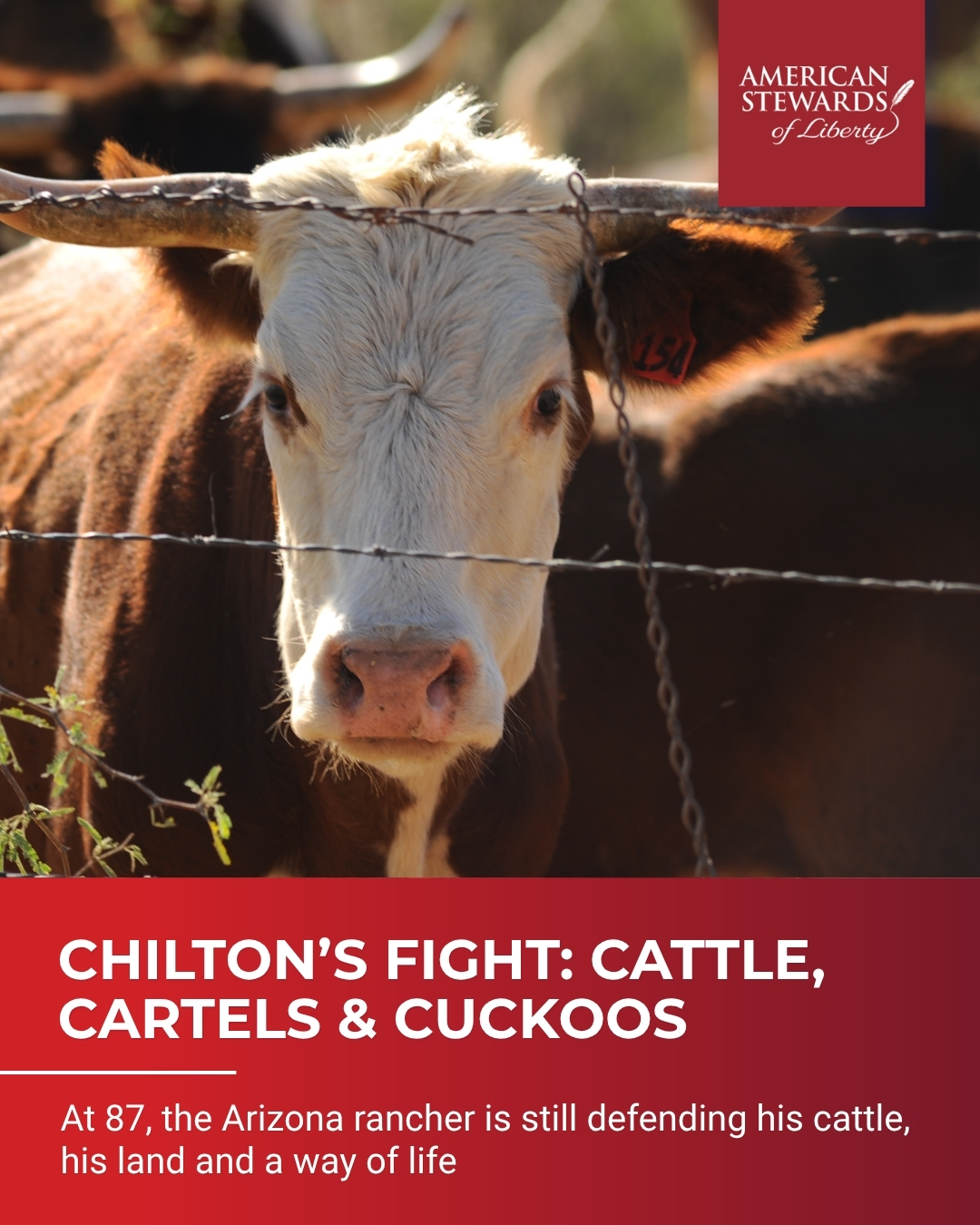
At 87, the Arizona rancher is still defending his cattle, his land and a way of life
For nearly four decades, Jim Chilton has run cattle on a sprawling southern Arizona ranch reaching to the Mexican border.
To say it’s been quite a ride is an understatement, and it’s not over. At 87, the fifth-generation rancher has battled cartels at the border and environmental groups in court, and he’s just scored a major victory in his years-long quest to delist the western yellow-billed cuckoo.
The challenges have been diverse, but a common thread has run through them all—the land itself, and Chilton’s determination to remain and thrive upon it.
Along the way, his battles with the radical Center for Biological Diversity (CBD), going back more than two decades, have become the stuff of legend. When CBD portrayed him as an irresponsible rancher who destroyed public lands, Chilton stood up against the maliciously false charges in court and won a $600,000 defamation judgment.
When grazing opponents later tried to use the Endangered Species Act (ESA) and the western yellow-billed cuckoo to defeat him, Chilton fought back again in the only way he says he knew how, and that was to turn to the scientific gold standard of testable evidence: He assembled an insurmountable case to defeat scientific imposture and defend grazing across more than 100 ranches.
Most recently, Chilton prevailed in another major round when, in August, a federal court rejected CBD’s challenge to federal findings allowing continued grazing in the Coronado National Forest, including findings that grazing conducted in accordance with Forest Service standards would not adversely affect the western yellow-billed cuckoo. Chilton has now followed that victory with a new request to the Trump administration to finish the job by delisting the bird altogether.
His is an inspiring story spanning generations, administrations, lawsuits, endangered species, drug smugglers—not to mention quite a few cattle.
The cattle, not least. Chilton comes from an Arizona ranching family whose roots in the state carry back to the 19th century.
“I’m a fifth-generation Arizona rancher,” Chilton told Liberty Matters last week. “Our ancestors moved from Texas in 1885 to Arizona and were early ranchers here in Arizona. I run about 450 head of mother cows and bulls. I’ve downsized, though. I was around a thousand until last year.”
Chilton’s family arrived from England in the 1650s, he says, and generation by generation the family migrated westward. The family drove cattle from Texas into Arizona in 1885, and Chilton himself grew up on farms and ranches, earned masters’ degrees from Arizona State University, and eventually returned to the life that had shaped his family for generations.
He, his father, and his brother established Chilton Ranch & Cattle Company in 1979, north of the present ranch. Unable to expand there, in 1987 Jim and his wife, Sue, bought a large 50,000-acre ranch just south of Arivaca.
Chilton points out that the cattle have been on the land for about 300 years.
“The interesting thing is, the ranch was essentially established back about 1690, when Father [Eusebio Francisco] Kino came and found the Indians here at Arivaca and gave them cattle and established a little visita for worship,” he said. “And the Spaniards caused cattle grazing to be established on a major scale. The Mexicans then, after Spain was removed in their revolutionary war, continued. They continued the land grants from the King of Spain, and they ran about the same number of cattle that we run now.”
Chilton is proud of his ranch, not just his heritage but its status today.
“So it’s a good ranch in the sense that I have 32 species of grasses,” he said. “All but four of them are native. They’re generally all perennials, meaning that they have long lives of 10, 20, 30 years, and they evolved along with grazing over the centuries. Bottom line, they’re very nutritious, even when they turn yellow in the fall, and maintain their nutritional value.”
Chilton said that the ranch grass is good right now: “So we’re about 3,700 feet in elevation, and we’ve got grass standing right now about 12 to 18 inches green, and our cows are smiling. Happy cows. They’re happier than Carnation’s cows.”
But Chilton’s ranch has one geographical characteristic that makes running cattle there vastly different from almost anywhere else in America: It sits on the southern border. And, he says, that’s one experience that has changed dramatically over the years. For starters, Chilton said, when he first bought the ranch, illegal border traffic was not a major concern.
“It was just kind of a normal thing,” he said. “And then in the mid-1990s, after the passage of NAFTA (the North American Free Trade Agreement), people started moving out of Mexico into the United States, and we had lots of people coming through the ranch, just good people looking for a new life and jobs.”
That all changed with the Great Recession of 2008-09, Chilton says.
“We then noted that the cartel, the Sinaloa Cartel, took over all the trails coming into the United States,” he said. “At that time, the boundary was marked only by a four-strand barbed wire fence, so it was very easy to climb over, climb through, or climb under.”
Then it became more of a drug route, Chilton says.
“I have five motion-activated cameras on the ranch, one camera for every 10,000 acres,” he said. “During the Biden administration, my cameras picked up about a thousand people a year in carpet shoes, camouflage, and similar backpacks. The Border Patrol intelligence officers have told me about 20 percent were packing hard drugs.”
Now, with Donald Trump as President, Chilton says things have dramatically changed once more: “When President Trump took over in the first year, there were 19, and I’m pretty confident that the Border Patrol apprehended most of them. We know that at least four of them that were apprehended were carrying hard drugs.”
Before the current administration’s border policies, Chilton said, there were armed groups, rival gangs attempting to intercept drug smugglers, and literal gunfights on the property. That’s no more.
“We’re no longer as fearful of running into groups with AK-47s and trying to sneak into the country,” he says. “And so I’m not as worried about my cowboys or myself being caught in the middle of a situation. So things are a lot better.”
Chilton recalled that, during his first term, when Trump was building a border wall, they were putting up a mile a week. But that all ended, he says, when Joe Biden became president in January 2021. And actually, Chilton says, the wall ended on his property.
“And when Biden took office on January 20th of 2021, the construction was stopped immediately,” he says. “So the end of the wall was on our ranch. In 2024, 20,000 people came around the end of the wall and were met by the Samaritans and the Humane Borders people that had tended the end of the wall and gave them water, food, medical attention, porta potties, but most importantly, wifi.”
Three times a day, Chilton said, the border patrol would drive from Tucson and pick up people.
“They all got in lines kind of like you saw in Texas,” he said. “They were processed for about a day, and then they were turned over to nonprofit corporations funded by the federal government and local governments where they had hotels rented, and then everybody was given an airplane ticket to go anywhere in the U.S. they wanted.”
So two groups of people came through the border over time, Chilton said—20,000 in street clothes, and a thousand per year in camouflage, carpet shoes, packing drugs, coming through the ranch, avoiding the border patrol at all costs.
His darkest recollection is of three people who died on the ranch in 2024—two, he says, from dehydration and one apparently murdered: “He evidently did something the cartel didn’t like.”
Chilton says that these days, compared to the Biden years, are like night and day: “I’m so happy my socks are rolling up and down.”
The Times They Are a-Changing
The border, however, isn’t the only place where Chilton believes outsiders have threatened his ability to continue ranching. His other long-running adversary has been the Center for Biological Diversity (CBD), a radical environmental organization that Chilton says seems to have made it a mission to destroy his ranch. Chilton says the group began targeting his grazing operation decades ago, using the Endangered Species Act and claims of overgrazing to challenge his federal grazing permit.
“Well, they seemed to have wanted to take me out in the sense that we have a witness who indicated that a Forest Service fish biologist and a U.S. Fish and Wildlife fish biologist met in Tucson with one of the originators of the Center for Biological Diversity and plotted how to use the Endangered Species Act to take me out,” he said. “Why? My ranch ran from Arivaca to the border, and I am guessing—it’s my opinion—that they wanted to take the ranch out and then start working both east and west on other ranches to eliminate cattle grazing. So they concocted reasons why I should be eliminated.”
First, Chilton said, they used the Sonora chub as their excuse, a small fish about two inches long that Chilton says occasionally swims from Mexico up into the United States.
“And what I mean by occasionally on my ranch, once in 1994, once in 1997, and once in 2004,” he said. “They also were concerned about a bat, a lesser long-nosed bat. And as a consequence, they made a lot of false statements about the ranch. They made a lot of false statements about my wife who was then on the Arizona Game and Fish Commission, and they tried to prevent me from renewing my grazing rights, or, in other words, eliminating my grazing permit and essentially the ranch.”
His response was remarkably systematic: “The only way I knew of to battle them was to use science. They said that there was overgrazing, that my cattle were stepping on fish—have you ever tried to step on a fish?—and that the bats weren’t getting enough food.”
Chilton said he and his team argued that they had never seen a lesser long-nosed bat on the ranch—the only one known was about 40 miles to the east—and that the bat wasn’t really endangered or threatened anyway.
“And we got scientists to make statements to that effect,” he said. “But more importantly, we hired Dr. Jerry Holechek and Dr. Dee Galt to come out from New Mexico State University and evaluate the ranch,” he said. “They eventually visited us 11 times doing grazing use studies and found that on average, we were only using about 29 percent of the grass each year.”
Undeterred, Chilton says, the Forest Service then said riparian areas were unsatisfactory and so, to counter that, they hired Dr. William Fleming at the University of New Mexico.
“I wanted to go out of state to get more objective scientists,” he said. “He came and he did a riparian study, found that all of our riparian areas were in good to excellent condition. And he published a paper stating so.”
But of course that wasn’t the end of it: “So then the Forest Service said, ‘Your soils are unsatisfactory. 44 percent are unsatisfactory.’ So we hired Dr. Fleming to come out once again, and he and Dr. Galt, who is a soil scientist, found that the erosion taking place was far less than their models and math tables would indicate. The soils were then in excellent condition.”
That was not the end, either, Chilton says: “And then the Forest Service said, ‘We’ve got to do a grazing capacity study.’”
The interesting thing is, Chilton said, in their own grazing capacity study, the Forest Service had used Holechek’s grazing model.
“Now, Dr. Jerry Holechek is the lead author in the Range Science textbook everybody uses all across the world,” he said. “And the Forest Service said the grazing capacity was 251, and I was permitted for 500. So I called Dr. Holechek and said, ‘Dr. Holechek, [using] your model, they cut my permit in half,’ and he yells, ‘They did it wrong.’”
So, Galt and Holechek did a grazing capacity study using a thousand clippings on the grazing allotment and concluded that, far from being cut in half, the Chilton permit should be increased from 500 to 551, Chilton said.
“So then I went into the Forest Service, and I told the Forest Service district ranger, who was a good guy, and I said, ‘Look, you’ve got to decide who you’re going to be sued by,’” he said. “Either the Center for Biological Diversity’s going to sue you, or I’m going to sue you. … And if I sue you, I’ve got 11 grazing use studies, a riparian study, a soil study, and a grazing capacity study. Now, who do you want to be sued by?”
Unsurprisingly, the grazing permit was recommended for renewal, Chilton said, and the CBD appealed, though that was short-lived: “The Forest Service Albuquerque hearing officer backed the district ranger, and it was over. I won.”
But even then that wasn’t the end of things with the CBD, Chilton said. After his permit was renewed, CBD published a press release and photographs portraying Chilton as an irresponsible rancher whose cattle had damaged the land. Chilton sued, and, in 2005, a Pima County jury found CBD had acted with actual malice and awarded Chilton $100,000 in compensatory damages and $500,000 in punitive damages. The Arizona Court of Appeals upheld the verdict in 2006.
The court of appeals could not have been more unequivocal in upholding the defamation claim.
“We conclude the jury could have found actual malice by clear and convincing evidence based solely on photograph #18,” the decision stated. “This photograph, taken of private land, depicts Ruby Pasture and the caption reads, ‘California Gulch completely denuded of forage and severely compacted.’ The photograph shows two cows lying on a dry and barren field, which, viewed in the light most favorable to Chilton’s defamation claim, clearly suggests that Chilton’s cattle solely created the damage.”
But that wasn’t the case at all. Significantly, the court observed, the photographer testified that he had attended a May Day festival at that very location about a week-and-a-half to two weeks before he took the photograph.
“And a resident of the area testified that about five to six hundred people were at that festival, with people coming and going throughout the festival, some camping on the land, and that the festival had lasted at least three weeks,” the decision states. “Chilton also presented evidence that several hundred cars, all-terrain vehicles, and recreational vehicles had also used this location during the festival. Because photograph #18 insinuates that Chilton’s cows caused the damage, and because [the photographer] took photograph #18 after being present at the festival, a reasonable jury considering all the evidence could have found sufficient evidence of actual malice.”
And with that the appeals court upheld the jury’s verdict that CBD had acted with actual malice and defamed Chilton.
The Yellow-Billed Cuckoo
Not content to retreat, CBD next turned its attention to the western yellow-billed cuckoo. Specifically, Chilton believes CBD’s subsequent campaign involving the western yellow-billed cuckoo grew out of that earlier defeat.
“They wanted revenge, and so they developed all kinds of reasons, and one of their tactics was to get the yellow-billed cuckoo listed,” he said. “The U.S. Fish and Wildlife Service fought them essentially on the issue of whether it was really endangered. And so they finally concluded it was threatened.”
Chilton describes the yellow-billed cuckoo as a species that’s mainly in Mexico and comes into the United States—the East Coast, and west of the Rockies; its range takes in most of southern Arizona, Chilton explained. And he said CBD sued the U.S. Fish and Wildlife Service, claiming it hadn’t designated critical habitat.
“So Fish and Wildlife lost in court, and they had to declare critical habitat, and it was a little greenie who was responsible for determining critical habitat,” he said. “She declared over 300,000 acres in southern Arizona and a little bit in New Mexico as critical habitat for the yellow-billed cuckoo.”
For his ranch, Chilton said the habitat designation covered from the north end of the ranch to the border on the south, about 18 to 19 miles of critical habitat. At that point, Chilton explained, CBD gave the Forest Service a 60-day notice that they were going to sue on behalf of the yellow-billed cuckoo and the Sonora chub, and their complaint included the elimination of grazing in southern Arizona during a period where they were requiring the U.S. Fish and Wildlife Service to redo their biological opinion.
And so Chilton once again turned to science. In one study, he retained two people to walk from the border about 18 miles up California Gulch and down another canyon and identify trees that were less than 30 years of age.
“What CBD argued was that cattle grazing ate little trees and, if you get rid of cattle grazing, you’d have more trees and the yellow-billed cuckoo would have more nesting sites,” he said. “So anyway, we found that on our ranch, we’d grown over 2,700 trees in the so-called critical habitat area.”
Chilton says they conducted additional studies and reports, too, and the Forest Service began putting many of their findings in the record. After a two-year consultation, FWS issued a biological opinion (BiOp), in which it concluded that the grazing program did not either jeopardize the continued existence of the species or adversely modify its critical habitat. For the cuckoo specifically, FWS said it did not expect grazing to result in incidental take of the bird.
The CBD challenged the BiOp.
“But anyway, since we were able to put into the record all this good information, including the study on trees that I did, the judge then had another side of the story,” he said. “Then [attorney] Norm James went all through the briefing process, and they responded, and then we responded. And then the judge had an oral argument hearing, and the government showed up and tried to put on a good defense stating that the biological assessment of the Forest Service, the grazing program, was appropriate, legal, and followed all the rules and regulations, and that the U.S. Fish and Wildlife Service followed all the rules and regulations. And so the judge ultimately concluded that the biological opinion and biological assessment were valid. Huge victory.”
Judge Angela Martinez rejected CBD’s principal cuckoo arguments. Especially important for the long-running dispute, the government’s biological opinion described the cuckoo as “relatively widespread and somewhat plastic” in habitat selection and concluded that grazing did not appear to be measurably affecting its distribution or abundance within the Coronado National Forest.
For Chilton and the ranchers, the practical point was that grazing conducted within Forest Service standards could continue without being expected to result in incidental take of the bird.
As Chilton puts it: “So we won a big one right there. That was the main big win.”
It was a big win after a long fight. Chilton was among the ranchers who had joined American Stewards of Liberty and its coalition partners in a 2017 petition to delist the western cuckoo, and the court’s reasoning echoed arguments they have made for years about the bird’s habitat flexibility and the weakness of the assumptions underlying its regulatory treatment.
Winning the grazing case isn’t enough for Chilton. Next up is another attempt at delisting the cuckoo. On September 1, Chilton wrote to Interior secretary Doug Burgum, asking the administration to delist the western distinct population segment (DPS). Chilton specifically argues that, under the 1996 Distinct Population Segment policy, to be listed as a DPS, a group must be both discrete and significant, and the western grouping fails both tests.
“We request that the Department of the Interior, acting through the U.S. Fish and Wildlife Service, immediately initiate and complete delisting of the Western Distinct Population Segment of the yellow-billed cuckoo ….; withdraw the April 21, 2021 critical-habitat designation; and direct every federal land-management agency under Interior’s authority to categorically reverse livestock-grazing allotment restrictions imposed on the basis of that listing and of the now-rescinded regulatory definition of ‘harm,’” the letter states. “…. The 2017 petition to delist, republished in 2024 by American Stewards of Liberty, remains pending and should be granted without further delay.”
The DPS for the cuckoo was plucked out of thin air, Chilton says.
“A yellow-billed cuckoo is a yellow-billed cuckoo,” he wrote. “The Continental Divide–watershed–desert imaginary lines used in 2014 is an administrative construct, not a biological one. Error in the original classification is an independent and sufficient ground for delisting under 50 C.F.R. § 424.11(d)(3).”
After decades of litigation, Chilton does not believe the fights over western grazing are finished.
“I think they’ll continue coming at us,” he said. “They have a theology that says that cattle grazing is bad, not recognizing that cattle have been here for over 300 years. And they have an insane—it’s my opinion—an insane view of things.”
The cost of resisting those challenges has been substantial. Chilton observes that environmental litigation can require lawyers charging hundreds of dollars an hour, and that expense itself can wear ranchers down even when they ultimately prevail.
Still, if the environmentalists keep coming, Chilton says he’ll be right there fighting.
“I’m 87, and I’ve got 25 more years,” he said, and then he recalled one of his father’s favorite sayings: “I have no enemies. No enemies whatsoever.”
Adding, with a satisfied smile, that it is because he’s outlived them all.