
Coalition: Government’s own findings undermine legal basis for ESA protection
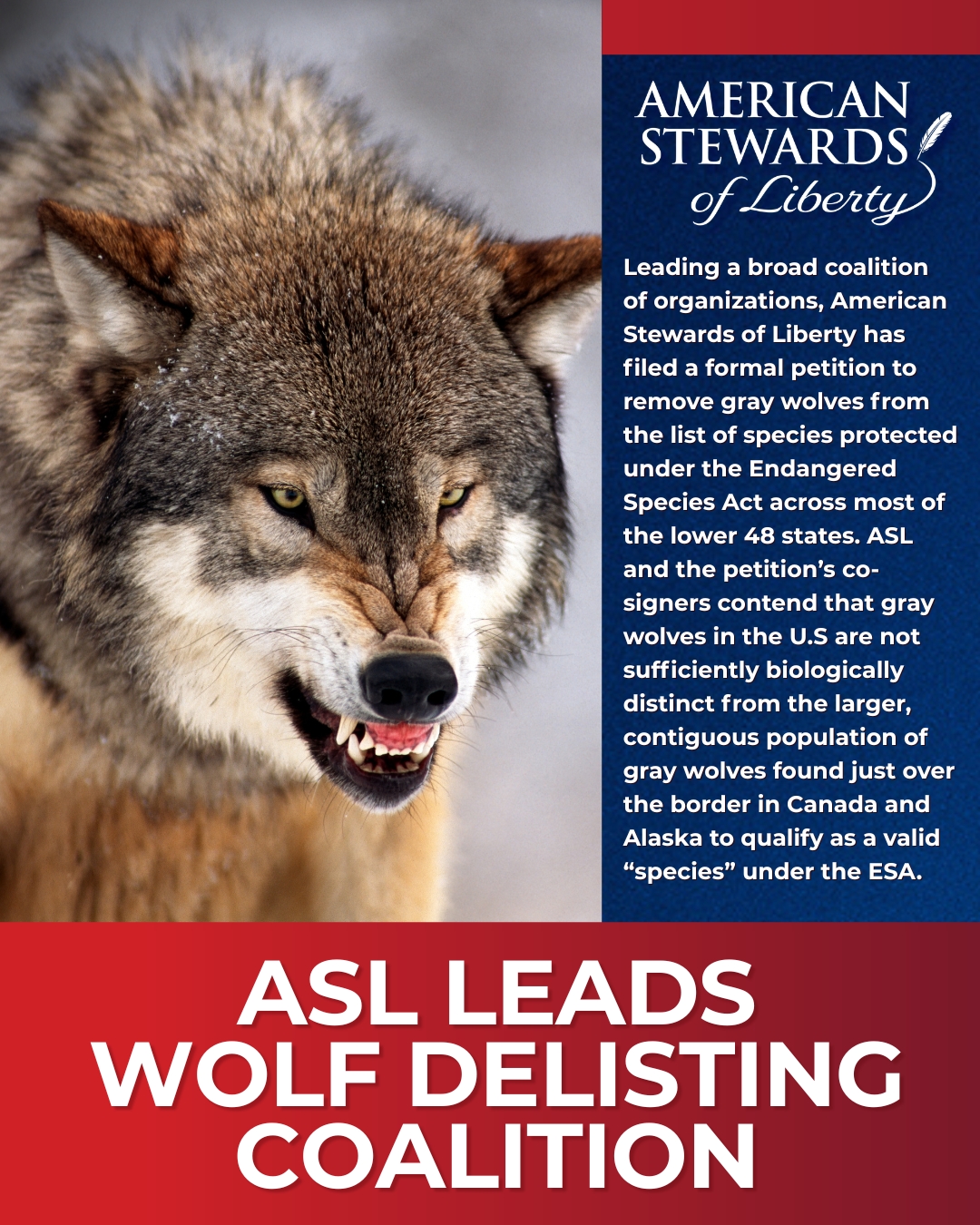
Leading a broad coalition of organizations, American Stewards of Liberty has filed a formal petition to remove gray wolves from the list of species protected under the Endangered Species Act across most of the lower 48 states.
Joined by local government, natural resource, forestry, conservation, and public-land organizations, American Stewards of Liberty (ASL) submitted the petition on August 21 with the U.S. Department of the Interior and U.S. Fish and Wildlife Service (FWS). Co-signers of the petition include the Kansas Natural Resource Coalition (KNRC), Great Lakes Timber Professionals Association (GLTPA), Committee for a Constructive Tomorrow (CFACT), BlueRibbon Coalition (BRC), and Ranchers Cattlemen Action Legal Fund United Stockgrowers of America (R-CALF USA).
Unlike previous delisting efforts that focused principally on the recovery of gray wolf populations, the petition’s co-signers contend that gray wolves in the U.S are not sufficiently biologically distinct from the larger, contiguous population of gray wolves found just over the border in Canada and Alaska to qualify as a valid “species” under the ESA.
Federal regulations require delisting when “the listed entity does not meet the definition of a species,” the petition asserts, emphasizing that such a foundational issue must be addressed before any continued listing can be justified.
Indeed, in its 2020 final delisting rule, the FWS concluded that the listed gray-wolf entities did not encompass an entire species or subspecies and found that they did not qualify as a distinct population segment. Though a federal district court later vacated that rule and reinstated federal protections, the FWS’s analysis holds, the petition asserts.
“The federal government should not keep an outdated listing in place when its own analyses show that the listed wolf groupings do not fit the Endangered Species Act’s current definition of a species,” Margaret Byfield, executive director of American Stewards of Liberty, said. “This petition asks the Service to follow the law, apply the best available science, and correct a listing structure that no longer matches biological reality.”
Specifically, the petition covers three groups of gray wolves that currently have ESA protection: Minnesota wolves, which are listed as threatened; gray wolves in all or parts of 43 other states, which are listed as endangered; and Colorado’s experimental population of gray wolves. It excludes the already-delisted Northern Rocky Mountain (NRM) population, as well as the separately listed Mexican wolf subspecies and red wolf.
The petition also argues that gray wolves have abundant habitat and prey, resilient and connected populations, face no significant threats from disease or current mortality levels, and can be sustainably managed by existing systems. Gray wolves are adaptable habitat generalists with stable or expanding populations and broad distribution in their principal U.S. ranges.
“Recovery is supposed to lead somewhere,” Byfield said. “When a species is secure, and federal protection is no longer legally or scientifically justified, management should return to the states and the people who live with the consequences. Stewardship of wildlife is most effective when it is rooted in local knowledge, on-the-ground responsibility, and accountable management. Keeping recovered wildlife under indefinite federal control is not conservation success—it is a failure to complete the work the ESA requires.”
Under the ESA, the petition asserts, the FWS is directed, to the maximum extent practicable, to make an initial finding within 90 days on whether a petition presents substantial scientific or commercial information indicating that the requested action may be warranted. A positive initial finding would initiate a fuller status review; it would not, by itself, delist the gray wolf, the groups say.
The present worldwide gray wolf population is estimated at between 200,000 and 250,000 animals.
“Because of its large population size and extensive range, the IUCN (International Union for the Conservation of Nature) classifies the gray wolf as a species of ‘Least Concern,’” the petition states. “The National Park Service estimates the current North American population of gray wolves at between 67,100 and 74,100 individuals, with between 53,600 and 57,600 of those animals in Canada.”
Not a species under the Act
According to the petition, when evaluating the conservation status of a listed or unlisted group of fish or wildlife, the threshold determination required of FWS is whether that biological group meets the definition of “species” in the ESA.
“This determination is ‘analytically distinct’ from and ‘not influenced by’ the subsequent decision regarding the species’ conservation status,” the petition states. “Only biological groups that satisfy the definition of ‘species’ may be designated as an ‘endangered species’ or a ‘threatened species.’ Thus, any petition that seeks to list, delist, or reclassify a species must contain ‘information sufficient to establish whether the subject entity is a ‘species’ as defined in the Act,’ as opposed to an arbitrary grouping of animals.”
With respect to the gray wolf, the petition continues, the continental United States population of gray wolves is part of a substantially larger circumpolar global population and is considered a common mammal throughout much of North America, Asia, and Europe.
“The population within the continental United States cannot properly be separated into one or more distinct population segments as there is significant cross-border interchange between gray wolves in the lower 48 states and the much larger Canadian gray wolf population, forming a single metapopulation,” the petition asserts. “Indeed, the gray wolf populations in the NRM and WGL (western Great Lakes) regions, as well as the Pacific Northwest, are the result of gray wolves naturally dispersing from Canada. In addition, gray wolves from Canada were imported into the NMR area in the 1990s to create experimental populations in central Idaho and the Yellowstone National Park area. Consequently, gray wolves in the continental United States are a very small and insignificant part of the much larger, contiguous population of gray wolves found in Canada and Alaska. They have no distinctive traits or important genetic variations that would support treating them as listable entities under the ESA.”
Accordingly, the petition observes, given population size and science, the FWS has attempted over the years to delist the gray wolf on multiple occasions, only to have those decisions vacated by reviewing courts.
“In 2020, FWS made another attempt to delist the gray wolf in the lower 48 states, issuing an extremely detailed final rule (the 2020 Delisting Rule) that removed the currently listed gray wolf entities from the list of endangered and threatened species,” the petition states. “Notably, FWS began its analysis by explaining that the gray wolf entities currently listed do not meet the ESA’s current definition of ‘species.’ FWS concluded that neither the population of wolves in Minnesota nor the wolves in all or portions of the remaining 44 states encompass an entire species or a subspecies of gray wolf.”
Consequently, FWS explained, those entities are eligible for listing only if they qualify as DPSs (distinct population segments) under the DPS policy’s criteria. However, the petition continues, the FWS explained that none of the entities are “discrete,” that is, markedly separated from other populations of the same taxon, and therefore did not qualify as a DPS.
“Because none of the listed groupings of gray wolves qualify as a DPS, FWS could have determined they are not a ‘species’ and should therefore be delisted,” the petition states. “However, FWS did not delist the gray wolf entities on that basis. Instead, FWS conducted a review of the entities’ status, including various configurations of gray wolves in the lower 48 states, and ultimately determined that none of them are in danger of extinction or likely to become extinct in the foreseeable future. FWS then concluded that gray wolves in the lower 48 states (with the exception of the separate Mexican wolf subspecies) have recovered and delisted them on that basis.”
A federal judge again vacated the rule and, after only brief consideration, rejected the FWS argument that the gray wolf entities did not meet the current definition of “species” under the ESA, the petition recounts. Environmental groups have further challenged the later FWS rulemaking, and FWS has reinstated the gray wolf’s previous listing status.
Nonetheless, the petition asserts, the FWS findings that the currently listed gray-wolf groupings do not meet the ESA’s definition of ‘species,’ comprising neither subspecies nor distinct population segments, are persuasive, and, without a valid species, no basis exists to list animals as either endangered or threatened.
“Put plainly, there is currently no valid scientific basis upon which to list gray wolves in the lower 48 states, a determination that carries with it significant economic consequences and should not be made lightly,” the petition concludes.
On that basis, the petition asserts, the FWS should make the requisite determination that delisting the gray wolf may be warranted, proceed to conduct a status review, and expeditiously publish proposed and final rules to remove it from the Endangered Species List.
Not even close
Joining in the announcement of the petition, CFACT president Craig Rucker said the gray wolf was not close to being endangered.
“It is a common, highly adaptable animal with a circumpolar population of 200,000 to 250,000 animals,” Rucker said. “North America alone holds tens of thousands of wolves, the overwhelming majority of them in Canada and Alaska. The relatively small numbers in the contiguous United States are simply the southern edge of that much larger, connected population. They are not a distinct species, subspecies, or valid distinct population segment under the Endangered Species Act.”
Rucker said delisting the gray wolf would return management to the states, where it belongs, and reduce needless conflicts with livestock producers, rural communities, and property owners, while still allowing genuine conservation of truly rare subspecies such as the Mexican wolf.
Great Lakes Timber Professionals Association executive director Henry Schienebeck said gray wolf populations have increased substantially in the areas of Michigan and Wisconsin where his group’s members work, live, and recreate, and that the growth was having real effects on wildlife management and recreational opportunities, including deer and bear hunting.
“Our members see these conditions firsthand in the forests every day,” Schienebeck said. “Wolf management should reflect current population conditions and allow wildlife professionals to balance healthy wolf populations with the needs of other wildlife and the people who depend on these forests. For these reasons, GLTPA wholeheartedly supports this effort to delist the gray wolf.”
Tracey Barton, executive director of the Kansas Natural Resource Coalition, said federal endangered species protections carry real consequences for local governments, landowners, and producers.
“Those protections should not continue when a species no longer meets the statutory standard for listing,” Barton said. “Delisting the gray wolf would return appropriate management authority to the states, reduce unnecessary federal regulatory burdens, and better protect livestock producers, rural communities, and private property owners. KNRC supports applying the Endangered Species Act as Congress intended—using sound science, recognizing successful recovery, and returning management to the states when federal protection is no longer warranted.”
BlueRibbon executive director Ben Burr said delisting would be consistent with FWS’s finding that wolves face no risk of extinction in the foreseeable future: “Endangered Species Act restrictions applied to a species that has recovered do little for the animal and constrain effective multiple-use management of natural resources by state and federal agencies,” he said.
Likewise, Ranchers Cattlemen Action Legal Fund United Stockgrowers of America (R-CALF USA), the largest trade association exclusively representing United States cattle and sheep farmers and ranchers, said gray wolf populations have encroached upon rangelands that historically sustained generational ranching operations and neighboring communities
“In many areas of the United States, these wolves are increasingly endangering livestock and threatening the livelihoods of all inhabitants,” Private Property Rights Committee chairman Shad Sullivan said. “State and local officials must be empowered to protect the property rights, freedoms, and liberties of area ranchers and neighboring community members by managing wolf populations in their localities, which can only occur upon the delisting of the gray wolf.”