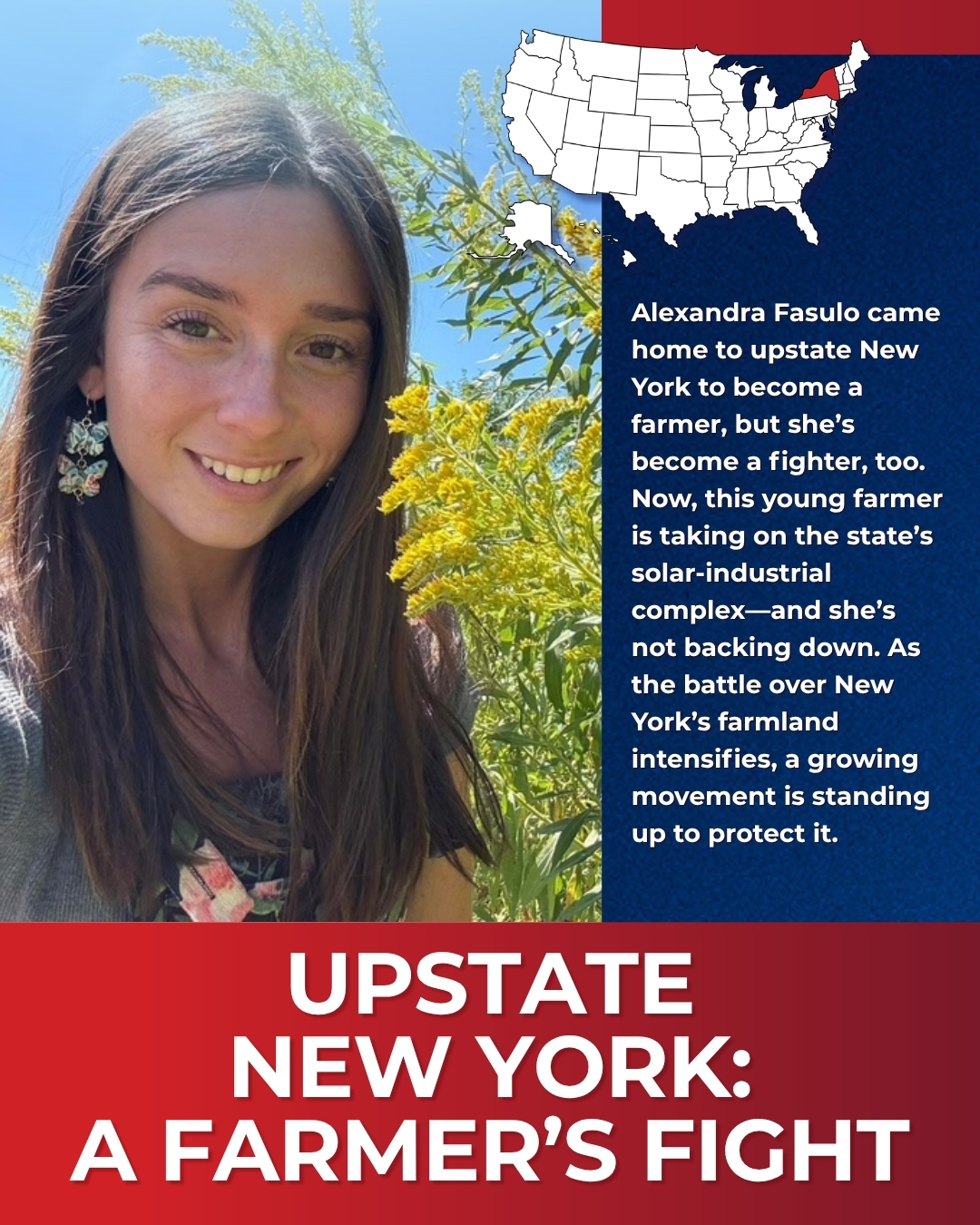
She came home to become a farmer. Now she’s a fighter, too.
Sit back and settle in, because this is a riveting, real-life story about who gets to decide what happens to rural land in modern America.
Our storyteller and participant is Alexandra Fasulo, an upstate New Yorker who spent most of her twenties running a freelance writing business and traveling. When Hurricane Ian destroyed her then-Florida home, she decided it was time to return to her rural roots and head home.
“I had not been liking Florida anyway, but that was so catastrophic,” she told Liberty Matters in a recent interview. “It gave me the perspective or courage to just say, ‘I don’t like it here. Go home.”
And to home she went, with plans to change her life after a successful career with her own freelance writing agency: “I pretty much sold the house and came back to upstate New York in 2023. And I was tired of the freelance writing stuff as well. I’d done it for eight, nine years. It paid amazingly, and I saved a lot. It taught me a lot of things about life and running businesses, but I had had enough. So I reset my life pretty dramatically and moved back upstate.”
What lay ahead for Fasulo was the pastoral acreage of the upstate and a newly blank page upon which to begin writing a new chapter of her life. That page didn’t stay blank for long. She bought land in Saratoga County and essentially decided to teach herself farming the same way she had taught herself business.
“I had taught myself how to run a business, so maybe I could teach myself how to farm,” she said. “I like to do stuff like that. So that was kind of the idea I had when I bought the 6.7 acres of farmland I now own.”
Fasulo busied her days teaching herself about farming, gardening, regenerative agriculture, pollinators, and more: “And I was into it. I was ready to start really learning all of this stuff.”
And that’s when, one day, Fasulo says, a man stopped at her farm. He proceeded to tell her something else she had not known about: solar companies and specifically their attempts to buy the hayfield across the road—the field the man was actively using to feed his horses.
“He was the first one to tell me that he would never sell,” she said. “And I was like, ‘What do you mean you’d never sell?’ And he was the first one to tell me what solar companies were doing to him, pretty much to get him to sell his very active hayfield that feeds the thoroughbreds. And we talked for a while, and there were a lot of red flags there for me—predator behavior, pressuring him, harassing him at his doorstep.”
So Fasulo said she posted online, simply asking if that issue was resonating with anyone else. Was it just a Saratoga County problem, she wondered? Was it just a New York problem? She wanted to know what was going on, and, Fasulo says, the post blew up, and from there the fight was on.
“I always share with people that I did not seek this out or intend to get into this,” she said. “But it is my fight to care about now. I was born and raised in upstate New York, outside of Albany. I am an upstater in my blood, which is why I care so much about the land here.”
And from that viral post, what Fasulo thought at first might be a Saratoga County problem suddenly looked to her like something happening across New York and well beyond. Within months she went from learning how to farm to learning about energy policy, electric grids, and New York state administrative law.
“Next thing you know, I’m giving a speech at my town board meeting against what’s going on,” she said. “And one thing led to another. My life took off on a side quest. I never in a gazillion years could have predicted it. I didn’t know anything about energy policy, the grid, none of it. All these things I know more than I ever planned to know about, and it all kind of began in October 2025.”
Now, only approaching a year later, the side quest Fasulo never intended to take, the fight she never intended to fight, has transformed her into one of the most persistent and effective grassroots opponents of New York’s renewable-energy siting regime.
Along the way, Fasulo has already formed a nonprofit. That idea came from her education in political science, where she says she gained an understanding about “problematic bureaucratic overreach,” namely, she understood that you have to consider your options realistically.
“So right away I identified suing is probably going to be a part of all of this,” she said. “If you sue, you need a lot of money. So, OK, where should we get the money? Oh, ‘I guess I’ll start a nonprofit because other people might also want to sue for their town.’ That definitely has been amazing as well.”
Ultimately, the battle Fasulo is helping to lead isn’t about solar energy. It is about whether Albany can transform enormous stretches of rural New York—farmland, wildlife habitat, entire communities—into vast industrial complexes after stripping the people who live there of the ability to say no.
ORES: The real villain
Fasulo says her true awakening came when she encountered the Office of Renewable Energy Siting, or ORES, which handles the siting of major renewable projects of 25 megawatts or larger.
In 2020, during the pandemic, the state legislature created ORES as part of the state budget, not through standalone legislation, and Fasulo sees that as emblematic of a larger problem: a consequential change in who controls land-use decisions that received little public attention.
“It wasn’t a good time—in the middle of a pandemic,” she said. “Most of the legislature was absent or unaware. Obviously, voters were not paying attention to what the Assembly members were doing because people were in the hospital on ventilators. And somewhere in the dead of the night between March 30th and April 2nd, the idea of ORES, the concept of it, was introduced and hidden inside of the budget bill.”
Such a significant alteration to energy siting should have been its own piece of legislation and debated on its own merits, Fasulo says.
“There were a few Assembly members at the time that are still in office now that knew this was a problem at 2 a.m.,” she said. “And I thanked them that they tried to stop it, but it doesn’t matter because our legislature’s so one-party rule. There was never a chance they were going to stop it, but they tried.”
The office subsequently became responsible for siting major solar and wind projects, including projects that local communities opposed, and that’s a key point Fasulo emphasizes repeatedly: ORES does not merely approve renewable projects; it can override local restrictions or prohibitions.
Indeed, ORES has extraordinary authority over local land-use decisions. State and local procedural permitting requirements are preempted, and ORES can waive local zoning and other requirements it finds “unreasonably burdensome” in light of the state’s climate targets. The RAPID Act has since expanded the centralized system to cover major electric-transmission projects as well.
All that is astonishing, Fasulo says, because the New York state constitution endows New Yorkers with strong home rule: “It basically says our townships and villages have the right to self-govern, we have the right to get together, to vote on things, and decide what is best for our townships.”
ORES’s authority contravenes those constitutional rights, Fasulo argues. It’s not an insignificant violation, she says, given local opposition to solar and other renewable projects. That opposition is intense, as she described a public hearing on the Fort Edward Solar project siting.
“We were in a church, hundreds of people coming out, and about 85 percent of the room was getting up and saying, ‘We don’t want this,’” she said. “And the 10 percent who did [want it] were, of course, the ones that already signed paperwork with the corporations and were going to earn millions of dollars. That’s their freedom to have done that, I suppose. My thing is with the home rule. If the mayor, if the town supervisors, if 85 percent of the people at the hearings who live in that town and who pay taxes in that town don’t want something, what home rule used to mean is that it wouldn’t pass because that’s the super majority of your town.”
But ORES supersedes the ability of New Yorkers to govern themselves, Fasulo says, likening the system to a “Frankenstein situation.”
“I realized that a few shadowy human beings in Albany get to just sit there and be on the phone with these foreign corporations,” she said. “They’re going to get to cut up our state at will. They’re going to get to do whatever they want. Nobody can stop them. We have no democratic way to stop this.”
For Fasulo, ORES converts what appears to be a renewable-energy dispute into a self-government dispute. People may own the land and towns may zone it, but the state has reserved the final decision for itself.
19,000 football fields
Not that Fasulo views what she is doing as an abstract jurisdictional fight. It’s one with immense real-world consequences, though she says the physical scale is sometimes difficult for people outside rural New York to comprehend. In one heavily targeted county, she says proposed projects could involve more than 19,000 acres of farmland.
“What’s hard about me trying to communicate this with people in urban areas or with city slickers is, they can’t conceive of that,” she said. “So I go, ‘Just close your eyes and try and imagine how big a football field is. It’s pretty big. If you sprint from one end to the other, you’re going to be out of breath. That’s just one acre.’ I go, ‘So just try and picture 18,000, 19,000 football fields.”
The ramifications of such a project are also almost equally incomprehensible, Fasulo laments.
“If there’s 19,000 acres of agrarian view sheds, farming, and history taken out, everyone’s property values go down because it’s one huge industrial hellscape,” she says. “Local businesses are going to suffer. Local tourism, agri-tourism, birdwatching, hiking. I always say to people, ‘You have to think about what this is going to do to a county when you take 19,000 acres out of commission from farming and what it does to the surrounding property values.”
Fasulo says ORES is churning out permit applications at a blistering pace.
“The scale of this is hundreds of thousands of acres,” she said. “Just one wind complex they’re trying to push through is 75,000 acres in its total footprint, including the access roads and the fencing. So we’re talking hundreds of thousands and pretty soon millions of acres across the state.”
For Fasulo, the industrial-scale development the state is imposing creates a cascade of destruction, from farmland, wildlife habitat, and view sheds to local businesses, agri-tourism, and even rural history and character.
“It’s the end for the county,” Fasulo says. “It’s the end of so much more.”
Prime suspicions
From money trails that disappear into the ether to bureaucratic re-imaginings of legal definitions, Fasulo says New York’s renewable-energy system has been structured to make large solar projects easier to build.
For instance, early on Fasulo began researching New York’s Mineral Soil Group classifications and found that the state’s method of evaluating farmland for renewable siting can treat land differently from the USDA prime-farmland system. Fasulo says the state classification system can cause farmland considered prime under federal standards to fall outside that standard in the state system, allowing developers to avoid mitigation costs.
Her reporting in this arena caught the attention of President Trump’s Special Envoy for American Landowners, John Rich, who, along with Environmental Protection Agency administrator Lee Zeldin and U.S. Department of Agriculture (USDA) secretary Brooke Rollins, sent a letter to New York Gov. Kathy Hochul raising many of the same questions Fasulo had been asking.
In the letter, the officials wrote that the USDA spent decades developing soil classifications that define prime farmland, and that the USDA Natural Resources Conservation Service was the world’s leading authority on soil science. What puzzled the officials was New York state’s apparent departure from those standards.
“The Mill Point Solar project in Glen, New York, illustrates the gap,” the letter stated. “In a recent third-party comparison, USDA’s classification system identified more than 82 percent of the affected land as prime farmland or its equivalent, while New York’s … system counted only 11 percent of that same land as prime. On some parcels where panels are proposed, USDA considers the acreage to be entirely prime farmland or its equivalent, while New York classifies less than 5 percent—or none—of it as prime.”
In rebuttal, the state says New York classifications actually protect more agricultural acreage than USDA’s generic classification. It says its prime farmland classification encompasses 5.7 million acres—more than one million acres above USDA-designated prime farmland—and denies that the system was altered to facilitate renewable development.
That may or not be true, but even if it is, it does not acquit the state on the community level. A classification system can encompass more productive acreage overall while still treating particular parcels and particular regions more leniently from the federal system. In other words, the statewide numbers can support New York’s claim that its system protects more acres overall while simultaneously stripping protections from significant acreage slated for solar development.
While the federal government and the state can debate that issue, the larger point is that, mitigation costs and reclassification aside, New York itself admits there’s a lot of solar development on prime farmland. According to the Department of Agriculture and Markets’ latest biennial report, during 2023-24 it reviewed 133 solar projects proposing to convert about 4,386 acres of Agricultural District land, with 43 percent of those projects sited on the very soils New York itself classifies as prime farmland, up from 38 percent from the previous biennium.
In other words, whether development costs are being reduced or not, enormous swaths of farmland are being lost to solar development, driven in part by robust state tax incentives that include sales tax exemptions on equipment, a 15-year real property tax exemption for the added value of the solar system, and megawatt-block cash incentives.
Fasulo says the state isn’t simply permitting a private market. In her view, government has simultaneously built an overreaching regulatory infrastructure for siting, superseded local authority, and financially encouraged the development. And, she argues, state energy subsidies mean taxpayers and utility customers help finance the renewable buildout many local communities oppose.
Finally, one of the lawsuits her nonprofit has pursued involves unfulfilled Freedom of Information requests because, Fasulo says, agencies have not provided the records she believes should be public.
The Solar Development Cometh
To Fasulo, one of the saddest byproducts of the solar saga in upstate New York is the street-level campaign that solar developers conduct door-to-door, like old-time snake-oil salesmen, offering lengthy contracts and immediate financial incentives to landowners to surrender their land.
New York says landowners participating in ORES projects do so voluntarily, and the state cites a 2026 Cornell study saying most farmers receiving solar-lease payments have used the income to continue or expand farming rather than leave agriculture.
But Fasulo counters that she has heard from countless lease-signers who have regretted signing on the dotted line, having succumbed to the siren song of the developers’ pitch, only to uncover poison pills in the fine print.
First, Fasulo says, the basic pitch is that development is inevitable—solar development is coming, whether you like it or not—so why not take the money?
“They have the best sleazy salesmen in the game,” she said. “It’s like the usual used-car salesman tactics where they come to your doorstep. That’s a big thing that they like to do. In a day and age when not many companies do that anymore, they physically come to your door.”
They already have the contract in the car, Fasulo says, and it’s 30 to 50 pages long.
“So you obviously cannot read and digest the contract in that moment,” she says. “It’s an impossibility. So they knock on the door, they tell you right away that your land would be perfect. We’re going to pay you all this money, and we’re going to pay you 10 times what you would get if you just sold the land.”
Then they start lying, Fasulo says, telling people their neighbors have already signed, so they might as well, too.
“What they then do is they show the initial sign-on bonus,” she said. “That day, if you sign on, someone told me it said $1,000. And what they do, they pull their pen out, and they click the pen, and they go, ‘If you sign on right now, I’m going to add a zero.’”
Voilà, Fasulo says, it’s $10,000.
“Now, unfortunately, especially in New York state, thanks to our governor and our one-party rule and our taxes, a lot of these people could use $10,000,” she says. “I’m not ever saying that’s crazy. Now to me, you are preying on downtrodden upstate New Yorkers. That’s where I get wildly angry. And these are contracts that an attorney should review because inside of them are the craziest clauses you’ve ever seen in your life, including a gag order for 30 to 50 years.”
Not on the spreadsheet
Sometimes individual stories become miniature versions of a larger story, snuggling as a perfect fit right down inside the bigger picture, like a Russian nesting doll of land grabs, democratic subterfuge, and environmental destruction in the name of the environment.
Fasulo points to the experience of upstate’s Holy Trinity Monastery as one of those nesting boxes. Fasulo visited after becoming acquainted with Father Nictarios Harding, a monk she met through Stop Energy Sprawl. The monastery, she says, has nesting eagles and is an extraordinary historic and religious site. A proposed wind complex, she says, would surround it on all four sides.
“They also have over 4,000 people buried there, and they said that every Russian Orthodox person in North America wants to be buried at the sacred monastery, so they have more people who want to be buried there than they can take in,” she said. “So their cemetery’s growing.”
Not only that, but the monastery has a landscape central to the monks’ worship.
“They have a hill they go on, and they have a cross at the top of it,” she says. “And a part of their peaceful existence and worship as Russian Orthodox monks is being able to face the eastward sun rising. It’s a part of their worship, and so they were explaining to me that these 600-foot wind turbines obviously would put a damper on that for them just to start, not to mention this is a place people make pilgrimages to.”
The same kind of disruption, Fasulo says, threatens Amish communities where residents rely on walking and horse-and-buggy transportation.
“You have the history, you have the historical markers, you have the ecological sensitivity, you have the endangered species, you have the right to freely practice your religion, and none of it is mattering,” she said.
To the rescue
Within months of entering this fight, Fasulo founded the American Land Rescue Fund. In its first year, she says the organization filed two lawsuits, purchased an environmental assessment, and funded another town’s lawsuit.
And the money, she emphasizes, isn’t coming from corporations.
“It’s just people,” she said. “It’s just people that are desperate to defend their towns and their lands and their animals.”
The lawsuits attack different pieces of the state machinery. Fasulo and the American Land Rescue Fund have participated in the Fort Edward ORES litigation, and in June 2026 the Fund and the town of Glen filed litigation challenging the implementation of the RAPID Act regulation.
One lawsuit challenges the state’s refusal to disclose records necessary for the public to understand the wildlife and habitat impacts of the proposed Fort Edward Solar project. The second seeks to nullify or set aside rulemaking actions that the Fund says violated the State Administrative Procedure Act and the State Environmental Quality Review Act by transferring permitting authority for major electric transmission facilities to ORES without following proper rulemaking procedures, including adequate public participation and judicial review.
Fasulo says she knows one lawsuit won’t dismantle the system: “We’re playing a long game here,” she says.
That long game includes building and working within a network of county planners, county executives, attorneys, and activists across New York. And social media—the thing that started with one post about the neighbor’s hayfield—has become the organizing infrastructure: “Since I look to social media as my main vehicle for this, my pages have kind of become a place where people can get together under them and whistleblow to me and get together with each other and form groups together. I’m texting more than I ever have in my life with people all the time.”
But Fasulo explicitly says she doesn’t want her work to become her movement.
“I do not have a monopoly, nor do I want to have a monopoly on this,” she said. “I would actually love to not. So I would say if you see something—whatever these companies are doing at your doorstep, what they’re doing at your land when they’re installing the panels, where they’re dumping the broken panels, take pictures and videos and post them. And if you don’t want to post it, send it to me, and I will post it. That’s our biggest chance here.”
In the end, Fasulo says, the fight is not so much about renewable energy as about self-governance.
“I and we want our home rule back,” she said. “And ORES must be dissolved. There is no path forward here where they exist. It cannot be. Our constitutional rights must be reinstated for everyone in our state.”
Fasulo says upstate New York’s townships and counties are very capable of figuring out energy policy on their own.
“I think everyone is very capable of understanding,” she says. “Everyone wants their electric bills to be lowered. We have so many ways to generate electricity in our state, so many ways. And thousands of people are leaving it every year, so it’s not a population problem. I am fighting for the dissolution of a bureaucratic communist body that was never elected by the people, and we want our home rule back.”
Last but not least, Fasulo did not want to forget the fight’s importance to another important constituency.
“And I will speak on behalf of the animals,” she said. “I know the animals would like their home rule back, too.”