They survived extreme drought; can they survive the government?
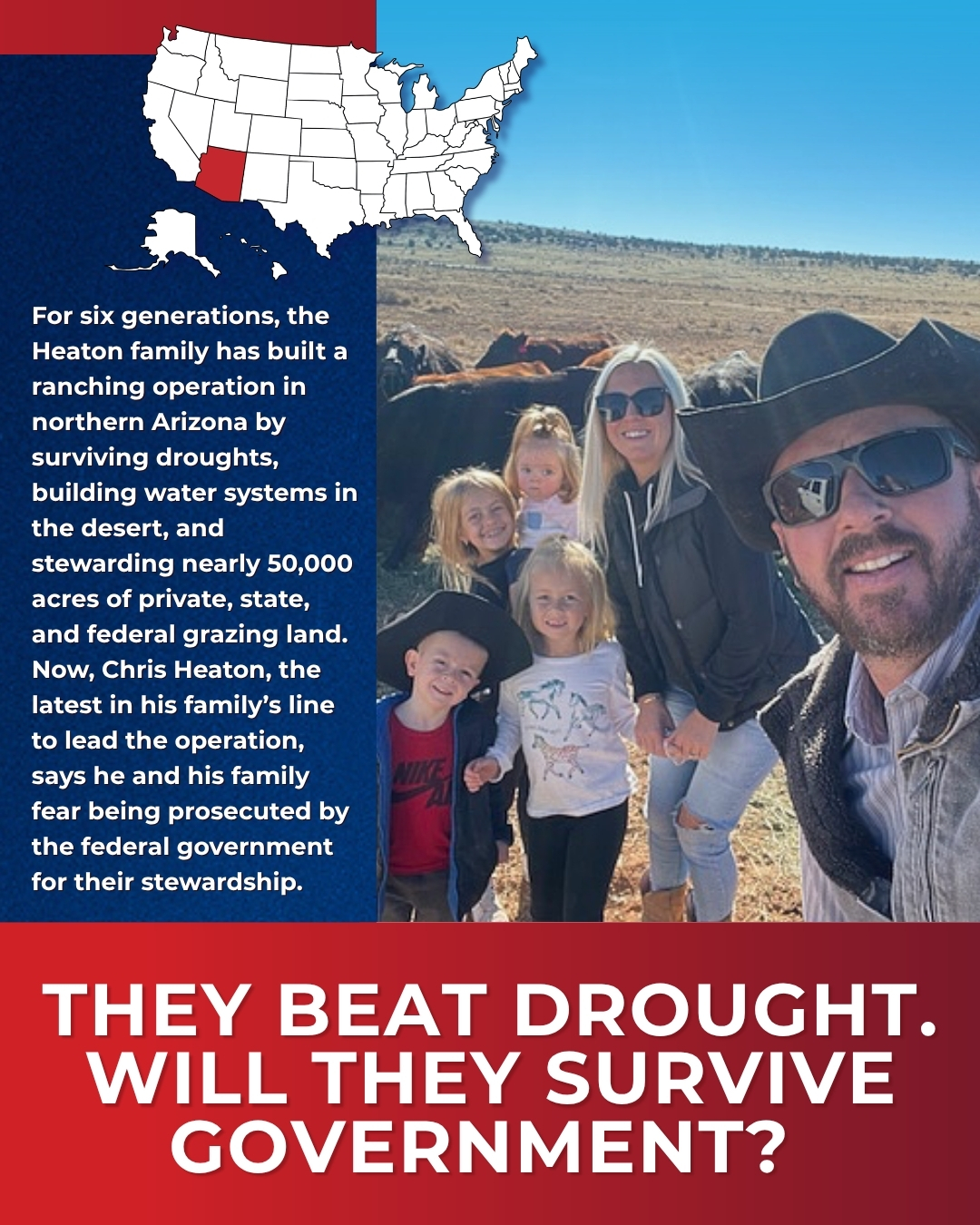
For six generations, the Heaton family has built a ranching operation in northern Arizona by surviving droughts, building water systems in the desert, and stewarding nearly 50,000 acres of private, state, and federal grazing land.
Now, Chris Heaton, the latest in his family’s line to lead the operation, says he and his family fear being prosecuted by the federal government for their stewardship.
Indeed, Heaton says the greatest threat to his family’s legacy and to the ranch itself is not weather or markets but a million-acre national monument created by presidential proclamation. Underlying that threat is the federal Antiquities Act—enacted to protect sensitive historical and archaeological sites—which gives the U.S. president unilateral power to create so-called “monuments” that restrict large areas of federal land without congressional approval.
Heaton says the Antiquities Act is being stretched into a tool for federal land control that leaves families like his uncertain whether ordinary ranch work could someday become a criminal offense.
Specifically, in 2023, then President Joe Biden designated by decree 917,618 acres—a land area larger than the state of Rhode Island and that sweeps in Heaton’s ranch—as the Ancestral Footprints Monument. The proclamation designates that portion of northern Arizona, including landscapes and everything in them as “objects of historic or scientific interest,” according to a lawsuit filed against the Biden administration by the Heatons in 2024.
Turning vast swaths of land into a national monument ends legitimate, productive use of federal land and undermines private property rights, Heaton told Liberty Matters this week in an exclusive interview.
“I was born and raised here in Kanab (Utah), ranching on the Arizona Strip where our ranch currently is,” Heaton said. “My family was some of the original pioneers that came down here with the Mormon Church and settled this area. So when they first got here, obviously they started ranching. This is in the late 1800s. Some of our water rights go back to 1871, which is pretty amazing.”
Over time, the ranch grew to approximately 49,000 acres through generations of hard work.
“We run a cow-calf operation,” Heaton said. “So we breed our mama cows early summer, and then our calves are born typically in the spring. And then in the fall is when we sell our calves at weaning at an average of 500, 600 pounds. And they go into the market in the United States, and they go all across the country.”
Heaton says the ranch is a mix of federal, state, and private land.
“I’m going to be really honest, there’s areas of the ranch that I can honestly say I have not stepped foot on,” he said. “I know where it all is, but I can say I’ve never been on this little hill here. I’ve never been down in that draw there. It’s big, big. And it has to be because we’re in a high desert, and so our cows have to work a little bit harder for their feed.”
What that means practically is that every pond, every spring, and every water line exists because someone in the family built or maintained it.
“In the early 1900s is when my grandfather was born, and he started organizing the ranch as we call it today,” Heaton said. “And it was before the area was even fenced off. They started building dams and dikes in the washes and drainages to store these monsoon rains that we get to store water because we have really relatively little-to-no live water. We have a couple springs, we’ve drilled a few wells, but everything else is what we catch and capture in the monsoon rains.”
All that was long before the federal Bureau of Land Management (BLM) and other federal agencies came along, Heaton says. Not that there haven’t been other trials and tribulations through the years. Beginning in 2020, the ranch survived perhaps its greatest challenge in generations: two consecutive years of devastating drought.
“2020 and 2021 were about the hardest years the ranch ever saw, and it was because of drought,” he said. “We did not get monsoons for two years, two summers in a row. So we sold about two-thirds of our herd. And we’ve never had to sell two-thirds of our herd. And in the history of our ranch, we’ve never had to haul water, which is pretty remarkable. But we had to haul water. And so we had just gone through those crazy two years. The market was garbage.”
But when the drought ended, the Heatons and their ranch were still standing.
“We made it through it,” he said. “And some of our neighbors did. It was pretty scary, but we made it.”
Fast forward to 2023. Rebuilding was paying off, and the ranch’s future once again appeared bright. Everything was humming along just fine, but Heaton says that is when the Biden administration came knocking on the door.
“Then we hear rumors about this monument, that the federal government intended to place most of our grazing country inside a new national monument,” he said. “And I’ll tell you, we had just gone through the worst of the worst and we’re like, ‘Okay, we made it through. Let’s recover. Let’s get going.’ So it was a straight knife to the heart when we heard that.”
The Monument’s How and Why
The idea for a monument had incubated for a long time deep in the brooders of the environmental movement, driven by an ideological agenda and particularly a desire to prevent mining in the region.
“They’re trying to stop uranium [mining], which to me is just asinine because why buy it from our enemies when we can mine it here in our country,” Heaton told Liberty Matters. “So what they do out here is, you’ve got the Sierra Club, the Grand Canyon Trust, and a bunch of these nonprofits that are here to protect this environment and these lands. And then they use the Native American tribes, and they get all the tribal leaders. They say it’s to protect their homelands. And so they get them all on board. And then they add some of the names from a couple of the different tribes’ languages into the monument to get their buy-in on it.”
During the Biden administration and before, as Heaton’s lawsuit described, environmentalists had repeatedly pressured Congress to pass legislation restricting mining in the region, but Congress never did.
“The increased interest in Arizona’s natural resources led to opposition and proposals within Congress to ban natural resource extraction—including mining in certain unregulated areas,” the legal complaint prepared by the Pacific Legal Foundation (PLF), which represented the Heatons, stated. “For example, Members of Congress proposed the Grand Canyon Watersheds Protection Act of 2008, the Grand Canyon Watersheds Protection Act of 2009 and the Grand Canyon Watersheds Protection Act of 2012.”
After Congress could not pass legislation to change the land designation around the Grand Canyon, the complaint states, the Obama administration, whose motto was “we can’t wait for Congress,” swung into action on behalf of environmentalists. In 2009, the secretary of the Interior unilaterally banned location and entry to a 993,569-acre area with the highest concentration of mining claims. In 2011, the complaint continues, the secretary withdrew 1 million acres for six months, and the next year withdrew 1 million acres from location and entry for 20 years, the maximum period allowed by statute.
The problem for the Obama administration and environmentalists was that those actions weren’t permanent, the complaint states, so some members of Congress again tried to restrict natural resource use but failed to pass legislation that would permanently change land use. When Biden took office, Heaton’s complaint states, and in the wake of those legislative defeats, environmentalists called on Biden to do what Congress refused to do and to use the Antiquities Act to regulate land use in the area broadly.
And that’s exactly what Biden did.
Heaton’s lawsuit was dismissed for lack of standing, as if having the government grab your land and rights does not give one standing, but that is a complicated technical argument involving the state of Arizona. The important point is that the case was not dismissed on the merits.
What the lawsuit does establish is that Biden defied congressional limitations on the use of the Antiquities Act, which required designations to identify specific objects to be protected and to confine the designation “to the smallest area compatible with the proper care and management of the objects to be protected.”
“The Antiquities Act is quite clear,” Heaton told Liberty Matters. “It’s the smallest area compatible with what you need to protect, what object you need to protect, whether it’s an old fort or whatever the case is. Or even these Native American sites. I’ll tell you, there are Native American sites in this monument, but they’re in a really small area, not spread over 900,000 acres. Most of the people don’t even know where they are. Only the ranchers know where they are because they’re not by a road.”
But Biden ignored all that—and the law—by designating “entire landscapes.”
Prosecution by Interpretation
The other thing the lawsuit established was the indisputable harms the Heatons would—and do—suffer under the monument designation.
By all accounts, Chris Heaton and his wife Cassandra undertake an array of tasks on their ranch. On any given week, they repair stock ponds or remove invasive tamarack trees to prevent the roots from siphoning the water supply. They clean sediment from earthen ponds, fix roads, maintain fences, rotate cattle, check water, and perform a variety of other demanding tasks.
The problem is, any one of those activities could run afoul of the monument’s management plan and trigger criminal penalties. That situation is made even more problematic given that no management plan has been released, so all bets are off on what the Heatons can do on their ranch, and any one violation could bring charges.
“The proclamation identifies landscapes, grasslands, drainages, vegetation, creeks, geological features, and many other natural resources as protected ‘objects,’” the PLF legal complaint observed. “The Proclamation also designates as protectable such ‘objects’ as plateaus, canyons, tributaries, remnants of homes, storage buildings, pottery, tools, other physical remnants of human habitation, 50 species of plants, groundwaters that flow into the Colorado River, different geological features such as Redwall Limestone, red cliffs of the Grand Canyon, Kaibab Formation, the Toroweap Fault, Colorado Plateau, Kanab Plateau, House Rock Valley, deserts, grasslands, woodlands, forests and old growth, riparian vegetation, and endangered species such as the western yellow-billed cuckoo, southwestern willow flycatcher, and northern leopard frog.”
The list even includes “objects” that the proclamation does not identify, the complaint established: “It is thus impossible to determine how many ‘objects’ the Monument protects.”
Finally, the proclamation also warns “all unauthorized persons not to appropriate, injure, destroy, or remove any feature of the monument and not to locate or settle upon any of the lands thereof.” Because the Antiquities Act carries criminal penalties for damaging protected objects, Heaton says he no longer knows where routine ranch maintenance ends and potential criminal liability begins.
“The thing is, they create the monument, and in the monument they list a bunch of objects, and they list the landscape, and they list the grasslands, the saltbrush, all the drainages of the Kanab Creek drainage basin,” he says. “So this whole plateau all drains into Kanab Creek. That’s just the layout of this topography of this high desert. And in a bunch of these drainages, we have our stock ponds, which depend on these monsoons. So we dam these drainages and have since the ’30s and ’40s, and we collect the water, and the floods break the dams. Sometimes we have to repair them and clean the mud out of the drainages and so on. But it says that all the drainages are objects and they say we can’t disturb or destroy any of the objects. And if we do, we’re subject to criminal penalties.”
On the one hand, Heaton says, the government tells them their grazing is protected, but, on the other hand, the grazing requires “interfering” with protected objects and on the government’s interpretation of ‘injuring’ or ‘destroying.’
“We just have the proclamation that says we can do X, we can’t do X, and they contradict,” he says. “And I talked to a lady with the Department of Interior after the proclamation came out and I said, ‘So it says I can ranch, but it says if I do X, Y, and Z, I’m subject to criminal penalties.’ And she said, ‘It’s up to the Department of Interior’s interpretation’ if I will be subject to criminal penalties.”
And Heaton says he told her that’s where he has a problem.
“And so we’re like, ‘Well, our cows are going to eat the grass, and that’s an object, and that’s a problem,” he says. “And then we’re going to maintain our ponds. That’s a problem. But in the proclamation, they say that they’re not going to disrupt grazing. The grazing’s still permitted.”
None of it makes sense, Heaton says, and then there is this:
“I’ve got four kids that love rocks,” he says. “And we have private ground out there, so we can pick up the rocks and everything on our private ground. But what if my kid picks up a rock on the monument and brings it home? Are we in trouble, or is my kid in trouble? Am I in trouble? You know what I mean? There’s all these kinds of things now that we’re like, ‘whoa, wait, hold on. It’s not hurting anything.’ Not that we’re out there taking rocks, but it’s just what if?”
There are even bigger worries, Heaton says.
“But the big concern is when I go clean a pond and someone videos it or takes photos of it and they say, ‘Look, Chris Heaton, he is out there destroying an object on a national monument.’ And they don’t know what the proclamation says. They don’t know what the rules are, but they know that’s an object and so then I’m destroying it.”
As the complaint notes, too, a portion of Kanab Creek’s Hack Canyon is on the Y-Cross Ranch and named as an object in the proclamation:
“On New Year’s 2024, Mr. Heaton took his family, wife, children, sister, and brother-in-law hiking down into Kanab Creek,” the complaint states. “In a few locations on the Ranch, there are chips of broken pottery scattered on the ground. If he, a family member, or one of his children picks up a piece of pottery, they are appropriating a part of the Monument, which could trigger criminal penalties.”
Death of a Thousand Cuts
As bad as all that is, Heaton says there’s even more. Multiple times, he stresses an important point: the monument by itself is not necessarily what ends ranching.
What ends ranching is their management plans. Heaton says previous monument designations have slowly reduced grazing allotments, closed roads, restricted water improvements, and gradually reduced ranching capacity over decades.
“It’s the death of a thousand cuts,” he says. “They just slowly start whittling at you and say, ‘Nope, nope, nope, nope, nope.’ And then you can’t do it.”
Heaton says that strategy is one of the main ways they shut everything down.
“So we’re saying, ‘Okay, you’re saying we can continue ranching, but you’re tying our hands,” he said. “And we don’t have a management plan. When they create these monuments, they do a management plan, and we’re familiar with them. Clinton created a monument, the Grand Staircase Monument. Obama created the Bears Ears Monument, and then Biden does this one. And those other monuments are right in our backyard. So we’re familiar with those. And we know these management plans are when the rubber hits the road and when they really restrict you.”
Over the last 20 years of the Grand Staircase, Heaton says the ranchers’ Animal Unit Months (AUMs, or amount of forage that one animal unit consumes in one month) have significantly decreased.
“They cut roads, and they say you can’t go down these roads,” he said. “And so then ranchers can’t go down and fix and clean their ponds because they cut the roads.”
And, in turn, Heaton says, if ranchers don’t have those ponds and springs and wells operational because they can’t maintain them, they are ultimately told they have to have fewer cows because they don’t have enough water.
“And so they start restricting you with all these little things,” he said. “And then before you know it, after 20 years, your AUMs are cut in half. So you can only run half the amount of cows. And then they say, ‘Well, it’s not our fault. We’re not telling you you can’t ranch because you can ranch all you want.’ But they cut all your numbers so you can’t make your payments, you can’t cover your bills, your expenses. And then ultimately you can’t ranch anymore, even though we’ve been ranching obviously for well over a hundred years in our area. So we’re waiting for this management plan, which has never happened.”
For Chris and Cassandra, this fight is not simply about his ranch and those of others within the monument today. After six generations building the ranch, they say their greatest concern is whether their children will still be able to inherit not merely the land but the freedom to ranch it as their family always has.
“And I think just for our kids, the future generations to come, we can handle it, we’ll get through it, but we want to see our kids work that land and hopefully their kids and see that carry on,” Cassandra told Liberty Matters. “Because part of the problem is, we don’t know what it looks like for them. We can see right now maybe what potentially could happen to us, but we don’t know when it changes hands if they’re going to say, ‘Oh, you know what? You’re out. You’re done. This was the deal with your dad. But it’s different now.’”
Chris Heaton thinks that’s what the whole point is.
“It’s to lock us out,” he said. “That’s the quickest way to get us off of it. And when I say us, I mean uranium mining, I mean logging, I mean ranchers. That is my honest opinion. It’s a way, it’s an avenue, it’s a vehicle to lock us out, to control it.”
That monuments kill local communities is indisputable, Heaton says, and proven just by looking around at what’s happened with previous monuments.
“We’ve seen that with the Grand Staircase Monument,” he said. “The town of Escalante, Utah, used to be a similar size as Kanab, and it’s about a ghost town. And Kanab’s about 5,000. So they were probably about 4,000 roughly when that monument was created in 1996. And I don’t even know what they are now, but their schools have almost shut down.”
Now Heaton says those towns depend only on tourism.
“There’s nothing else,” he said. “They had logging up there, lots of ranching. And that’s what we’re all about in this country, capitalism. And then they say, ‘Oh, we’re going to just rely on tourism and that tourism dollar is the high. It’s all we need.’ But as soon as Covid or something like that hits, it kills these communities because people aren’t traveling from Europe; they’re not coming from Canada or wherever. And these towns just dry up.”
By contrast, Heaton said, pioneer families and their succeeding generations did a great job of building and sustaining prosperous communities, and still do.
“This area was settled in the late 1800s by a bunch of the pioneers that came into this region, and they did a dang good job,” he says. “They literally tamed some of the roughest parts of this nation, remote, rugged, nasty areas, and made life in these small little valleys. And they did amazing things, and a lot of their ancestors are still in these rural communities. And these people are still doing a dang good job. And I think they did such a good job that everybody wants to come and see it.”
And it’s a shame, Heaton said, that the government wants them to stop doing what they are doing to protect it.
“But we’ve done a really good job protecting it already and making a living and using the natural resources that are in and around our area so that these communities are even here for people to come and stay and visit,” he said. “And so it’a like they all want to come and see the Grand Canyon and all these other amazing, beautiful sites. But the only way they could come is because our ancestors established these communities and tamed this area.”
Heaton says several things need to be accomplished. First, shrinking the monument from a million acres, or removing it completely. He and Cassandra say they are thinking about refiling their lawsuit. Even if they don’t have a great shot in the lower courts, they say they are hoping to get any future case to the Supreme Court.
Heaton also thinks the Antiquities Act needs to be reformed.
“I don’t think the Antiquities Act is a problem,” he said. “I think the abuse of the Antiquities Act is the problem. I think what has happened, and it didn’t just happen with Biden, but it’s been happening. …. So it’s like if Congress doesn’t do it, then all of a sudden a president can. That’s wrong. A president should never have power to control a million acres.”
Heaton says he is optimistic that the current administration will continue to take the issue up, and he’s enthusiastic about conversations he has had already with John Rich, the USDA’s Special Envoy for American Landowners, USDA secretary Brooke Rollins, and other administration officials.
“So I hope that we can get the ball rolling with their help,” he said. “The Antiquities Act really has got to be addressed with Congress.”
The Heatons say they have felt the weight of the situation but will persevere, just as they have in the face of all the other challenges their ranch has faced.
“There’s that weight, where we’re the sixth generation, and all of our ancestors previously have made it work through droughts and floods and snowstorms and all the above,” he said. “And we went through that crazy drought in 2020 and 2021. We made it through it. And then all of a sudden there’s a chance that this is going to be shut down on our watch.”
And by the government, Cassandra added.
But Chris and Cassandra Heaton say they are determined not to let that happen. They say that after all those floods and snowstorms and droughts, they will still be standing after the latest government maelstrom.
There’s no reason to doubt them, and every reason to believe them.