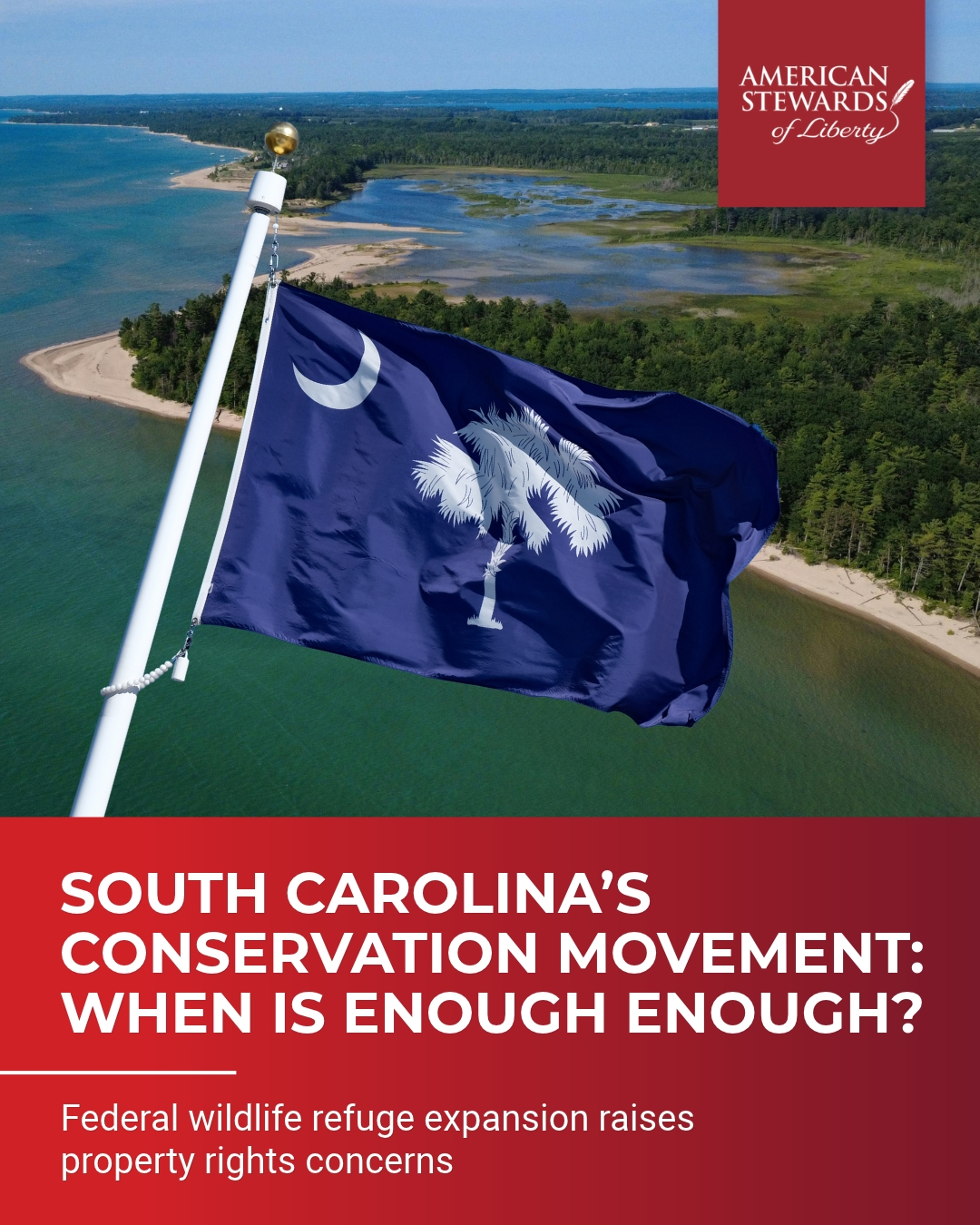
Federal wildlife refuge expansion raises property rights concerns
South Carolina’s aggressive campaign to place millions of additional acres under permanent conservation restrictions is gathering momentum, with the state now committed to restricting use on a third of all the state’s land—the outgoing governor wants it to be 50 percent—and now the federal government is proposing a major expansion of wildlife refuge acquisition boundaries across the state’s coastal lowcountry.
As Liberty Matters reported last week, with Gov. Henry McMaster’s blessing, the South Carolina legislature overwhelmingly voted to set a statutory goal of preserving 7 million acres by 2050, approximately one-third of the state. McMaster himself is even more ambitious and has called for restricting 10 million acres by 2050.
Just two weeks ago, the governor created a commission to coordinate and pursue those efforts among state agencies, local governments, private landowners, NGOs, and other institutions. Meanwhile, the state’s conservation network has identified millions of additional acres as priorities for protection, especially in the lowcountry, where more than 320,000 acres have already been encumbered in the ACE Basin, more than 200,000 along the Savannah River, 62,220 acres of conservation easements in the Pee Dee Basin, and 25,000 acres of connected properties in the Coosawhatchie region.
If that isn’t enough, the U.S. Fish and Wildlife Service (FWS) is proposing to expand acquisition boundaries for 10 national wildlife refuges along the Georgia and South Carolina coasts, including four within South Carolina’s 120,000-acre Lowcountry Refuges Complex: Cape Romain, Ernest F. Hollings ACE Basin, Santee, and Waccamaw.
And it’s not a minor tract of land the FWS is proposing to draw into its habitat boundaries. The agency proposes adding up to 300,000 acres to the existing 120,000-acre South Carolina complex, while the Savannah Coastal Refuges Complex, currently covering nearly 60,000 acres, is targeted for an additional 150,000 to 200,000 acres. All totaled, the proposal identifies a 4.5-million-acre planning landscape that FWS considers ripe for refuge expansion in two areas in South Carolina and Georgia.
To the FWS, there’s a “slow hurry” to get it done, as they say in the lowcountry, mainly because the proposed expansions are intended to protect what FWS says is increasingly fragmented coastal habitats.
“The goal of the proposed boundary expansions is to increase the Service’s ability to conserve resilient and connected coastal lands that provide necessary habitat protection for migratory birds and resident wildlife, as well as support the conservation of rare, threatened, and endangered species,” the FWS states in its September 17 request for public comments. “The proposed boundary expansions would also provide opportunities for additional public access to coastal wildlands for outdoor recreation, consistent with the National Wildlife Refuge System policy that wildlife-dependent recreation activities (i.e., hunting, fishing, wildlife observation, photography, environmental education, and wildlife interpretation) shall be considered priority uses.”
And how did the FWS come up with their desired acreage? Apparently they consulted the states of Georgia and South Carolina, and something called “the Southeast Conservation Adaptation Strategy (SECAS) Southeast Conservation Blueprint priority areas based on natural and cultural resource indicators.”
Got that? In plain English, in the short run the government seeks to add up to 300,000 acres to the refuge boundary, which would be about two-and-a-half times its current size. It’s important to point out that that does not automatically turn those acres into federal property, impose conservation easements, or subject their owners to refuge management. But it does reveal where the FWS wants to go next to do just that, and the designation alone can have serious and immediate effects on private property within it.
Again, the FWS says the expanded authorized boundary is urgently needed.
“The natural and wild qualities of the South Atlantic region of the United States have been altered, fragmented, and significantly impacted for over 300 years,” the request states. “These impacts have entered a period of acceleration over the most recent decades, resulting in conservation concerns for imperiled wildlife species; the further fragmentation and reduction in connected habitats; the loss of truly wild, natural, and free functioning earth systems; and further loss or reduction of public access and the ability of people to access wild land.”
Those claims need context, however.
South Carolina’s population is growing—it is the fastest-growing state in the nation—and coastal urban areas are facing serious infrastructure issues as that growth outpaces capacity, but most of the in-migration has been concentrated in urban areas surrounded by massive swaths of protected land. Arguably, the state’s zealous conservation policies have funneled that growth disproportionately into areas ill-equipped to handle it.
If anything, the coastal city of Charleston increasingly resembles a 15-minute city—a central, walkable downtown surrounded by planned suburban hubs, which themselves are surrounded by millions of almost moat-like acres of “protected” land where ever fewer people can live or work or farm.
Population migration may be in a “period of acceleration,” but it’s got nothing on the conservation movement’s “period of acceleration” over the last 40 years, especially in the lowcountry, where “protected” land has grown to more than 1 million acres. The Fish and Wildlife Service’s proposed expansion would add a sizable federal component to a conservation campaign already operating on an extraordinary scale.
Unexpected opposition emerging
It may be that, between the Legislature’s almost zombie vote to eventually take control of one-third of the land out of private hands, not to mention out of a free and productive economy, and the governor’s mission to effectively take 50 percent of the state’s acreage, the conservation movement is beginning to hit the outer limits of what it can accomplish.
In the wake of the FWS expansion announcement, for example, murmurs of discontent have been heard from hunters, anglers, and other outdoor enthusiasts—a group not known for speaking out against South Carolina’s conservation objectives. To cite just one example, Matt Wongrey, who describes himself as a South Carolina sportsman, waterfowl hunter, and conservationist, submitted to the FWS a comment opposing the proposed expansion, which he posted on his Facebook page and discussed on his popular YouTube channel in a video entitled “How much is enough?”
Wongrey questioned the necessity of additional federal management.
“I strongly support legitimate habitat conservation,” Wongrey wrote. “However, conservation and expanding federal control are not automatically the same thing. …. [t]he South Carolina Lowcountry Refuges Complex could potentially expand by between 30,000 and 300,000 acres. That is an enormous range and deserves far more explanation before the public should be expected to support it.”
The area surrounding the Santee National Wildlife Refuge and the Santee Cooper lake system particularly concerned him, Wongrey wrote.
“Before any expansion moves forward, the public deserves a clear accounting of how much land and water within the proposed acquisition boundary is already publicly owned or controlled by Santee Cooper, the State of South Carolina, or other public entities,” he wrote. “If land is already publicly owned and already providing wildlife habitat and recreational opportunities, what conservation problem requires transferring, leasing, or otherwise placing additional acreage under federal refuge management?”
What’s more, Wongrey continued, some supposedly public areas were, in fact, not open.
“We already have examples within Santee National Wildlife Refuge where portions of Lake Marion are seasonally closed to all public access, including boating and fishing, for migratory bird sanctuary purposes,” he wrote. “That makes questions about the potential future management of additional lands and waters especially relevant to fishermen and boaters as well as hunters.”
In fact, the Santee National Wildlife Refuge currently closes portions of its lands and waters to public access from November 1 through March 1, including Cantey Bay, Savannah Branch and Black Bottom.
Transparency was of the utmost importance, Wongrey wrote.
“For every parcel of existing public land or water being considered for inclusion, the public should know who owns it today, who manages it today, what recreational activities are currently allowed, who would manage it under the proposal, and whether any existing hunting, fishing, boating, or other public access could be restricted in the future.”
Wongrey said conservation should not be used as an excuse for federal encroachment.
“I also strongly object to using the broad concept of ‘conservation’ as sufficient justification for an expansion of this magnitude without demonstrating why existing state, Santee Cooper, private, and cooperative conservation efforts are inadequate,” he wrote. “… protecting habitat should not automatically mean placing hundreds of thousands of additional acres within potential federal acquisition boundaries, particularly when some of those lands and waters may already belong to the public. For these reasons, I oppose the proposed South Carolina Lowcountry Refuges Complex boundary expansion as currently presented.”
In a September update, Wongrey said that the FWS had supplied some answers to his concerns, but he still wasn’t 100-percent onboard.
A zero-sum game
Beyond access issues are those of economics and property values. The expansion would place a question mark over another 300,000 acres of land that would morph overnight from a designated developable landscape into a protected one, with all the practical economic consequences such designations carry.
It would also sweep in thousands of private property owners who would now live within a federal habitat refuge that, for many, did not exist and was not contemplated when they bought their property, all without meaningful input or consent.
To be sure, the Fish and Wildlife Service acknowledges that privately owned properties may be included within expanded acquisition boundaries without the owners’ consent to sell.
“If approved, the proposed major boundary expansions would enable the Service to work with willing landowners to explore voluntary conservation actions, including fee title sale, that would further conserve the diverse and rich coastal habitats that provide habitat for wildlife, fish, and plants, as well as public access for wildlife-dependent recreation,” the FWS request for comments states. “An effort of this scale requires a vast network of partners. The Service’s collaborative conservation ethos could leverage partnerships from the non-profit sector, academia, Federal and state governments, Native American Tribes, and private sector.”
The FWS’s policy is to work with willing sellers, the scoping request asserts. That could mean more than what it says. Government land agencies often seek out property owners and initiate contact to try to convince them to sell, often with sweetened deals at above-market prices. All the while, the FWS assures everyone their rights are safe: “Being included within the proposed boundary expansion area would not affect how owners use their property or to whom they may choose to sell their property.”
In the end, though, the FWS could leave property owners twisting in the lowcountry wind if they don’t agree to behave.
“There is no guarantee or commitment from the Service that properties included within the boundaries of the proposal would be purchased in the future,” the request for comments states. “Future purchases would be dependent on willing sellers, available funding, and/or changes in land use that make a parcel non-compatible with a conservation mission.”
That’s a considerable incentive and an equally considerable threat to landowners given the possibility that the refuge designation may well lower their property values. A landowner whose property falls within a federally designated acquisition area may retain every formal right to develop, subdivide, or sell, but the designation would raise questions among potential purchasers, lenders, and developers about the property’s future, likely affecting its marketability and value.
To that point, multiple studies show declining property values on lands under conservation easements, but the evidence is thinner on private properties within wildlife refuges that retain the ability to develop. Nonetheless, the inputs into that calculation don’t look promising for property owners.
For one, there is a possibility of future condemnation by the FWS. The FWS almost always follows a willing-seller approach; however, it retains the legal authority to take land if a private landowner within a refuge acquisition boundary plans to build something the FWS believes would destroy the ecosystem that the refuge was created to protect. So inside an authorized acquisition boundary, private property remains private—until it doesn’t. The FWS assurance only goes so far.
Property owners building within a refuge boundary will also face stricter environmental reviews, zoning limits, or delayed/denied permit approvals. Navigating such a risky regulatory landscape could prompt developers to build outside the perimeter and drive the market away from existing housing.
All those factors will almost certainly drive costs comparatively higher.
Interestingly, environmental groups often talk about impacts just outside the boundaries of wildlife refuges when addressing property values. A new study by Resources for the Future, a net-zero outfit, concluded that the impact of the Endangered Species Act has, on average, been modest, with home prices in surrounding communities actually increasing by as much as 10 percent.
One must consider the source when assessing those conclusions, but even they acknowledge an impact inside the boundary. While the researchers found no statistically significant average effect on housing prices within ESA-protected areas (wildlife refuges often serves as critical habitats of ESA-pre-texted species), they identified more complicated permitting processes and higher permit-denial rates in counties with larger shares of ESA-protected land.
“Because it becomes a little harder to build in these areas, developers might decide to build just outside the areas—leading to more homes, and perhaps with the growing scarcity of open lots, another reason for prices in surrounding communities to rise,” says Resources for the Future’s Beia Spiller. “All in all, this seems to shift some construction activity from areas that are important for the survival of protected species toward areas that are already built up—and the shift away from protected areas means that area-based conservation policies can have their intended effect.”
What she’s saying is that the intended effect is to drive people out of protected areas by increasing the costs and effort of building there and thus reducing demand and property values for existing land within the boundary.
That begs the question of whether voluntary acquisition policies are really voluntary when conservation priorities leverage government incentive and regulatory authority to its advantage in the regional land market. The central concern is whether a landowner can remain legally free to use property while facing practical pressures that make certain uses less attractive, more difficult, and, in some cases, impossible.
A new governor
Emerging questions about conservation’s limits may also have political implications. McMaster, South Carolina’s radically pro-conservation Republican governor, is stepping down, and the state’s Republican attorney general, Alan Wilson, was elected his successor.
While it’s too early to know where Wilson will come down on the issue of government expansion, the early signs indicate there could be a sea change in conservation policy, the state legislature’s almost-unanimous support for environmentalists notwithstanding.
For instance, responding to a South Carolina Land Trust Network candidate questionnaire, Wilson was the only gubernatorial candidate in either party who stopped short of endorsing McMaster’s ambitious acreage target.
“I support South Carolina continuing to aggressively conserve important land, provided we do it responsibly, respect private property rights, prioritize voluntary conservation, and ensure taxpayers receive value for their investment,” he wrote. “I believe the focus should not simply be on reaching an acreage number. We should prioritize protecting the right land, including working farms and forests, wildlife habitat, watersheds, historic properties, and areas important to outdoor recreation.”
Wilson has involved South Carolina in several significant property-rights lawsuits during his tenure as attorney general, particularly cases challenging federal environmental regulations that restrict how private landowners can use their property.
Particularly germane is Wilson’s participation in a challenge to the Endangered Species Act. In Alabama v. National Marine Fisheries Service, Wilson joined a coalition of 20 states challenging two federal rules adopted in 2016 that expanded the government’s authority to designate private land as critical habitat for endangered species. The rules allowed federal agencies to designate land even when the endangered species did not currently inhabit the property and the land lacked biological features necessary for the species’ survival.
In March 2018, Wilson announced that the federal government had agreed to reconsider the rules in response to the litigation.
“These rules are another example of the federal overreach of the Obama administration that we’ve fought at every step,” Wilson said then. “Some of these rules are so ridiculous they’d be funny if they didn’t have real consequences for property owners.”
Wilson also participated in multiple challenges to federal Waters of the United States (WOTUS) regulations. In 2015, he joined a multi-state lawsuit challenging the EPA and the Army Corps of Engineers’ authority over small streams, roadside ditches, and other water features on private land.
In 2018, Wilson joined a 10-state coalition seeking a preliminary injunction against the 2015 rule, arguing that it unlawfully expanded federal jurisdiction. In 2023, South Carolina and more than 20 states challenged the Biden administration’s newly revised WOTUS rule that would have imposed additional permitting requirements and penalties on farmers, ranchers, developers and other property owners.
His own track record as attorney general, and not least his response to the environmentalists’ conservation ambitions during the governor’s race, stand apart from McMaster’s unbridled conservation aspirations, and it suggests that at least some political leaders are beginning to distinguish support for conservation from support for ever-expanding numerical targets and government land control.
Time will tell the tale, of course. Wilson’s opposition to particular federal regulations and his position on conservation acquisitions are hardly the same.
For decades, South Carolina’s conservation movement has enjoyed broad political support, substantial public and private funding, and remarkably little legislative resistance. Yet the federal refuge expansion brings to the surface concerns that could become ever louder as conservation efforts move away from strictly coastal ecosystems and into the state’s traditionally developable interior.
Certainly, nothing to date indicates that any significant backlash is underway. But wary voices percolating here and there from rural areas, combined with an administration with a—so far—different focus on property rights, raise the possibility that the conservation movement’s greatest political challenge may come not from developers who long ago lost the battle of public opinion, but from conservation-minded people who simply believe there should be limits to the government’s reach.