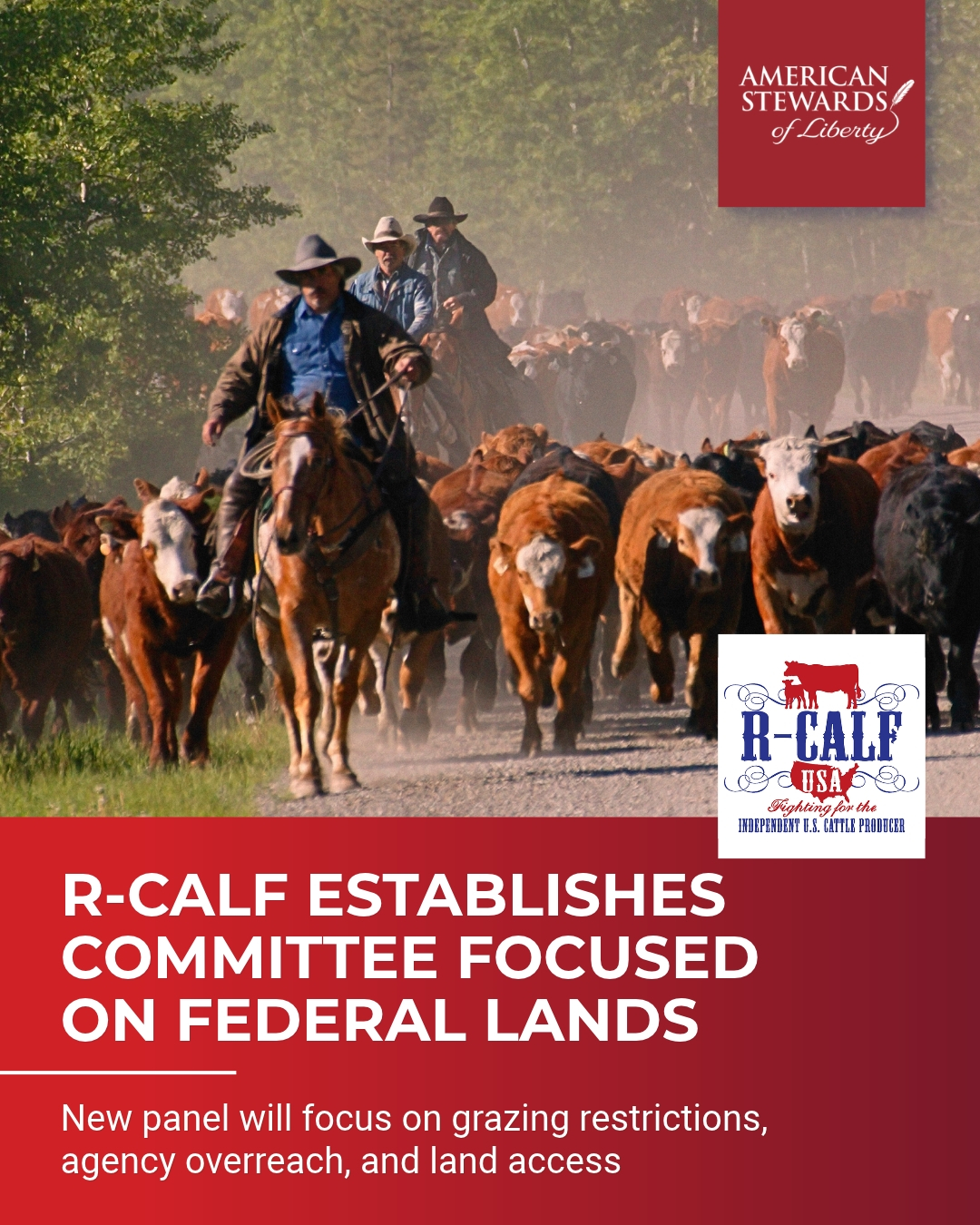
New panel will focus on grazing restrictions, agency overreach, and land access
R-CALF USA has established a new Federal Lands Committee to address what the organization calls increasingly complex challenges facing cattle and sheep ranchers who depend on federally managed lands.
The Ranchers-Cattlemen Action Legal Fund United Stockgrowers of America, or R-CALF, is a national trade association representing independent cattle and sheep producers. The committee will focus on a range of issues from grazing policies to federal lands access to predator management, and more.
Eric Gropper, R-CALF vice president, said R-CALF recognized the need for dedicated attention to ranchers who graze livestock on lands administered by the Bureau of Land Management and U.S. Forest Service.
“Ranchers who depend on federal lands face challenges that are different from those faced by producers operating strictly on private property,” Gropper said. “Whether it’s grazing policies, federal agency overreach, or legal battles that threaten a rancher’s livelihood, we need to make sure these producers have a strong voice and that their concerns are being addressed. This committee gives us a way to focus on those issues and work toward meaningful solutions.”
Lorene Bonds of Colorado will chair the committee, with oversight from Marie Lawson of Nevada and R-CALF Region XI director Brent Espil, Region I director George Wishon, and Region IV director Cash Carruth.
Declining grazing opportunities
The new committee’s creation follows years of R-CALF criticism of federal grazing policies. In comments submitted this past July on newly proposed BLM regulations, R-CALF argued that federal agencies had in the past progressively adopted policies favoring reductions in grazing.
“These U.S. cattle producers raise the livestock that supply American beef and lamb, and in the western parts of the country, they depend on private, state and federal lands to raise their herds,” R-CALF CEO Bill Bullard wrote in the comments. “Given that the BLM manages more than 247.3 million acres across the western United States, of which over 155 million acres is grazed, the decisions made by the BLM disproportionately impact our nation’s western cattle and sheep herds.”
Bullard said the Trump administration’s proposed rules were a step in the right direction and that R-CALF was largely supportive. Those rules are intended to give ranchers greater flexibility by simplifying permit renewals and allowing grazing dates to shift with BLM approval, among other things.
Bullard also praised it as a long-needed corrective against an ideological push to target grazing.
“It’s concerning to our organization that in recent decades it seems a radical agenda to reduce grazing on western federal lands has taken root in many of our federal agencies, and our western herds have decreased on federal lands as a result,” he wrote. “While it’s difficult to quantify an exact number of how many AUMs (Animal Unit Month) have been lost on BLM land since 1934 (passage of the Taylor Grazing Act or TGA), according to one source ‘since 1954 there has been a 52.2 percent reduction in the number of AUMs—from 18.2 million to about 8.7 million.’”
That’s a net loss of 9.5-million AUMs on BLM lands in the western states, Bullard wrote. As such, he said there was a desperate need to rebuild not only the domestic cattle herd but also the sheep herd.
While R-CALF characterized the BLM’s proposed grazing regulations as an improvement, Bullard in his comments urged the agency to go further. Among other things, R-CALF called for restoring suspended grazing allotments, protections against reductions in active grazing capacity without scientific justification, as well as formal recognition of ranchers’ interests in range improvements and strengthening local grazing advisory boards.
Critically, R-CALF supported requirements intended to prevent grazing allotments from becoming de facto conservation leases rather than remaining available for livestock production.
Taken together, the proposals illustrate the kinds of substantive federal land-management issues the new committee is positioned to address.
R-CALF welcomes new Interior initiative
Meanwhile, the committee’s creation coincides with a series of Trump administration initiatives intended to reduce regulatory obstacles facing ranchers.
On October 27, Interior secretary Doug Burgum signed an order, Supporting America’s Ranchers Through Resilient Rangelands, that address R-CALF’s specific goals, including directing federal agencies to identify additional grazing opportunities, to consider restoring suspended allotments, and to reduce permitting delays.
It also calls for full 10-year grazing permit renewals, greater use of technology, and a publicly accessible map of available grazing lands.
“We welcome this new development,” Bullard said of Burgum’s order. “For too many years. ranchers and their cattle and sheep have been removed from federally managed lands, contributing to the alarming contraction of both our domestic cattle and sheep industries. Reprioritizing grazing on these lands is an important step in restoring national food security for Americans by rebuilding our domestic beef and lamb supply chains.”
The committee is thus set to roll out at a good time when R-CALF’s longstanding policy objectives have gained support within the administration, while the practical work of carrying out those reforms remains ahead.
Agency overreach and agricultural lawfare will add another dimension to the committee’s work. R-CALF has increasingly voiced its concerns about government enforcement actions, litigation, and land-use decisions that it believes threaten the viability of independent ranching operations.
In April, at a House Oversight Committee roundtable titled Farming on Trial: The Growing Use of Lawfare Against American Agriculture, R-CALF Private Property Rights Committee chairman Shad Sullivan argued that government agencies, environmental organizations, and public-private partnerships were increasingly using regulation, litigation, and land-use decisions in ways that threatened family ranching operations.
“Across the country, we are seeing the same pattern of land taken through eminent domain, grazing reduced, and operations pushed out through what can only be described as death by a thousand cuts,” Sullivan said.
Sullivan cited a controversy in Washington state as an example of the pressures facing ranchers. According to R-CALF, the government fined the operation, King Ranch, more than $250,000 over disputed wetlands allegations. The organization also opposed a proposed transfer of more than 12,000 acres of state grazing land associated with the operation before the underlying allegations had been adjudicated.
R-CALF argued that proceeding with the transfer under those circumstances “would be at best opportunistic and at worst sinister.” Sullivan called for congressional scrutiny of the dispute and urged lawmakers to ensure government policies and enforcement actions did not undermine independent producers.
Those kinds of disputes help explain why the organization sees a need for a committee dedicated specifically to federal lands. Though the King Ranch was on state land, similar situations arise on federal lands, and are also increasing.
Bullard said the new Federal Lands Committee will work alongside R-CALF’s existing Private Property Rights Committee, reflecting the overlap between federal land-management decisions and ranchers’ broader property interests. While private landowners generally own their property, ranchers operating on federal lands typically depend on grazing permits and allotments administered by federal agencies.
“With our nation’s cattle herd being the smallest since 1951, there is a desperate need to rebuild not only our domestic cattle herd, but our sheep herd as well,” Bullard wrote in his July 17 comments. “Restoring common-sense management to BLM land grazing, restoring reduced and suspended AUMs, and protecting private property interests of federal land grazers has never been more important.”