
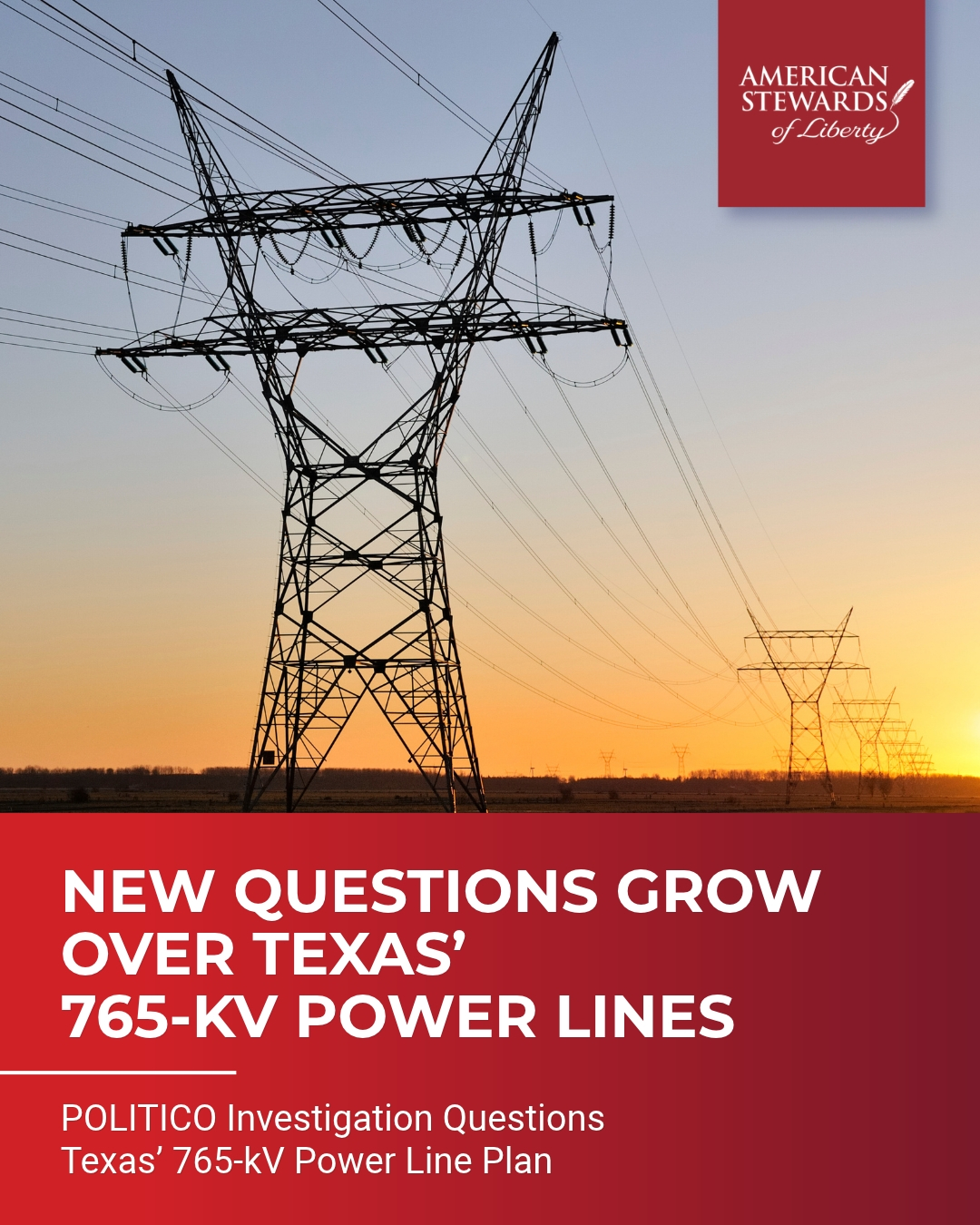
New reporting shows Texas officials were working with Big Tech and transmission companies to accelerate massive new electricity loads while the state was pushing an unprecedented transmission buildout across private land. It is time for a full stop.
A new investigation by POLITICO raises fundamental questions about the justification Texas officials have given for the state’s proposed 765-kilovolt transmission system.
For nearly a year, landowners have been told that these enormous transmission lines are necessary to solve a reliability problem in the Permian Basin. That justification traces back to legislation directing the Public Utility Commission and ERCOT to address rapid load growth and reliability needs in the region.
But POLITICO now reports that, behind the scenes, state officials were simultaneously working closely with some of the world’s largest technology companies to accelerate an unprecedented wave of data-center development in Texas.
According to the report, senior members of Gov. Greg Abbott’s staff met privately in December 2025 with representatives from Google, OpenAI, Meta, Amazon Web Services and Nvidia. PUC Chairman Thomas Gleeson, senior ERCOT officials and representatives of major Texas transmission companies—including Oncor and AEP Texas—were also listed as participants.
The meeting was described on the governor’s chief of staff’s calendar as a “transmission roundtable.”
Two days later, ERCOT publicly unveiled a new framework intended to accelerate the connection of enormous new electricity users to the grid.
The implications are significant.
POLITICO reports that Texas is simultaneously working toward completion of a roughly $33 billion ultra-high-voltage transmission system that would help power technology campuses stretching from East Texas toward the Permian Basin.
That is a very different context from the one presented to thousands of Texas landowners whose property stands in the path of these lines.
The Demand Changed. The Justification Should be Reconsidered.
Texas’ prospective large-load queue eventually grew to more than 470 gigawatts—more than five times the state’s record peak electricity demand. Roughly 90 percent of those requests were from data centers.
The scale became so extraordinary that Gov. Abbott ultimately ordered ERCOT and the PUC to stop approving new data-center connections while the state audits whether the projects are legitimate and whether the grid can support them.
That raises an obvious question:
If Texas does not yet know which of these massive data-center loads are real, why is the state continuing to threaten to condemn private property to build transmission infrastructure designed in part to serve extraordinary projected load growth?
This is precisely the kind of question American Stewards of Liberty has been asking throughout the 765-kV proceedings.
Administrative Law Judges reviewing the proposed central 765-kV path have already concluded that the utilities failed to prove the project was necessary. Critically, they also found that no analysis had established whether rapidly growing Central Texas data-center demand might consume generation that was supposedly available to be transmitted west into the Permian Basin.
In other words, the state has been approving transmission infrastructure before answering a very basic question: where will the electricity actually come from, and who will use it?
Texans Were Promised a Permian Reliability Project
The Legislature directed the state to address reliability and rapid electrical-load growth in the Permian Basin.
It did not expressly authorize the transformation of that directive into a statewide 765-kV transmission network.
Texas Attorney General Ken Paxton has already raised that concern, arguing that the Legislature never clearly contemplated a statewide 765-kV buildout when it enacted HB 5066 and urging the PUC to allow lawmakers to review a policy decision of this magnitude.
Legislators from both parties have likewise questioned the process and called for the PUC to slow down.
The POLITICO investigation adds an important new dimension.
At the same time Texas landowners were being told that massive new transmission infrastructure was necessary to solve a Permian reliability problem, state officials were actively trying to accommodate unprecedented new electricity demand from some of the world’s largest technology companies.
Those facts deserve to be reconciled before one acre of private property is condemned.
Time for a Full Stop
Texas needs reliable electricity. It also wants to remain competitive in artificial intelligence, manufacturing and other energy-intensive industries.
But economic development cannot become a blank check written against private property.
Transmission lines create permanent easements across farms and ranches. Ratepayers ultimately bear enormous infrastructure costs. Once those lines are built and the land is condemned, those decisions cannot simply be undone if the demand forecasts later prove wrong.
The state itself has now acknowledged enough uncertainty about data-center demand to order an audit.
The same caution should apply to the transmission system being built to accommodate Texas’ rapidly expanding electricity demand.
Until the audit is complete, the Legislature has reviewed the state’s energy strategy and Texans know exactly what demand these lines are being built to serve, there should be a full stop on further 765-kV approvals and construction.
Texas should know what it is building, who it is building it for and whether it is actually necessary before taking another Texan’s land.