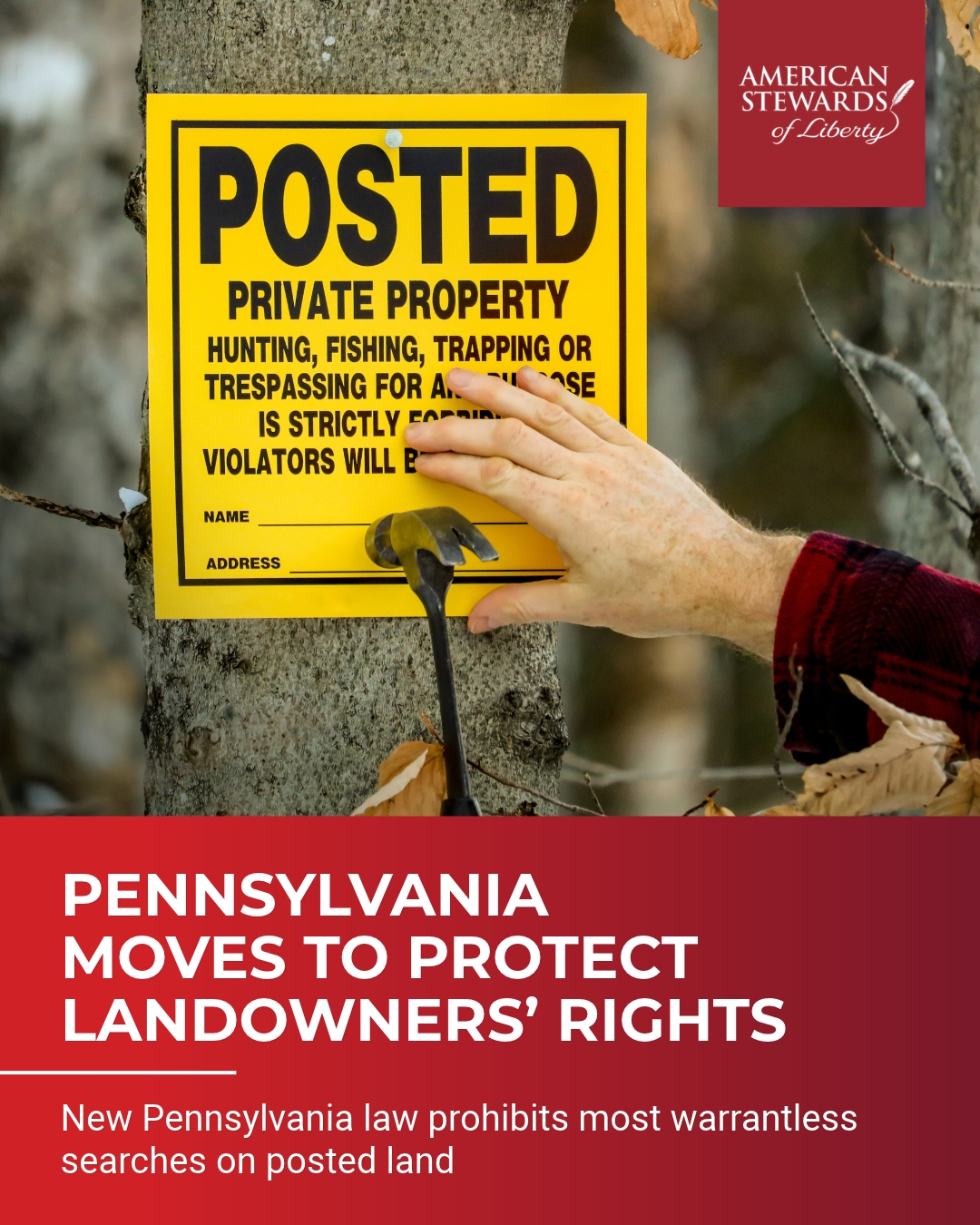
New Pennsylvania law prohibits most warrantless searches on posted land
Pennsylvania has enacted legislation curbing the authority of state game wardens to enter posted private property without a warrant, following a state Supreme Court decision in July that also bolstered constitutional protections for landowners.
Gov. Josh Shapiro signed the bill on October 22. The House had approved the bill 203–0, and the Senate subsequently voted 50–0 to concur in House amendments, sending the measure to the governor.
With enactment, Pennsylvania becomes the latest state to strengthen protections against warrantless government searches on private rural lands. Republican state Sen. Dan Laughlin, who authored the measure, said it was intended to protect constitutional rights while preserving the Pennsylvania Game Commission’s ability to enforce wildlife laws.
“Our game wardens play a critical role in protecting wildlife, enforcing our hunting laws and keeping people safe,” Laughlin said. “Nothing in this bill prevents them from carrying out those responsibilities.”
Indeed, Laughlin said, supporting game wardens and protecting private property rights were not mutually exclusive: “We can and should do both. This bill provides clarity for law enforcement while ensuring the constitutional rights of landowners are respected.”
What the Bill Does
Specifically, the legislation removes the previous grant of blanket authority to Pennsylvania Game Commission wardens to enter private property, including posted land, without warrants or probable cause.
The new law brings the statute into line with constitutional restrictions recognized by the state Supreme Court in July. Game wardens retain the power to investigate suspected hunting violations, enforce wildlife laws, and obtain warrants when necessary, and they may also enter property under legally recognized exceptions to warrant requirements.
But warrantless entry into posted lands without an exigent circumstance or other recognized exception is no longer allowed.
Laughlin’s original legislation proposed to require game wardens to obtain warrants before entering any private property, posted or not. However, the House Appropriations Committee stripped that language from the bill.
The legislation became necessary after the Pennsylvania Supreme Court’s July 21 decision in Punxsutawney Hunting Club v. Pennsylvania Game Commission, which rejected application of the federal open fields doctrine under the Pennsylvania constitution. Liberty Matters reported on that case in July.
The case involved two private hunting clubs whose properties had been repeatedly entered by game wardens without warrants. Officers had conducted surveillance despite no-trespassing signs, locked gates and purple boundary markings intended to exclude intruders.
The court concluded that Article I, Section 8 of the Pennsylvania Constitution provides greater protection than the federal Fourth Amendment for private land beyond the immediate surroundings of a home when owners have taken sufficient steps to exclude intruders.
The justices also overturned their 2007 decision in Commonwealth v. Russo, which had adopted the federal open fields doctrine under state law.
In the hunting club case, the justices noted the lengths the hunting clubs went to preserve privacy on their properties and named that as a deciding factor in the case.
“Moreover, the Hunting Clubs only permit entry onto their properties by members, their members’ guests, contractors who help maintain their properties, and a gas company that owns the subsurface mineral rights to their properties and that accesses its well pad through a defined access trail,” the decision stated. “Collectively, these efforts demonstrate that the Hunting Clubs, at least subjectively, expect that the privacy of their members will be protected when those members are present on the Hunting Clubs’ private land, including their open fields.”
But the more pertinent question, the court emphasized, was whether society was prepared to recognize the Hunting Clubs’ subjective expectation of privacy in their land as reasonable.
“To answer that question, we must first make an important distinction,” the decision stated. “Truly open fields—i.e., private land that is unposted and unbounded—is fundamentally different in kind than private land conspicuously posted with ‘no trespassing’ signs and purple paint and/or bounded by fences, gates, and other structures.”
With respect to the former, the court stated, the landowner has made absolutely no attempt to exclude intruders and/or to advise the public that the land is indeed private, but, in the latter scenario, the landowner has taken steps to notify the public that the land is private and that they should not intrude thereon without permission.
“We believe that a society is both prepared and willing to protect a landowner’s expectation of privacy in his/her affairs conducted on his/her private land located beyond the curtilage as reasonable and legitimate when such landowner has taken sufficient steps to notify members of the public that the land is private and that they should not trespass,” the decision stated.
The Pennsylvania ruling will affect government officers across state agencies because the court expressly applied the warrant requirement to other government officials. It also extends constitutional protections to posted farmland, forests and other rural acreage, even though the federal open fields doctrine generally permits warrantless searches beyond the immediate surroundings of a home.
The decision also has implications beyond Pennsylvania—similar litigation has been filed in other states, including Alabama, Louisiana and Virginia. A Tennessee appeals court also ruled against warrantless surveillance of private land in 2024.
That decision in Rainwaters v. Tennessee Wildlife Resources Agency also relied on protections in the Tennessee Constitution rather than the federal Fourth Amendment. State officials subsequently declined to appeal, leaving the ruling intact.
In that case, a state constitutional challenge sought to vindicate the right of Terry Rainwaters and Hunter Hollingsworth, two Tennessee landowners, to be free from unreasonable warrantless entries and digital surveillance of their private properties.
“Terry owns about 136 acres of rural property along the Big Sandy River in Camden, Tennessee, where he lives, farms, and hunts,” their complaint stated. “Most of Terry’s property lies behind a locked gate and ‘No Trespassing’ signs. It is not open to the public. Yet in December 2017, Tennessee Wildlife Resources Agency (TWRA) officers entered Terry’s property—without a warrant or probable cause—and installed two surveillance cameras to monitor Terry for potential violations of state wildlife laws.”
Before discovering the cameras, Rainwaters reported seeing TWRA officers roaming around his property without permission, the complaint alleged.
Meanwhile, Hollingsworth owned about 93 acres of rural property along the Big Sandy River in Camden, Tennessee, where he farmed, camped, and hunted, and he reported the same conduct. In Hollingsworth’s case, the complaint continued, on at least three occasions, TWRA officer Kevin Hoofman spent hours wandering around the property, taking covert photos and video footage of Hollingsworth and his guests.
The appeals court said the conduct turned the idea of a reasonable standard for warrantless searches on its head.
“Considered in the relation to the circumstances of the present case, what the TWRA is arguing is reasonable stands in opposition to the restraint upon unreasonable searches and seizures that emerged from the American colonial era in opposition to arbitrary British search practices,” the court wrote. “Under what the TWRA purports to be a reasonable search, each agent is empowered with the discretionary authority to determine for himself or herself if there is a reasonable basis to suspect hunting activities are occurring on the property.”
What’s more, the court continued, the TWRA does not notify the property owners of its entries or keep records.
“How often and for how long and whether their entry is concealed or not are matters of discretion for the TWRA agents to decide for themselves,” the court observed. “There is no clear system of judicial review that allows consideration of the TWRA’s entries upon private property or their agents’ comportment thereupon.”
Even in the case at hand, where the entries had been brought to the court’s attention through the plaintiffs’ suit, the TWRA had not even attempted to support those entries with an individualized showing of sufficient basis to justify entry into the property, the court stated.
“Instead, the TWRA asserts that their approach is systematically reasonable because its officers only search if they conclude that they have a reasonable belief that hunting is occurring or has occurred,” the court concluded. “The TWRA searches, which it claims are reasonable, bear a marked resemblance to the arbitrary discretionary entries of customs officials more than two centuries ago in colonial Boston.”
The court rejected the agency’s justification for warrantless searches.
“The TWRA’s contention is a disturbing assertion of power on behalf of the government that stands contrary to the foundations of the search protections against arbitrary governmental intrusions in the American legal tradition, generally, and in Tennessee, specifically,” the court concluded. “Simply stated, given the purpose of Article I, Section 7 of preventing arbitrary intrusions upon privacy and personal liberty, what the TWRA claims is reasonable is not.”