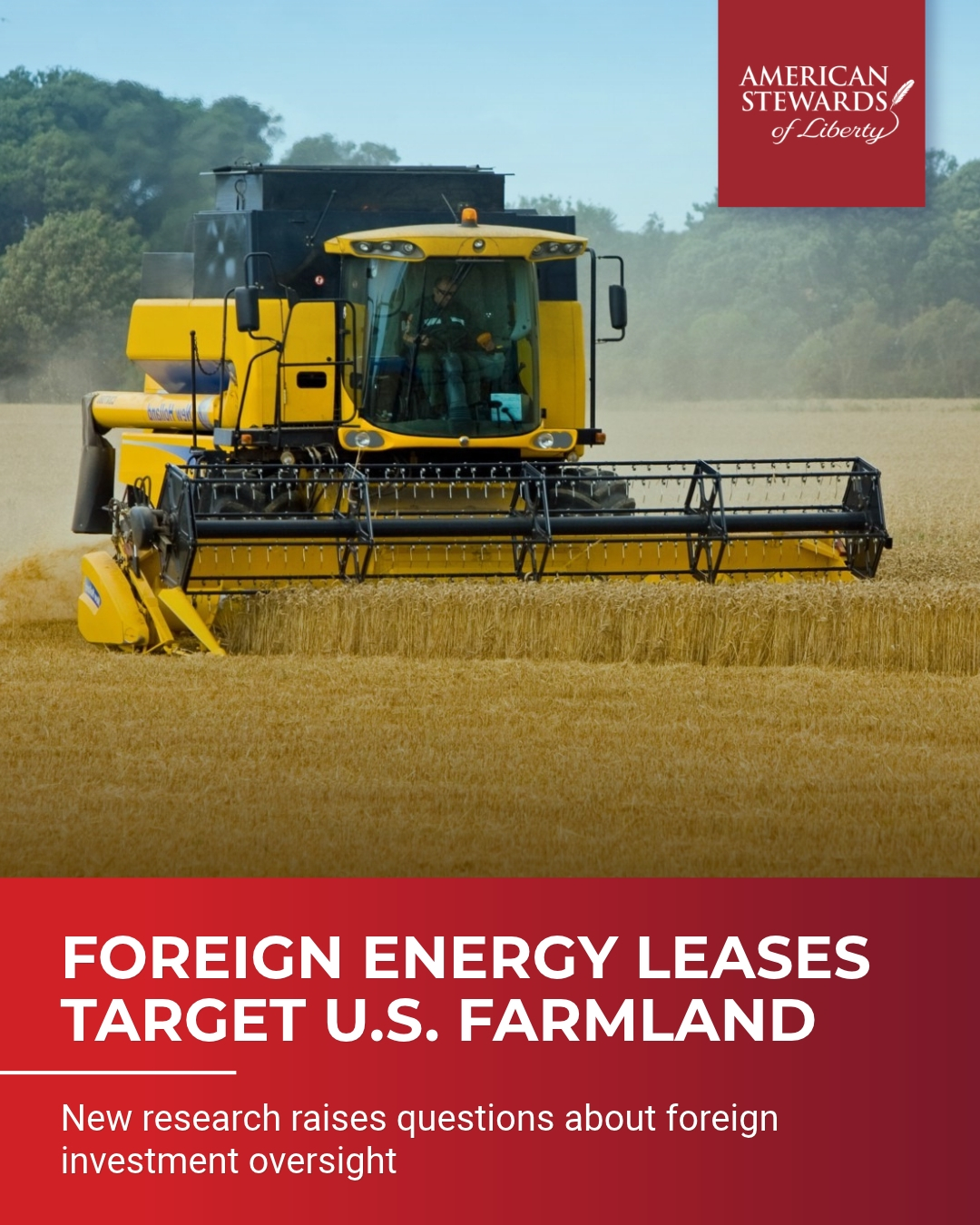
New research raises questions about foreign investment oversight
Foreign entities hold approximately 6.3 million acres of American agricultural land under long-term wind and solar leases across 555 counties in 42 states, according to research released last week.
All totaled, foreign entities hold approximately 6.9 million acres of American land in long-term agricultural leases.
Oklahoma leads in wind and solar foreign leasing with more than 1 million acres, followed by Texas, Nebraska, New Mexico, and Kansas. About 76 percent of the acreage is cropland.
The analysis by University of Illinois researchers Bruce Sherrick and Juo-Han Tsay examined USDA records through December 31, 2024. The researchers published their findings October 14 in farmdoc daily.
Wind accounted for approximately 5.3 million acres, solar for 686,166 acres, and projects identified with both accounted for another 251,202 acres.
In 83 counties, 5 percent or more of farmland was under foreign-agricultural wind and solar leases, while in six counties it was 25 percent or more. Because the Agricultural Foreign Investment Disclosure Act (AFIDA) reports whole-parcel acreage, those shares represent the upper bounds on the land actually used by energy facilities.
Among foreign entities, Canada accounts for 59 percent of foreign-held energy lease acreage, followed by Italy at 14 percent, the United Kingdom and Denmark at 6 percent each, the Netherlands at 5 percent, and France at 4 percent. However, USDA data shows that China, Russia, Iran, and North Korea also have holdings.
The Illinois researchers observed an important feature needed for interpreting leased acreage.
“First, AFIDA indicates the total acreage of the parcel associated with the lease, not the area actually used,” the researchers wrote. “A wind lease may cover an entire farm even though turbines, access roads, and other equipment occupy a small share of the leased area. Utility-scale solar is different where panels occupy most of the area within a project, so solar leases are more likely to take land out of crop production for the life of the project.”
Disclosure Law
Right now, under the AFIDA, foreign entities must disclose qualifying interests in American agricultural land, including leases of 10 years or longer. AFIDA, however, is a disclosure law; it does not restrict foreign investment.
National security concerns have focused particularly on investments by countries considered adversaries of the United States, and a 2024 Government Accountability Office (GAO) report raised issues regarding USDA data collection and reporting with respect to foreign investments in farmland.
In addition, some lawmakers have expressed support for stricter disclosure requirements for foreign investors from adversarial countries and for investors that use complex organizational structures, for improvements to data collection generally, and for better reporting of AFIDA, the Congressional Research Service has reported.
In response to congressional directives and to the GAO recommendations, USDA launched an electronic reporting portal in January to improve the collection and verification of foreign agricultural land disclosures.
The USDA portal is part of its National Farm Security Action Plan, announced in July 2025. The initiative seeks to strengthen enforcement of AFIDA through better verification, monitoring and disclosure of foreign agricultural land interests, the USDA states.
Agriculture secretary Brooke Rollins has emphasized that the administration intends to increase monitoring of investment in American farmland, particularly investments involving foreign adversaries.
“President Trump is putting America First, and this includes increasing transparency and scrutiny of one of our most valuable national assets, American farmland,” Rollins said. “We are working to improve reporting of foreign owned land in the United States. This move to streamline the reporting portal will increase compliance and assist our efforts to effectively enforce accurate reporting of interests held by foreign adversaries in U.S. farmland. The online portal will allow us to obtain verifiable information about foreign interests in American agricultural land and protect the security of our farmers.”
USDA subsequently proposed sweeping changes to AFIDA regulations in June 2026. According to a breakdown of the proposed rule by John Young of the law firm Norton Rose Fulbright, the rule would expand the definition of agricultural land subject to reporting to include wind and solar projects, pipeline projects, as well as cutting a reporting exemption for easements and leases lasting 10 years or less, reducing that to one year.
Foreign adversaries would be required to disclose leases regardless of duration.
The proposal would also require more detailed identification of beneficial owners and impose substantially higher penalties for failing to report.
“Beneficial owners are defined as any foreign persons that, directly or indirectly through any contract, understanding, relationship or other arrangement, exercise decision-making authority over the agricultural land or the legal entity holding it, including the power to direct the sale, lease or use of the property,” Young wrote. “Beneficial owners would automatically meet the definition of significant interest or substantial control regardless of the size of their economic interests. Any interest held by a foreign adversary or Foreign Adversary Controlled Entity would also be included under the definition regardless of amount.”
Failure-to-report penalties would rise dramatically, Young reported.
Those penalties could reach 2.5 percent of the property’s fair market value every seven days for foreign adversaries, subject to a 25 percent cap, after a flat penalty of $250 on the 91st day after acquisition.
The changes would strengthen federal oversight but also expand compliance obligations for legitimate foreign investors, Young observed.
In addition to the penalties, Young reported, the expansion of the agricultural land definition to include solar and wind generation and pipeline transportation is the most significant change.
“Foreign-owned energy companies that lease agricultural land for wind or solar development, including those currently exempt as holding leases of less than 10 years, may find themselves newly subject to reporting obligations when the final rule takes effect,” he reported.