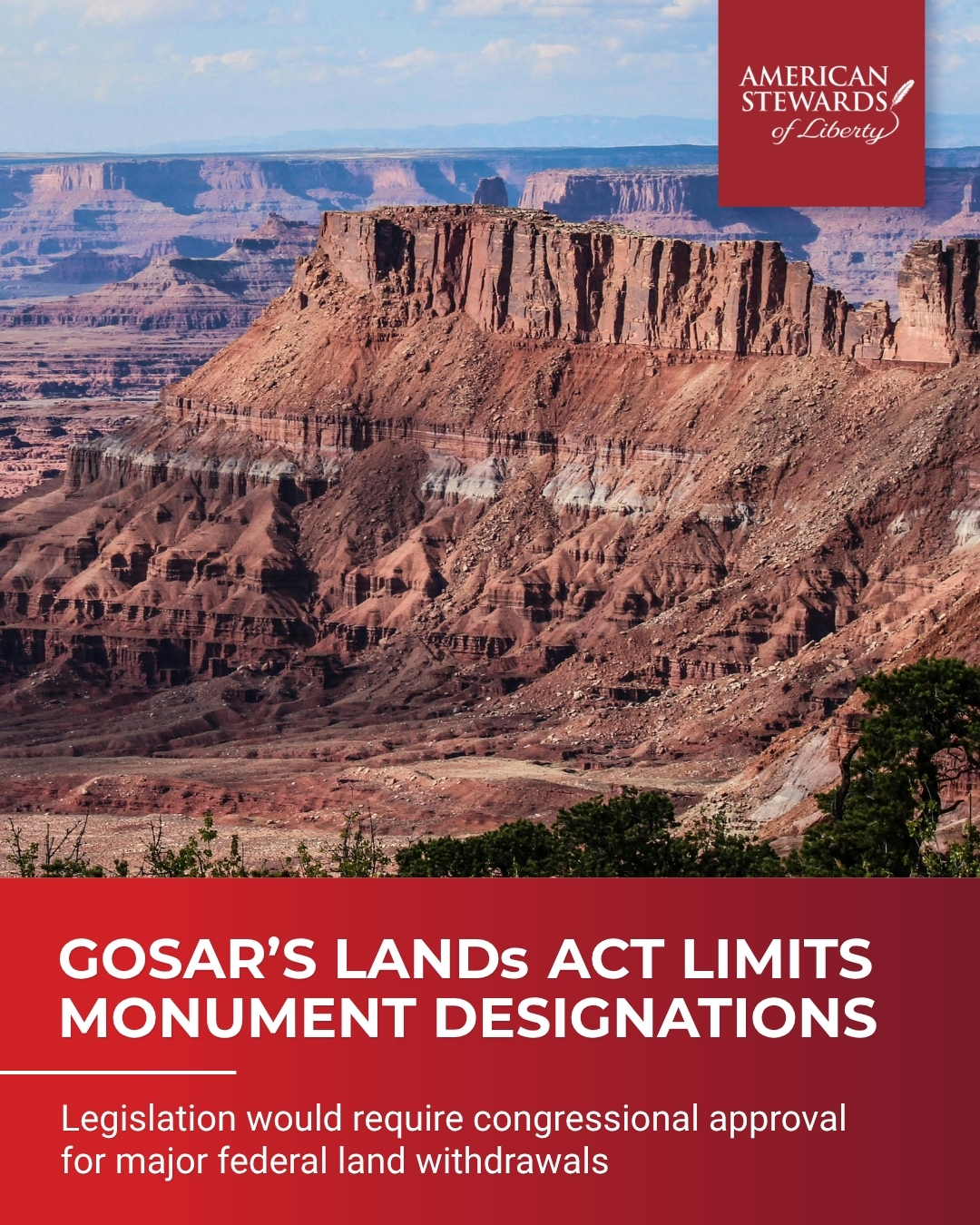
Legislation would require congressional approval for major federal land withdrawals
Arizona Rep. Paul Gosar has introduced the Legislative Approval for National Designations Act, or LANDs Act, which aims to restore congressional authority over major federal land withdrawals and reduce the President’s power to lock-up land with the stroke of a pen.
Gosar said passage of the legislation would rein in unilateral executive action under the Antiquities Act. That law gives presidents authority to designate national monuments on federal lands to protect historic, archaeological, and scientifically significant resources, but Gosar says presidents have transformed that legitimate authority into a mechanism for restricting the multiple use of public lands.
“For more than a century, the Antiquities Act has been abused to allow presidents to lock up enormous amounts of public land with the stroke of a pen,” Gosar said in introducing the bill. “That is not how representative government is supposed to work. The LANDs Act puts the people and their elected representatives back in the driver’s seat. If millions of acres are going to be withdrawn from multiple use, Congress should have a say.”
American Stewards of Liberty (ASL) executive director Margaret Byfield said the legislation would restore a basic principle of representative government.
“Decisions that lock up vast areas of federal land should not be made without Congress and the people’s elected representatives having a voice,” Byfield said. “By requiring congressional approval for major land withdrawals, focusing the Antiquities Act on actual objects of antiquity, protecting private property, and preserving state authority over water rights, this bill brings much-needed accountability to federal land policy.”
Under the bill, any federal land withdrawal exceeding 5,000 acres would require congressional approval. For national monuments specifically, presidential designations would ordinarily be capped at 640 acres without congressional approval, reinforcing the Antiquities Act’s existing requirement that monuments encompass the smallest area compatible with protecting the object involved.
In addition, the LANDs Act would prohibit new national monument designations within 50 miles of another monument and would require private property owners’ written consent before a national monument could encumber their property.
The bill would also prohibit reserving water rights through a designation and include a revised definition of the antiquities eligible for protection. It does provide for an exception for emergency designation for no more than one year to prevent “imminent and irreparable harm” to a covered antiquity,
From Protecting Antiquities to Controlling Landscapes
According to a February 2025 Congressional Research Service (CRS) report, Congress enacted the Antiquities Act in 1906 amid concerns about theft and destruction at archaeological sites. Lawmakers designed it to provide an expeditious means to protect federal lands and resources.
Specifically, the CRS report explains, the Act authorizes the president to proclaim national monuments on federal lands containing “historic landmarks, historic and prehistoric structures, and other objects of historic or scientific interest.” The president is directed to reserve “the smallest area compatible with the proper care and management of the objects to be protected.”
“President Theodore Roosevelt used the authority in 1906 to establish Devils Tower in Wyoming as the first national monument,” the report states. “Of the 21 presidents since 1906, 18 have used Antiquities Act authority to establish, enlarge, diminish or otherwise alter national monuments.”
But presidential use of the authority has expanded dramatically. Franklin Roosevelt exercised the authority most frequently —36 times —but Barack Obama proclaimed the greatest amount of monument acreage, about 554 million acres, primarily through two expanded marine monuments, the CRS observed. All totaled, Obama designated 29 new monuments and enlarged five others, while President Joe Biden designated 10 new monuments, enlarged four monuments, and redesigned one. Presidents have proclaimed 168 monuments, including marine areas.
The pace and scope of activity have become a central concern for supporters of Gosar’s legislation, namely, that an authority created so that a president could quickly protect particular antiquities has become capable of determining the management of extraordinarily large areas without going through the ordinary legislative process.
As a result, a lot of those designations have been contentious, the CRS report explains.
“Litigation and legislation related to the law have been pursued throughout its history,” the report states. “To give one historical example, displeasure with President Franklin D. Roosevelt’s proclaiming of the Jackson Hole National Monument in Wyoming in 1943 (which became Grand Teton National Park) prompted litigation on the extent of presidential authority under the Antiquities Act, and led to a 1950 law prohibiting future establishment of national monuments in Wyoming unless Congress made the designation.”
The report also cites litigation against President Carter’s 1978 establishment of monuments in Alaska, which led to a statutory requirement for congressional approval of land withdrawals in Alaska larger than 5,000 acres.
“President Clinton’s proclamation of the Grand Staircase-Escalante National Monument in 1996 (1.8 million acres) triggered several lawsuits, a law authorizing land exchanges, a law altering the borders of the monument, and proposals to amend or revoke presidential authority under the Antiquities Act,” the report states.
Defenders of the existing Antiquities Act contend that its great virtue is precisely its speed. Presidents can protect vulnerable archaeological, historic, and natural resources before looting, vandalism, development, or other permanent changes occur, they say.
They also point out that presidents of both parties have exercised the authority, courts have mostly upheld presidential designations, and some monuments that provoked fierce opposition when created eventually became enormously popular. For example, the Grand Canyon’s 1908 monument designation was challenged but ultimately became part of one of the world’s best-known national parks.
But that argument also crystallizes the question the LANDs Act raises: whether the desirability of a particular monument justifies allowing one president to make land-use decisions of enormous scale without congressional approval.
Spoiler alert: It does not.
The Underlying Disputes
The flip side of the argument is, of course, that presidents can use monument designations as political weapons to restrict the productive multiple use of federal lands and to cripple unfavored economic development. The 2025 CRS report acknowledged those concerns and cites evidence supporting their legitimacy.
“Monument designation can limit or prohibit land uses, such as development or recreational uses,” the report states. “Limitations or prohibitions may be included in the proclamations themselves, accompanying administration statements, management plans developed by the agencies to govern monument lands, agency policies, or other sources. Some use issues may not arise for particular monuments given their distinctive characteristics, for instance, their small size or water-based nature.”
That was precisely the concern raised last week by Simone Griffin, the policy director at BlueRibbon Coalition.
“Massive federal land designations move lands away from their traditional multiple-use management and toward single-use restrictions,” Griffin said. “Large-scale designations have lasting negative consequences for communities, access, economic opportunity, and the management of our natural resources. Those decisions deserve the scrutiny of Congress and the people’s elected officials.”
Another primary objection to national monuments is that the declaration might not only change the property’s management by restricting uses but also do so by relying on vague authority, the report states.
“At least over the past 50 years, monument proclamations typically have had explicit protections for valid existing rights for land uses, but the extent to which designations may affect existing rights is not always clear,” the report states. “A common concern is that monument designation potentially could result in new constraints on development of existing mineral and energy leases, claims, and permits. Some fear that mineral exploration and extraction activities may have to adhere to a higher standard of environmental review, and may have a higher cost of mitigation, to ensure compatibility with the monument designation.”
There’s a basis for those concerns, the CRS report states.
“Most monument proclamations since 1996 have barred new mineral leases, mining claims, prospecting or exploration activities, and oil, gas, and geothermal leases, subject to valid existing rights,” the report states. “This has been accomplished by language to withdraw the lands within the monuments from entry, location, selection, sale, leasing, or other disposition under public land laws, mining laws, and mineral and geothermal leasing laws.”
In some cases, provisions of proclamations that withdraw monument lands from new energy and mineral development have been controversial, as was the case for the 1996 proclamation of the Grand Staircase-Escalante National Monument: “President Trump’s 2017 reduction of this monument, and the Bears Ears National Monument, provided for the lands removed from the monuments to be opened to energy and mineral development. President Biden’s 2021 enlargement of both monuments withdrew the monument lands from new energy and mineral development.”
In July 2026, Trump again sharply reduced both monuments and reopened excluded lands to mining, mineral, and geothermal leasing, subject to other applicable federal protections. So the monument designations have become something of a political volley, with Congress sitting on the sidelines.
Another concern is whether commercial timber cutting would be restricted as a result of designation.
“For instance, President Clinton’s proclamation of the Giant Sequoia National Monument (in 2000) expressly precluded future timber production, although certain then-current logging contracts could be completed,” the report stated. “In many other cases, the proclamations have implied, through a general prohibition against removing any ‘feature’ of the monuments, that timber cutting is precluded. … Logging supporters assert that forests can be used sustainably and that concerns raised by environmentalists as grounds for limiting commercial timber operations do not reflect modern forestry practices.”
Other concerns raised include the possible effects of monument designation on fishing and grazing, and some proclamations have restricted these activities to protect monument resources. What’s more, monument management plans may impose additional restrictions.
“For instance, proclamations for some marine monuments established by President George W. Bush restricted or prohibited commercial and recreational fishing,” the report states. “President Obama’s expansion and establishment of marine national monuments appears to have enhanced focus on the potential effect of monument designations on fishing.”
Then, in 2014, President Obama’s expansion of the Pacific Remote Islands Marine National Monument prohibited commercial fishing within the expanded monument’s boundaries while permitting other types of fishing, such as noncommercial, recreational, and scientific and research purposes.
“In addition his 2016 proclamation establishing the Northeast Canyons and Seamounts Marine National Monument generally banned commercial fishing and phased out red crab and American lobster commercial fishing,” the report stated.
President Trump’s 2020 proclamation modifying the monument removed those restrictions, although President Biden’s 2021 proclamation restored them.
Finally, states and counties have frequently viewed restrictions on federal lands within their jurisdictions as threats to economic development.
“They maintain that local communities are hurt by the loss of jobs and tax revenues that results from prohibiting or restricting future mineral exploration, timber development, or other activities,” the report stated. “Some contend that limitations on energy exploration could leave the United States more dependent on foreign oil.”
But the critical focus has been the way monuments are created, including the absence of a requirement for state or congressional approval before a presidential proclamation and a perceived inconsistency between the Antiquities Act and other laws governing land withdrawals, environmental review and public participation. The LANDs Act’s stated bottom line is to empower elected representatives of affected lands to determine which uses best suit their communities, including livestock grazing, energy and mineral development, timber production, recreation, wildlife and fish protection, or national monument restrictions.
For more than a century, the Antiquities Act has allowed presidents to protect historic and scientific resources without waiting for Congress, but what began as authority to protect particular objects using the “smallest area compatible” with their protection has evolved into presidential power to designate enormous landscapes—and, increasingly, marine areas—with major consequences for grazing, energy, mining, recreation, water and surrounding rural communities.
The LANDs Act would not repeal the Antiquities Act, but, as Byfield said in support of the Gosar bill, it would draw boundaries around presidential authority and require Congress to approve the largest land withdrawals and monument designations, thereby restoring the basic premise of representative government.