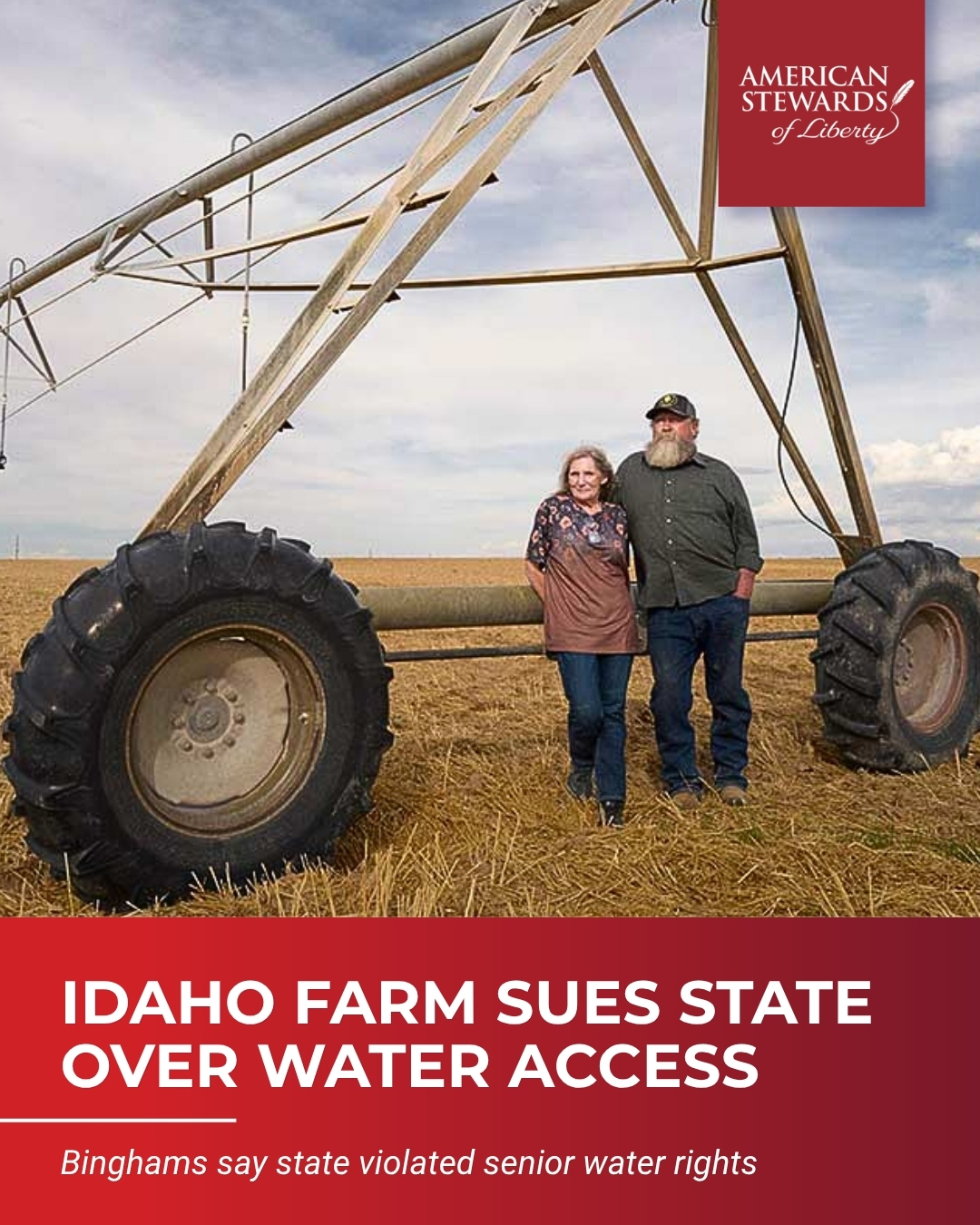
Binghams say state violated senior water rights
An Idaho farming family that has worked the same land for generations is challenging the state after a state agency ordered the family to stop pumping water despite holding some of the region’s senior water rights.
Jerry and Valerie Bingham say that Idaho’s Department of Water Resources (DWR) violated the state’s “first in time, first in right” system by curtailing their water while permitting junior users who agreed to participate in state-approved mitigation plans to continue pumping.
In September, after suffering under a near-total pumping prohibition for more than a year, the Binghams filed a lawsuit, arguing that the DWR violated state law by failing to respect the senior priority of their water rights and by taking those rights in violation of the Idaho and U.S. constitutions. Represented by Pacific Legal Foundation (PLF), the Binghams say they simply want to return to what they say is a lawful, predictable framework that Idaho farmers need to steward resources, grow food, and plan for the future.
“The case is about more than one family’s farm,” Damien Schiff, PLF senior attorney said. “It asks whether the institutions governing scarce resources will give people the certainty to invest, steward those resources responsibly, and produce an abundant future, or whether arbitrary decisions will make all three harder.”
The Bingham family has farmed about 1,000 acres near Blackfoot in Bingham County since 1950, raising crops, including wheat, alfalfa, and potatoes. Jerry Bingham grew up on the farm and took over its operation after his father died.
According to the complaint, farming operations are not sustainable without the ability to irrigate crops. The Bingham family owns extensive water rights dating back to 1950 and, except for a 1987 right, are among the most senior in the Eastern Snake River Plain aquifer.
All of which goes to the heart of the dispute: Idaho’s doctrine of prior appropriation. State law provides that, among competing “appropriators,” the user who acquired the water right first generally has priority, a principle known as the western water-law principle of “first in time, first in right.” The doctrine applies to groundwater as well as surface water.
“Under Idaho law, when there is insufficient water to satisfy the legal entitlements of all users, a senior user may place a ‘call’ for water with the department,” the complaint states. “In the Snake River basin, a ‘call’ was submitted to the department in 2005 by a coalition of senior surface water users. This call required the department to curtail the amount of water used by users with rights junior to those senior surface water users.”
That practice, administered under state management rules, continued for a score of years, PLF asserts. Then things changed.
“But in July 2025, the department issued a general curtailment order that required all groundwater users with water-right priority after 1900 to completely curtail groundwater pumping unless they agreed to operate under a department-approved mitigation plan or joined a water district with an approved mitigation plan,” the complaint states. “This resulted in a total curtailment of the Bingham family’s water rights.”
Subsequent curtailment orders have continued to restrict the family’s pumping, PLF observes, and the result has been a near-total loss of access to groundwater since July 2025.
“Owing to the July 2025 curtailment order, and subsequent orders issued by the department, the Bingham family has been unable to pump any groundwater (except for a brief period in the spring of 2026),” the complaint states. “These curtailment orders applied to the Bingham Family without regard to the relative seniority of their water rights among those users with rights arising after 1900. But under Idaho’s law of prior appropriation, the department, in its curtailment orders and mitigation plan, must respect the relative seniority of water rights possessed by groundwater users.”
Far from respecting those rights, the family alleges, the state turned that hierarchy on its head.
“The Department did not do so here, but instead prohibited the Bingham family from using water while allowing junior water users (who had agreed to a department-mandated mitigation plan) to use the water to which the Bingham family was and is entitled,” the complaint states. “Moreover, no possible exception to observance of strict priority—such as lack of beneficial use, futility, or waste—could excuse the department’s actions, because no such exception was or is applicable to the Bingham family’s use of their water rights.”
As Real as Murder
Bureaucracies often view land disputes through the lens of almost zealous abstraction, disconnected from real people and seeing only mirages of form in a hazy distance. On the bureaucratic side, fought in courtrooms and through jungles of intermingled code, the ephemerality of regulatory function can be easily dismissed for the sake of administrative will and purposes. Bureaucrats seldom have to look their victims in the eyes.
For the victims, it’s no abstraction, especially for the Binghams. Their complaint says the curtailments have prevented them from planting and harvesting crops normally. Without dependable access to irrigation water, they also say they cannot make ordinary decisions about future planting, insurance, contracts, and financing.
“The deprivation by Defendants of the Bingham family’s water rights has nearly destroyed their farm and livelihood by preventing them from raising and harvesting crops and by inflicting catastrophic financial losses, which continue to the present day,” the complaint states. “Without water and without crop income, farm operations are unsustainable, and the Bingham family faces the loss of the good credit that they have worked their entire lives to build, the possibility of loan defaults, and the specter of bankruptcy.”
The losses have piled up in just a short period of time, PLF asserts.
“For 2025 and 2026, the Bingham family was unable to plant potatoes on their farm and had to rent land, resulting in estimated lost revenues from not being able to plant and harvest potatoes (because of added costs for rents) of approximately $300,000,” the complaint states. “The curtailment also substantially limited the value of the wheat crop harvested on the farm for 2026, resulting in estimated lost revenue from not having adequate water for the wheat crop of approximately $388,000.”
The Binghams say they attempted to resolve the problem without litigation. PLF says they proposed five different mitigation strategies that would allow them to preserve their water rights and continue farming, but none was accepted.
“Despite the Bingham family’s diligent efforts to lift the curtailment orders, propose multiple mitigation plans, and pursue administrative and judicial challenges to defendants’ curtailment orders, defendants have refused to permit the Bingham family to access or use their property or compensate them for taking their property,” the complaint states.
From Water Dispute to Property-Rights Case
And so in September, the Binghams sued, making an inverse condemnation claim, that is, a lawsuit in which a property owner alleges that the government has effectively taken private property without formally using eminent domain and without paying the constitutionally required just compensation.
Rather than merely asking whether the state administered water rules incorrectly, the family argues that its water rights are constitutionally protected private property and that the government effectively took those rights when it prevented the Binghams from using their water while permitting junior users to continue pumping.
“The department’s curtailment orders deprived the Bingham family of their private property by disregarding the seniority of the Bingham family’s water rights under the Idaho doctrine of prior appropriation and prohibiting them from using the water they had the senior right to use,” the complaint asserts. “Allowing a junior holder of water rights to divert water from a senior holder ‘is contrary to the underlying basic principle of water rights in the State of Idaho, that first in time is first in right ….’”
The complaint relies on both the Idaho Constitution and the Fifth and Fourteenth Amendments.
“All water rights (whether senior or junior) are constitutionally protected real property that cannot be taken without just compensation,” the complaint states. “This is precisely what defendants’ curtailment orders have done—disregard the Bingham family’s constitutionally protected priority in favor of junior water users.”
The lawsuit seeks just compensation—the full and perfect equivalent of the property taken—interest dating from the alleged initial taking on July 25, 2025, applicable business damages, costs, and attorney fees.
Separately, the Binghams are seeking a stay of the curtailment pending the outcome of the dispute. Their filing argues that immediate relief is necessary because uncertainty about whether they will have water prevents them from planning the next growing season and threatens the farm’s survival.
“Without immediate relief, the Binghams cannot make prudent planting, insurance, contracting, and financing decisions because of the department’s total curtailment,” their memo in support of a motion to stay states. “This inability to plant and plan for next year’s growing season threatens bankruptcy for the Binghams and their family farm. Because the department’s order illegally disregards the priority system at the center of Idaho water law, and because the balance of harms overwhelmingly favors preserving the Binghams’ ability to use their relatively senior rights while this court reviews the department’s action, the court should stay enforcement of the curtailment order.”