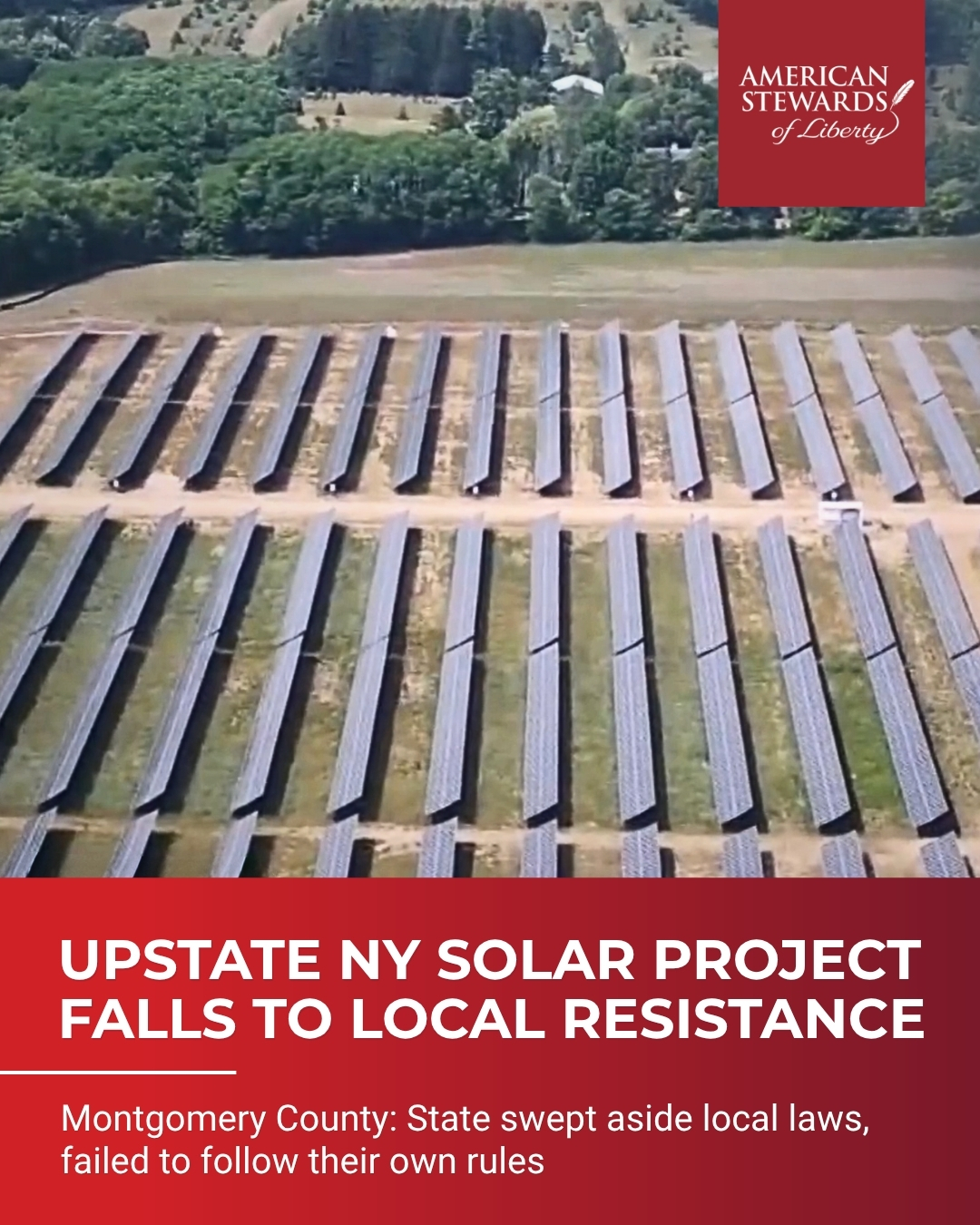
Montgomery County: State swept aside local laws, failed to follow their own rules
In a major victory for upstate New York property owners and citizens, a massive solar development planned for Montgomery County appears headed for the dust bin after years of resistance from local governments, residents, and the area’s Amish farming community.
Flat Creek Solar NY LLC had proposed a 300-megawatt solar facility in the towns of Root and Canajoharie. New York’s Office of Renewable Energy Siting and Electric Transmission (ORES) issued a final siting permit on April 3, but, on September 15, the developer informed state officials that it did not intend to exercise its rights under the permit and sought to relinquish it “without prejudice.”
Flat Creek also asked for the unused portion of its $300,000 project deposit to be returned and acknowledged that, if it later decided to pursue the project, it would have to begin the pre-application process from scratch and submit a new application.
Flat Creek Solar NY LLC was established as a wholly owned subsidiary of Toronto-based Cordelio Power, then wholly owned by the Canada Pension Plan Investment Board (CPP). Pattern Energy Group acquired Cordelio in April, but CPP Investments remains Pattern’s majority shareholder, leaving the project under a corporate parent majority-owned by the Canadian pension fund.
There is one little wrinkle in the company’s withdrawal letter worth keeping an eye on. On September 22, ORES informed Flat Creek that its letter did not satisfy New York’s regulatory requirements for relinquishing a permit because it failed to provide required information, including the reason for relinquishment and the status of remaining permit obligations.
In other words, the developer has declared its intention to abandon the permit, but ORES has not accepted the formal relinquishment as of this writing. So it’s technically alive, if practically dead. However, because there are no rules in the “green” globalist war on American property and prosperity, that administrative detail is especially important to remember given that ORES does not want the project to die.
But for now, chalk it up as a big win for landowners and citizens fighting a massive invasion of foreign-owned solar and wind projects that threaten New York’s farmland and our national security. U.S. agriculture secretary Brooke Rollins praised the withdrawal and delivered a message to New York state officials.
“America should never be forced to sacrifice its most productive farmland to satisfy a radical energy agenda,” Rollins posted on X. “@USDA will continue standing with American farmers, protecting the land that feeds our nation, and ensuring rural communities have a voice when their future is on the line. [NY] Governor [Kathy] Hochul should listen to New York’s farmers, not steamroll them.”
Liberty Matters has already reported on those efforts, led in large part by upstate resident and native Alexandra Fasulo, who has galvanized an unprecedented movement for property rights and local control in this very government-tilted state.
Allies in the Battle
Fasulo has a lot of help. In fact, long before Flat Creek decided to walk away, Montgomery County had been building an aggressive challenge to New York’s renewable-energy siting regime. At an August 20, 2025, public comment hearing, Montgomery County attorney Meghan Manion told an administrative panel that ORES and Flat Creek had declined to comply with the law.
That could not stand, Manion told the judges.
“I’m the Montgomery County attorney for those of you who don’t know me,” Manion said at the hearing. “And the county sends me because I’m in a unique position in my role to ensure that the county adheres to laws. So I understand the difficult position you are in to look at the petitions and determine if there’s a question of fact.”
Not a problem, Manion told them, because she was actually submitting 80 pages of questions of fact for the judges’ review.
“However, I wanted to just make the record clear tonight that we do have a cumulative impacts law in Montgomery County that ORES has chosen not to follow and deemed it preempted and that the applicant has chosen not to follow,” she said. “But this is a law that represents very significant concerns for Montgomery County government because what’s happening is there’s about ten thousand acres of solar being targeted in Montgomery County at this point, and the legislature had a concern that each of these projects was being looked at in a vacuum without considering the overall impacts on our county.”
She specifically pointed to Amish communities throughout the county that could be cumulatively affected by large-scale solar development.
“In the audience, there are a number of Amish communities here, not just ones directly impacted by this project, but neighboring communities and communities across the county that have come here because this large-scale solar impacts all of them cumulatively across the board,” she said. “So Montgomery County wants to ensure that those rights are protected and that cumulative rights from Montgomery County are protected as a whole.”
Montgomery County residents live amid the regulated landscape, she said, while the judges did not.
“We in Montgomery County, we live here, and we know what it looks like,” she said. “We are proud of it. We live in a beautiful place. But the judges, you guys aren’t from here, and so you don’t see what we see in our beautiful community. I just want to point out that the Montgomery County Scenic Byways Law was passed because we have gorgeous, beautiful vistas in Montgomery County that are on rolling hills. And I just want to show the judges and everyone here tonight that rolling hills are not mitigated by plantings. There’s no way that solar panels can be mitigated by trees.”
Following Manion at that hearing was Terresa Bakner, an attorney with the law firm of Whiteman, Osterman, and Hanna, representing the town of Canajoharie.
“I can tell you that along with Montgomery County, the towns are very concerned about the cumulative impacts on all of these projects in Montgomery County,” she said, adding that town board members had opposed the project from the beginning. “And they have spent funds and a lot of resources to bring their viewpoints in front of ORES. Unfortunately, so far, those viewpoints have been ignored, and we have a draft permit that’s been issued that overwhelmingly grants the developer exemptions for the very laws that were put into place to protect the visual environment and to protect the people in the town.”
Town and citizen objections to the project had been overwhelming, Bakner said, in part because of insufficiently mitigated visual impacts where solar panels were proposed immediately adjacent to the town’s most heavily used recreational fields.
“Come to cheer your child on in football and soccer and look at our solar panels,” she said. “Doesn’t that say great things about our community? … And at every meeting, those concerns have been ignored. The visual simulations show that they’re not, in fact, going to be mitigated. People don’t move here to sit in their houses and not look outside.”
Even more important, Bakner said, was the loss of productive agricultural lands.
“Yes, farmers should have a right to retire when they want to retire,” she said. “But should it be possible to have other farmers move in, farmers like the Amish community that have been moving in from other areas?”
The point was, Bakner said, there were alternatives to solar panels.
“These are a fad,” she said. “They’ll be here, and they’ll be gone, because the ISO (independent system operator) reports have demonstrated that with this solar path, there will not be reliable electricity in New York state anymore.”
As Manion and Bakner asserted, the state did not listen. ORES issued the permit, adding another cap to the wave of solar and wind projects that foreign-controlled corporations ride to impose their land-use will and way, never mind the destruction of farmland, wildlife habitats, religious sites, property rights, or local control. State and local procedural permitting requirements are preempted, and ORES can waive local zoning and other requirements it finds “unreasonably burdensome” in light of the state’s climate targets.
Naturally, the people lost in the administrative tribunals, so the county and towns went to a real court. On June 18, following ORES’s April 3 permit issuance, Montgomery County, the town of Root, the town of Canajoharie, and Residents for the Preservation of the Mohawk Valley (RPMV) filed separate challenges to Flat Creek’s permit. As Fasulo has reported in her work, Montgomery County argued, among other things, that ORES failed to conduct the required review of county laws, improperly denied the county full-party status, improperly determined that the county had raised no substantive and significant issues requiring an adjudicatory hearing, and consequently issued the permit through a legally defective process.
While the developers grappled with those legal challenges, a separate dispute emerged between the project’s corporations and landowners. On August 18, landowners leasing property for the project sued Flat Creek Solar NY LLC, Cordelio Power and related entities, and Pattern Energy Group, which acquired Cordelio earlier this year, in a dispute over allegedly unpaid rent.
And so a big wind was coming: the intersection of financial complications and massive public opposition. It’s hard to know what ultimately prompted Flat Creek to step away—financial disputes, public opposition, legal challenges to the state’s siting processes and laws, the compounding economic burdens of all those, or a combination thereof—but it’s almost certain that the firestorm of grassroots opposition played a significant and perhaps deciding role in the decision.
In any event, Flat Creek’s apparent demise completes an extraordinary chronology.
Montgomery County, the towns, and residents raised objections through the administrative process. Administrative law judges declined to grant them full-party status after determining that they had not raised substantive and significant issues warranting adjudication. The groups appealed administratively. ORES nevertheless issued the permit. Court challenges followed, and now the developer itself has declared its intent to surrender the permit.
That makes Flat Creek more important in the larger scheme of things. Montgomery County insisted that state preemption did not relieve the state itself of the obligation to follow its own law and procedures, and the argument has resonated.
“It means they are completely giving up its rights under the permit, and if they were to restart, they would have to go back to the very beginning, which is good news for Montgomery County, because we have been challenging all along that this permit does not adhere to Montgomery County local laws,” Manion told local media last week.
For the Amish farmers, neighboring residents, and local officials who spent years opposing Flat Creek, the immediate result is straightforward, barring any shenanigans from ORES, which technically has yet to accept defeat. The people won, and the 300-megawatt development is dead.
For other New York communities confronting large renewable-energy projects, the more lasting question may be whether Montgomery County has demonstrated that local resistance can survive state preemption—not by simply saying no, but by forcing the state to defend how it exercised the enormous authority it gave itself.
The matter has also continued to expose the foreign ownership behind what can only be described as an unprecedented drive by globalist corporations to essentially bully and confiscate vast swaths of New York soil for profit and folly. Flat Creek Solar was developed by Cordelio Power, a Toronto-based renewable-energy company wholly owned by the Canada Pension Plan Investment Board (CPP Investments). In April, U.S.-based Pattern Energy Group acquired Cordelio in a share-based transaction. CPP Investments was already Pattern’s majority shareholder, and the acquisition increased its ownership stake in the company.
For Fasulo, it’s another important victory in her energetic role as a leader of the upstate movement, and she joined in the celebration when Flat Creek announced its withdrawal.
“Montgomery County did not just sit there and take this level of domination over its lands,” Fasulo wrote on her Substack. “The county itself, through a lawsuit filed by Meghan Manion, as well as the towns of Root and Canajoharie and Residents for the Preservation of the Mohawk Valley, challenged New York State over the siting of Flat Creek Solar. The Amish communities and their expert Anabaptist study, uploaded to the Department of Public Service (DPS) Flat Creek Solar docket, were ignored. Individuals attempted to upload GPS coordinates and photos of eagle nests within the project bounds. The Department of Environmental Conservation (DEC) ignored reports of eagles and redacted submissions that made it through the bureaucratic blockade. I drove out to the Flat Creek Solar project site at the end of March 2026 to document the eagles myself.”
It’s tough going sometimes, Fasulo wrote.
“Covering the Office of Renewable Energy Siting (ORES) in New York State has been a depressing pursuit for the last 12 months,” she wrote. “There is hardly ever any good news that spills out of this shadow bureaucratic agency, which was given the legal power to supersede our home rule, local zoning laws, and environmental regulations.”
But, Fasulo stresses, good things can and do happen:
“But cheers erupted from Amish households yesterday when news spread across Upstate New York that, for the first time since ORES was created, a major energy developer had relinquished its final siting permit. Flat Creek Solar, sited in the towns of Canajoharie and Root in Montgomery County, New York, is no more.”
But the movement it spawned is, and it’s going strong.