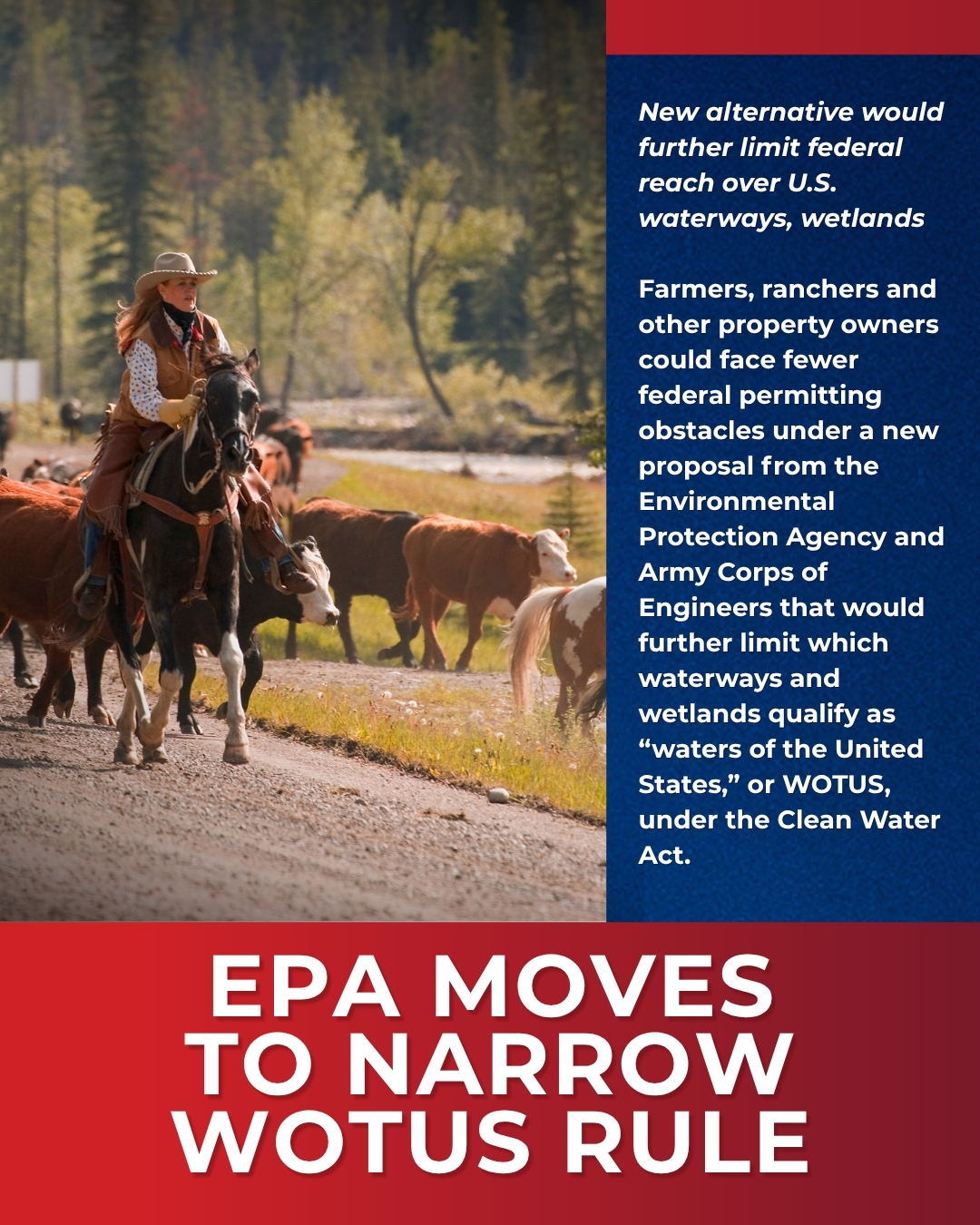
New alternative would further limit federal reach over U.S. waterways, wetlands
Farmers, ranchers and other property owners could face fewer federal permitting obstacles under a new proposal from the Environmental Protection Agency and Army Corps of Engineers that would further limit which waterways and wetlands qualify as “waters of the United States,” or WOTUS, under the Clean Water Act.
The agencies issued a supplemental proposed rule September 9 offering alternatives to portions of the WOTUS rule proposed by the Trump administration last November. The new rulemaking would move away from a reliance on a locally determined “wet season” and instead generally limit federal authority to perennial waters and wetlands having a continuous surface-water connection to those waters.
Both EPA and the Army Corps are still gathering input on the proposed rulemaking, saying the action reflects the agencies’ commitment to radical transparency and to developing a durable, final WOTUS definition that adheres to the Supreme Court’s direction in Sackett v. EPA.
“The EPA’s goal is a durable WOTUS definition that follows the law and ends burdensome regulatory uncertainty,” EPA administrator Lee Zeldin said. “Today’s action reflects our continued commitment to transparency and public input, ensuring we have fully considered a wide range of potential policy options. We look forward to public feedback on this supplemental notice, which will help strengthen the real-world expertise behind the final rule.”
The alternative definitions offered in the supplemental proposal would narrow the scope of federal jurisdiction over waters and wetlands, excluding most intermittent streams and seasonally inundated wetlands from federal regulation.
Adam Telle, assistant secretary of the Army for Civil Works, said the proposed rulemaking represented not just radical transparency but radical reform.
“Under President Trump’s leadership and the Army’s ‘Building Infrastructure, Not Paperwork’ initiative, we are overhauling sclerotic government overreach to remove friction from our economy,” Telle said. “The Supreme Court’s Sackett decision delivered the certainty our nation has been seeking for decades, and today we are taking one more step to ensure our regulations adhere to that decision.”
Telle said the proposed rulemaking adhered to Sackett and provided an even more straightforward articulation of federal jurisdiction under the Clean Water Act.
“All Americans, including landowners, farmers, sportsmen, conservationists, and businesses, deserve the opportunity to further shape this rule, which will enable them to carry out their version of the American Dream free from improper bureaucratic interference,” he said. “The U.S. Army Corps of Engineers stands ready to implement this rule once final, using technology like never before, to give Americans answers from their government at Trump Speed.”
Decades of Uncertainty
The proposal represents the latest salvo in a generational jurisdictional battle between property owners and environmentalists, not to mention between the states and the federal government, over how far federal authority extends under the Clean Water Act.
It’s a crucial question because the statute regulates discharges into “navigable waters,” which Congress has defined as “waters of the United States” but exactly what constitutes WOTUS has divided regulators and landowners and even led to a remarkable Supreme Court decision in which there were five separate opinions and no majority (a 4-1-4 decision in Rapanos), leading to decades of legal confusion.
What’s not confusing is that whoever controls the water controls the land, and, more practically, Clean Water Act violations can result in enormous civil and criminal penalties, while determining whether a particular feature is federally regulated can require a lengthy and expensive Army Corps permitting process.
The latest major ruling came in the Supreme Court’s 2023 Sackett v. EPA decision. The court limited federal jurisdiction over wetlands, holding that covered wetlands must have a continuous surface connection to relatively permanent waters, such that it is difficult to determine where the water ends and the wetland begins.
Yet ambiguity always seems to rise to the top when it comes to government and especially the federal government, and Sackett provided no different outcome, with terms such as “relatively permanent” and “continuous surface connection” remaining vague. The Trump administration attempted to resolve those questions with its 2025 WOTUS proposal, which defined “relatively permanent” waters as bodies of surface water that stand or flow continuously either year-round or during the “wet season.”
However, that immediately begged the question: What is a wet season?
It was open season on that answer, given that the proposed regulatory text contained no definition. The regulated community immediately envisioned endless examinations of regional climate, hydrology, topography, seasonal precipitation, and even evaporation to determine whether a particular water qualified.
There was also the not-so-little problem of no precedent or mention of a “wet season” or a “wet season standard” in the CWA, in Sackett, or other Supreme Court cases. A client alert from the law firm Vinson & Elkins highlighted enforcement concerns because of the lag time between precipitation and wetland inundation. In other words, a rule intended to create certainty threatened to introduce another subjective jurisdictional test.
The supplemental proposal drew a much brighter line. In the new definition, the EPA and the Corps have effectively hung “wet season” out to dry, eliminating it entirely, and are considering confining “relatively permanent” waters to perennial waters, that is, to those containing standing or continuously flowing water every day of the year under ordinary conditions. That would substantially narrow federal jurisdiction by generally excluding waters that flow only seasonally or after significant precipitation.
There is some flexibility in the proposal. A waterway could ordinarily cease flowing for up to 30 consecutive days in a year without losing its jurisdictional status, while unusual events such as qualifying droughts would not necessarily change its classification. The agencies say the approach would be more predictable and could reduce the need for property owners to hire expensive consultants to determine whether federal jurisdiction exists.
The proposal applies a similarly restrictive approach to wetlands. It would tighten the definition of the “continuous surface connection” required for wetlands. Rather than the 2025 proposal’s standard that surface water exist at least during the wet season, the supplemental alternative would delete reference to “wet season” and define continuous surface connections as “perennial surface water in a wetland that is continuously connected with the surface water in the jurisdictional water such that it is difficult to determine where the jurisdictional water ends and the wetland begins.”
It’s also important for landowners to know that merely possessing the physical characteristics of a wetland would not necessarily place land under federal jurisdiction. The proposal says that only portions of a wetland that are effectively indistinguishable from jurisdictional waters would be federally regulated; wetland areas lacking standing or flowing water could fall outside WOTUS.
For farmers, ranchers, builders and other property owners, the most significant consequence would be a greater ability to determine, before undertaking work, whether a federal Clean Water Act permit is necessary. With fewer water features considered WOTUS, some activities that previously might have required costly federal permitting could escape those requirements altogether.
That would not mean such waters are unregulated. Waters outside federal jurisdiction can still be regulated by states, tribes and local governments, EPA emphasizes.
The National Association of Home Builders (NAHB) welcomed the effort to eliminate the uncertain wet-season test, arguing throughout the rulemaking that unclear jurisdictional standards delay residential and mixed-use construction and increase housing costs. NAHB says the new alternatives could make jurisdictional determinations more predictable, though the organization is still reviewing how the perennial-water standard and 30-day exception would work in practice.
Agricultural organizations also reacted favorably. National Cotton Council chairman Nathan Reed said the proposal provides agriculture with greater clarity over which waters are federally regulated.
“We’re pleased that the agencies have published a supplemental proposal that provides more clarity for agriculture on which waters are jurisdictional under the Clean Water Act,” Reed said. “We also appreciate that the agencies attempted to adhere to Supreme Court precedents to create a more durable rule without imposing unworkable burdens on farm operations or creating legal instability across administrative changes.”
The agencies emphasized that the supplemental proposal does not withdraw or replace the November 2025 proposal but will be considered alongside the original proposal and the approximately 220,000 comments already submitted before issuing a final rule.
The comment period runs through October 9.