Attorney general says misleading property-risk predictions depress home values
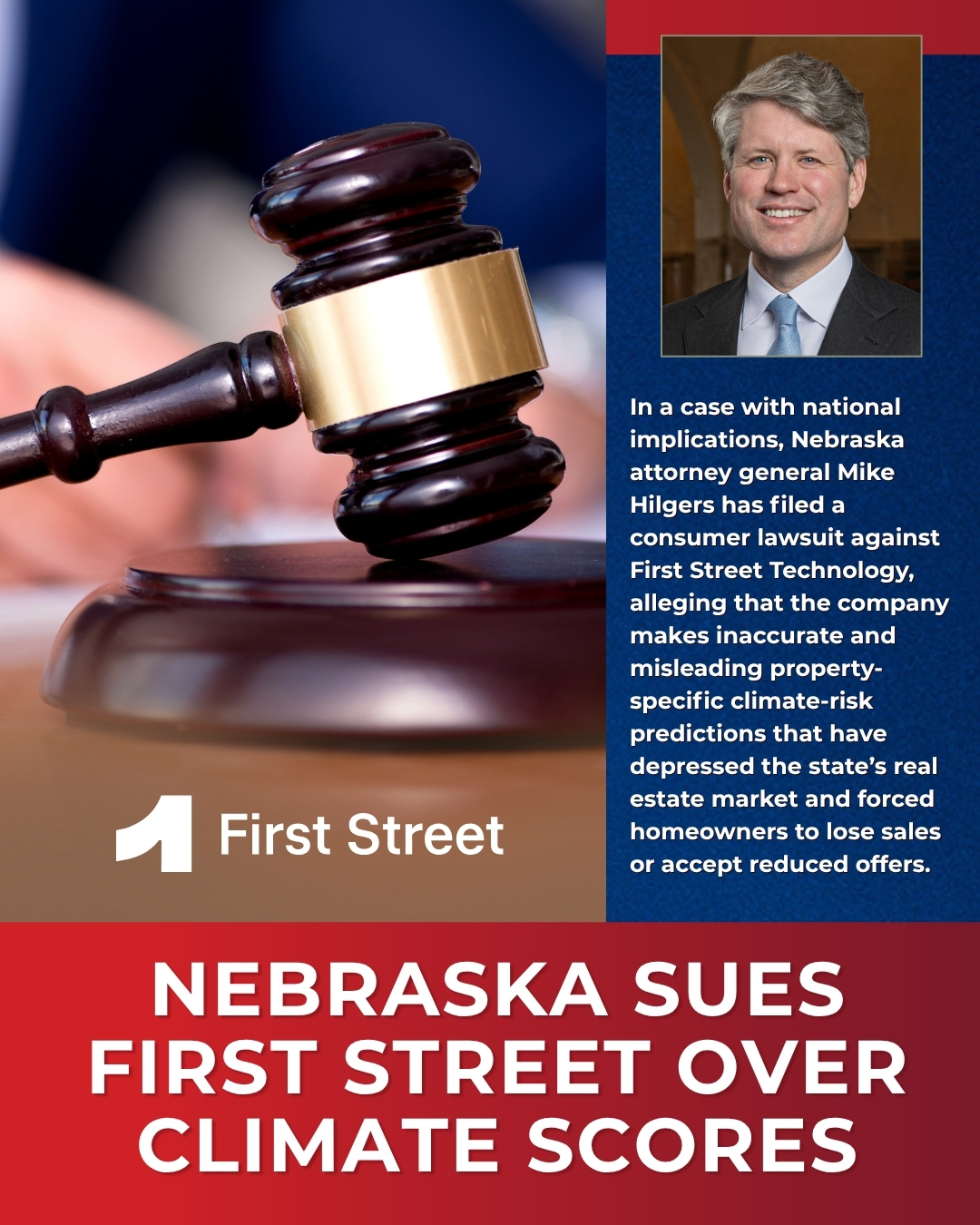
Nebraska attorney general Mike Hilgers has filed a consumer lawsuit against First Street Technology, alleging that the company makes inaccurate and misleading property-specific climate-risk predictions that have depressed the state’s real estate market and forced homeowners to lose sales or accept reduced offers.
The August 27 complaint, filed in Dakota County district court, seeks to stop the allegedly deceptive practices, recover unlawfully earned profits, and impose civil penalties.
“First Street is making a profit at the expense of the value of Nebraskans’ homes,” Hilgers said in filing the lawsuit. “First Street passes off misleading and often inaccurate climate speculation in a way that drives down home values and increases costs and frustrations for Nebraskans. The deceptive behavior has to stop.”
Liberty Matters has been covering this story since last year when American Stewards of Liberty member, Stephanie Cross, first exposed this climate-score controversy. In July, a report by consumer advocates called for a congressional investigation into First Street’s private scoring system and its influence on the housing market. The Nebraska action now bundles those concerns in a state consumer-protection lawsuit with national implications.
According to the Nebraska complaint, First Street claims to offer “accurate and reliable” risk scores for loss events like flood and fire for every parcel of property in Nebraska, but nothing could be further from the truth, with serious consequences for Nebraskans, the state alleges.
“First Street Technology, Inc. passes off inflated and inherently speculative predictions about every Nebraska property’s flood risk as concrete, objective facts,” the complaint states. “But they are not. First Street does not disclose that its predictions are significantly higher than historical claims data and predictions made by other models.”
Neither does First Street disclose that its models fail to consider certain mitigating factors Nebraskans take to protect their property, and that there is no meaningful way for Nebraskans to dispute First Street’s findings, the state alleges.
“The result is catastrophic to Nebraska homeowners—once a Nebraska property has been labeled a climate risk by First Street, Nebraskans face an unexpected and unsolicited burden in selling their property for full value,” the complaint states. “Prospective home buyers see First Street’s Risk Factor scores through real estate portals like Zillow and Redfin. First Street provides those scores without the benefit of material qualifying information about their limitations and uncertainty, all while claiming that it is being ‘transparent.’”
As a result, the complaint continues, Nebraskan homeowners have been unable to sell their homes or have had to accept significantly reduced offers because First Street’s speculative scores spook prospective home buyers. In addition to being inherently speculative, the complaint adds, First Street’s scores are frequently based on objectively inaccurate facts about a particular property’s characteristics.
“And First Street’s expressly stated policy is to refuse to consider consumer complaints regarding such inaccuracies,” the complaint states. “As a result, First Street’s errors go uncorrected, causing significant financial harm to the maligned homeowner whose property has been defamed.”
In some of the rare instances in which First Street does address an inaccuracy, the state observes, First Street may direct a homeowner to First Street’s underlying data, which First Street either withholds as proprietary or hides behind a paywall.
Scientific studies
The lawsuit makes clear that the state understands that predictive models will inherently include error and does not seek to impose on First Street a duty of absolute accuracy.
“Rather, First Street’s conduct rises to the level of unlawfulness by inducing consumer reliance on fundamentally flawed prediction models without communicating such limitations,” the complaint states.
The lawsuit claims that First Street knows its scores are speculative, inflated, and frequently inaccurate, and it cites scientific studies that the state says demonstrate those flaws. Specifically, the complaint highlights concerns raised by floodplain management organizations and differences between First Street’s projections and federal flood risk data.
“As First Street itself acknowledges, its flood risk projections deviate enormously from the predictions of FEMA’s floodplain maps,” the complaint states. “First Street considers this a feature of their product, rather than evidence that their model predictions are unreasonably high.”
Then, too, in June 2020, when the company began offering its Risk Factor tool for flood risk, the Association of State Floodplain Managers (ASFM) issued a list of talking points expressing concern with First Street’s data, the state reports. Among the concerns was that the “analysis does not model roads and hydraulic structures like bridges, culverts and dams,” and that it appeared to overpromise the accuracy and appropriate use of large national data sets and models that themselves appeared to have been downscaled for use at the parcel level.
“First Street has not made any public statements addressing the ASFM’s concerns,” the complaint states. “First Street has not altered its marketing claims given the ASFM’s concerns and instead still markets its model predictions as accurate at the property level out to 30 years in the future. First Street’s marketing does not direct consumers to consider FEMA data before or in addition to its Risk Factor scores.”
That’s not all, the complaint states.
“The American Flood Coalition (AFC) also issued its perspective on the Foundation’s data when it was released in 2020,” the complaint states. “The AFC cautioned that First Street’s data ‘complements but does not replace FEMA’s maps.’ First Street’s data ‘should not be regarded as an authoritative source of flood hazard information for engineering design or for insurance ratings.’”
The data should also not be used to set a Base Flood Elevation for permitting or determining local building codes and zoning ordinances, the AFC warned.
While First Street has largely failed to respond to scientific criticisms of its prediction models, and does not disclose those concerns to consumers, the complaint points out that the industry has taken notice, with companies like Zillow reducing their reliance on First Street’s scores and removing those scores from real estate listings.
“Everyone agrees that careful and sensible risk prediction is a worthwhile endeavor for multiple industries, including the real estate and insurance industries,” the complaint states. “But First Street’s for-profit business model does not yield careful or sensible results. Instead, First Street’s predictions are a scare tactic that drum up additional business for First Street while destroying the value of many Nebraskans’ most important asset: their home.”
From nonprofit to very profitable climate-risk business
Nebraska’s complaint also tracks First Street’s corporate evolution, alleging that the company’s nonprofit origins provide credibility for a commercial enterprise that profits from the risk information it produces.
“First Street started out as the First Street Foundation, a non-profit entity dedicated to climate change,” the complaint recounts. “The Foundation publicly billed itself as a neutral research organization seeking to make ‘climate risk accessible, understandable, and actionable.’”
Major climate change activist groups funded the foundation, including the 2040 Foundation, the High Tide Foundation, and the Grantham Foundation, the state reports.
“The Foundation’s purportedly neutral non-profit mission quickly developed into a for-profit enterprise,” the complaint states. “Before transitioning to a for-profit model, the Foundation began developing proprietary databases and models, building licensing infrastructure, and entering into paid agreements with real estate platforms, insurers, banks, and asset managers.”
In 2020, the foundation formed Risk Factor, LLC, a licensing entity created to monetize the intellectual property being developed within the non-profit, the state asserts.
“In 2024, the Foundation transferred its models, intellectual property, and other assets to Risk Factor, LLC,” the complaint states. “The Foundation then sold the newly enriched Risk Factor, LLC to First Street Technology, Inc. for over $16 million, which the Foundation received both in cash and in stock in the newly-named First Street Technology, Inc.”
Risk Factor, LLC is now First Street’s principal for-profit product through which it provides numerical and purportedly objective risk scores for individual properties, the state alleges.
“The newly formed for-profit First Street Technology, Inc. shares many of the same executives as the non-profit Foundation did, including Matthew Eby, First Street’s Founder and CEO,” the complaint states. “Despite this, the Foundation did not list its sale of Risk Factor, LLC to First Street Technology, Inc. as a transaction involving interested persons on its 2024 tax filings.”
Though both the Foundation and First Street Technology, Inc. still exist, the state continues, First Street makes no attempt to distinguish its non-profit and for-profit entities: “For example, in a 2024 press release—which was the first year of First Street’s for-profit entity’s existence—First Street stated that ‘[o]ver the past eight years, First Street has integrated the most advanced climate science with state-of-the-art engineering approaches.’”
On June 24, 2026, the global analytics firm MSCI Inc. announced an agreement to acquire First Street for $120 million: “Today, First Street exists as a squarely for-profit enterprise,” the complaint states. “Revenues from First Street’s weather predictions greatly exceed philanthropic funding from either First Street Technology, Inc. or from the Foundation.”
The bottom line is, the complaint states, First Street’s business model is subject to significant moral hazard. For one thing, First Street itself admits that much of its variation from government flood risk assessments occurs at a granular level.
“For example, First Street admits that its model predicts over twice as many properties with 100-year flood risk as government data does,” the complaint states. “It also admits that its misalignment with government data is largely in its assessment of small waterways and tributaries, rather than the larger coastal waters and river channels.”
It all adds up to an incredibly deceptive enterprise, the state alleges in the lawsuit.
“The blending of First Street’s nonprofit credibility with for-profit commercialization is itself part of the deceptive scheme: consumers encountering First Street’s Risk Factor scores on real estate platforms are led to believe they are relying on the product of disinterested scientific inquiry, when in fact they are relying on the product of a venture-capital-backed enterprise that profits from the scores it refuses to correct,” the complaint states.
The July report
In July, Liberty Matters reported on the then just-released report “Climate Score Scam, How Wall Street is Quietly Undermining American Home Values,” a collaboration between American Stewards of Liberty member and Realtor Stephanie Cross, American Energy Institute senior fellow Molly Vogt, and Consumers’ Research.
The authors said an immediate congressional investigation into the scores was warranted. Specifically, the researchers reported that millions of Americans were searching for homes on Zillow, Redfin, and other platforms and were seeing climate-risk scores produced by First Street.
Foreshadowing the Nebraska complaint, their report argued that the scores gave a private company outsized influence over how homes were perceived in the marketplace. It also produced a serious case study to back up its claims: a Tennessee property valued at approximately $6.2 million that reportedly carried a FEMA Zone X designation indicating minimal flood risk had received a 9-of-10 flood score from First Street.
“After the score appeared on listing platforms, showings declined, buyer interest collapsed, time on market increased; the seller was forced to reduce price; and the score could not be effectively challenged,” the report states.
As such, the report called on Congress to immediately investigate the integration of private climate risk scores into real estate platforms to determine whether the models were operating lawfully, and whether they have been suppressing property values without adequate oversight. The report also urged mandating public disclosure of all agreements between real estate platforms and third-party data providers, including financial terms, data usage rights, and governance considerations.
“Any climate-risk score appearing on a real estate listing must include a formal, accessible, and timely dispute process,” the report urged. “Homeowners whose property values are affected by inaccurate private scores must have a meaningful path to challenge them.”
Finally, the report urged Congress to examine whether institutional power is not only buying into housing markets but also shaping how residential property is perceived and valued through private climate-scoring systems embedded in dominant listing platforms.