
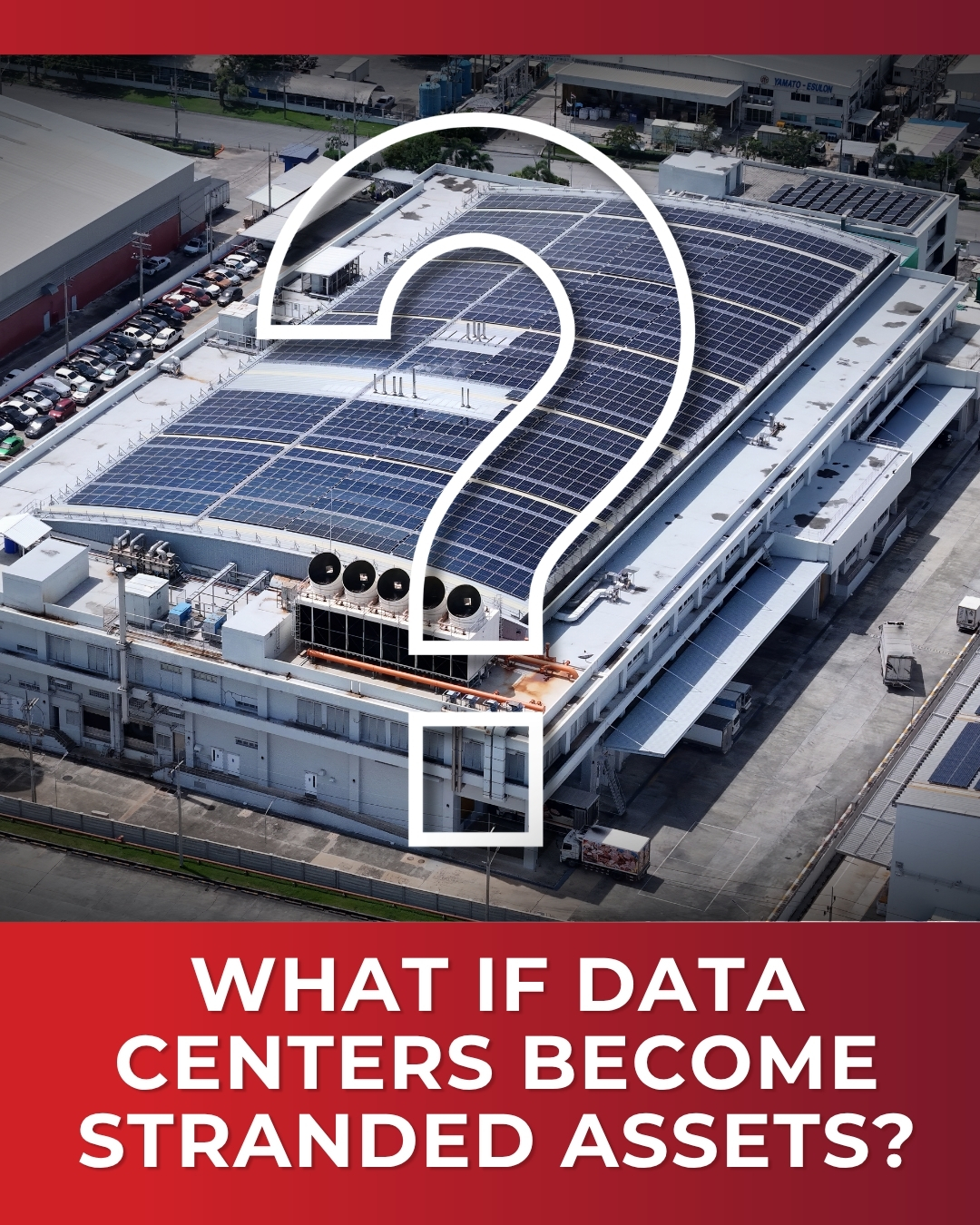
What happens if data centers become stranded assets?
America is furiously building hyperscale data centers—and many communities are furiously fighting them—on the assumption that artificial intelligence will require vast amounts of centralized computing capacity for decades.
Amid fierce local battles over land use, environmental regulation, and private property rights, projects are nonetheless being approved at a rapid pace, while property owners and local communities are watching farmland, residential land, and swaths of private acreage transformed to accommodate them.
So far, as these tug-of-war political scenes illustrate, almost all the attention is being paid to what happens when a data center arrives. Far less attention is being paid to what happens when one leaves. Those voices are barely heard above the din of the room.
Dana Kuhnline of ReImagine Appalachia is one of those voices who wanted to know about the other end of the line.
“The rapid expansion of data centers in the region brings up big questions—one line of inquiry we haven’t heard discussed as much is what happens to the e-waste and infrastructure of data centers when technology becomes obsolete or a site is shut down?” Kuhnline wrote recently on ReImagine Appalachia’s blog.
That prompted her to do some some research, and what she found surprised her, especially the realization that the industrial life cycle of a data center can be surprisingly short. For starters, data-center equipment is routinely replaced as technology advances at lightning speed.
“Looking through industry materials, it seems that the industry standard is to replace data center equipment every 3-5 years,” she wrote. “Those tracking industry trends made note when Microsoft extended the lifespan of its data center equipment from 4 years to 6 years. Newer industry materials note that with planning and maintenance, equipment can last up to ten years.”
But, Kuhnline observed, even with optimistic estimates, “it seems that we’re looking at a scenario where in 5-15 years, we’ll have facilities full of unusable, obsolete equipment.”
Not to mention the facilities themselves, which also may sit around unused. If demand craters or technology gallops ahead of the curve or risky investments go south, communities could end up saddled with massive infrastructure built specifically to serve a market that no longer exists.
Of course, equipment becoming obsolete does not necessarily mean the facility becomes obsolete, but rapid equipment turnover begs the question of how long it will take before the facilities that house it must turn over, too. Technology changes often scale down space needs, not the other way around, even in an era of centralized computing.
So communities could be hit with downsizing costs on the backend even as they were hit with up-scaling costs on the front, and taxpayers and ratepayers could still be paying all the costs long after the economic reason for the data center itself has disappeared.
Not a new problem
There is real-life precedent for the concerns. In Decommissioning Data Centers: Avoiding Stranded Assets, Columbia University’s Ashwin Murthy looked at the history of abandoned data centers and found that it was not uncommon for them to remain vacant for years while owners tried to unload the properties.
In Hartford, Connecticut, the former Bank of America data center rose up as a 255,000-square-foot, five-story industrial palace that remained vacant for almost two decades. Connecticut subsequently allocated $4 million in brownfield funding toward abatement and demolition and redevelopment. In Teaneck, New Jersey, a 55,000-square-foot former data center stood empty for years before it was sold and repurposed in 2015. And in Trumbull, Connecticut, the former Unilever data center also sat vacant for years.
According to Murthy, hyperscale facilities potentially magnify the problem.
“Prior to the AI market, data centers that were abandoned (for financial reasons or otherwise) often remained vacant for extended periods of time, employing only a skeleton crew of security and maintenance professionals tasked with not letting the assets fall to ruin while waiting for new buyers,” Murthy wrote. “Contemporary hyperscale data centers that stop operating may be even harder to repurpose or restart because they are massive, resource-intensive facilities. … As such, they risk becoming effectively abandoned warehouses at the end of their lives, wasting major land resources.”
Data centers also require intensive grid infrastructure upgrades, Murthy wrote, with ratepayers picking up the tab if the company fails and the facility sits unused.
“Further, data centers naturally generate substantial e-waste which could pose threats if not properly disposed of,” he wrote.
It gets worse. Utilities may have constructed substations, transmission lines, and other supporting capacity specifically to accommodate the data center’s insatiable electricity demand. Those ongoing costs must still be paid.
Fractal computing
Some in the industry believe there is an alternative future. Jay Alexander, vice president of Fractal Computing, believes that the centralized hyperscale model itself is approaching technological obsolescence.
“Hyperscale data centers—many of them—will end up like the abandoned JC Penney strip mall because there is not the demand to support them and distributed computing will capture much of the new compute business,” Alexander has written on his Substack, The Black Swan Files. “We have been saying it for 3 years—the entire data center madness phenomenon is a bubble, driven by forces not inherent to AI—driving needless data centers that will become stranded assets in the near future.”
His argument is not that artificial intelligence is going away, itself a bubble that will pop or a fad that will fade. What he challenges is the idea that the AI future necessarily requires all these hyperscale data centers. It’s the hyperscale centers, not the AI, that represent the bubble.
“The future of A.I. is intelligence everywhere—on your phone, watch, tablet, computer, in your car and refrigerator,”Alexander wrote. “You may not want all the A.I. features companies build into products, but they are going to do it nonetheless—because A.I. generates new outcomes.
What A.I. does not generate is the revenue for massive, centralized, hyperscale data centers.”
Fractal’s alternative is what it calls distributed computing. Instead of transporting enormous amounts of data to centralized computing centers, computing occurs closer to where the data lives. Small computers running together perform work that was once carried out in large, centralized facilities.
“We know that because we can prove it right now, if anyone cares to try out that model,” Alexander wrote. “Every company or government agency has over 1,000 times the compute power it thinks it has—today—if it focuses on distributed computing, not centralized. Deciding where the problem lies means no centralized data center because there is no need to send data to that behemoth to decide if the car, hurtling at 60 miles per hour down an Austin highway, can make the turn or not.”
In a white paper arguing its case, Fractal Computing cites its own experience.
“Across multiple deployments in utilities, telecommunications, and financial services, Fractal’s software stack has replaced data centers of 5,000 square feet or more, drawing approximately 2,000 kilowatts of continuous power, with clusters of ten small commodity computers occupying
roughly two square feet of shelf space and drawing approximately one kilowatt—a 99.95 percent reduction in power and a 2,500-fold reduction in physical footprint,” the white paper states.
The technical reason is architectural, the company explains.
“Conventional AI on centralized infrastructure is slow because data travels long distances—across networks, through software abstraction layers, through remote storage—before reaching the processor performing inference,” the paper states. “Locality-optimized distributed architectures co-locate AI models with their data, eliminate unnecessary abstraction layers, and parallelize work across many small nodes simultaneously. A network of modest computers, each handling a partition of the overall workload, collectively outperforms a centralized supercomputer on the same task while consuming a small fraction of the power.”
If the computing power required for serious AI workloads can be delivered by hardware that fits on a shelf, draws about a kilowatt, generates no meaningful noise, and needs no specialized cooling, then that hardware does not need to be concentrated in a remote industrial facility, the company observes.
“It can be distributed,” the paper states. “It can be local. It can be in the buildings communities already trust most: their public schools, their public hospitals, and the federal buildings that anchor their downtowns and county seats. And because the underlying compute unit is small and modular, it can be deployed at whatever scale a given building actually has room for.”
Fractal is just one company making this argument, but it is also making a case that communities may be missing a large part of a needed debate, that is, it’s not only how the data center will impact the community in the short-term; it’s what will happen in the long-term once its windows are shuttered, perhaps far sooner than anyone might realize.
If technology continues moving in the direction Alexander, Fractal, and others believe it is, America could be spending billions constructing today’s computing infrastructure just as the economics of computing begin to move elsewhere.
But Alexander and Fractal—and others out there—are not doom-sayers. They see another, brighter possibility. Indeed, they have flipped the facility argument on its head. Rather than facing abandoned data centers, Fractal proposes using already abandoned or underused buildings for smaller, localized data centers, turning unused space in schools, hospitals, and federal buildings into thousands of small computing nodes connected into a distributed national network.
“Convert idle and underused space inside public schools, public hospitals, and federal buildings owned or operated by the U.S. General Services Administration into a distributed, nationwide network of micro data centers — Community AI—that collectively deliver meaningful distributed computing capacity at a small fraction of the energy, water, and land footprint of centralized alternatives,” the paper states.
“No other category of American institution combines the same four properties at national scale: near-universal geographic distribution reaching every rural county and urban neighborhood alike; existing power, connectivity, and physical security infrastructure that a node can use at negligible marginal cost; round-the-clock or extended-hours staffing that a purely commercial site would have to hire from scratch; and a level of public trust that a remote data center operator cannot manufacture,” the white paper states. “Schools and hospitals are, in a very literal sense, the pre-built scaffolding for a distributed national computing network—sitting idle in this capacity today.”
Fractal contends that a network consisting of 10,000 school nodes, 2,000 hospital nodes and 3,000 federal-building nodes would consume approximately 25 to 50 megawatts altogether—a fraction of the continuous electrical demand of one proposed hyperscale facility. And rather than communities supplying land and infrastructure to enormous outside developments, existing community institutions could earn revenue by supplying otherwise unused space to the computing network, it states.
Of course, Fractal’s particular architecture, and those of any competitors, must still stand the test of time. The company’s specific future is less important to the stranded-asset question than the technological possibility it represents.
It deserves to be part of the discussion, especially given that computing technology is changing rapidly, while the buildings, transmission lines, and land-use decisions made to accommodate today’s technology could remain for generations.
Finally, the lesson from wind and solar is to plan for the funeral before the wedding, as they say in the industry. Along with approvals must come plans for decommissioning and for protecting communities when the day of the dead arrives, as well as regulatory governance throughout the project’s lifetime.
The debate over hyperscale data centers has largely assumed that the facilities built today will be required tomorrow. That is unknown at this point and arguable. But neither communities nor landowners should have to make that bet with their property, while developers make it with somebody else’s money, specifically that of ratepayers and taxpayers.