
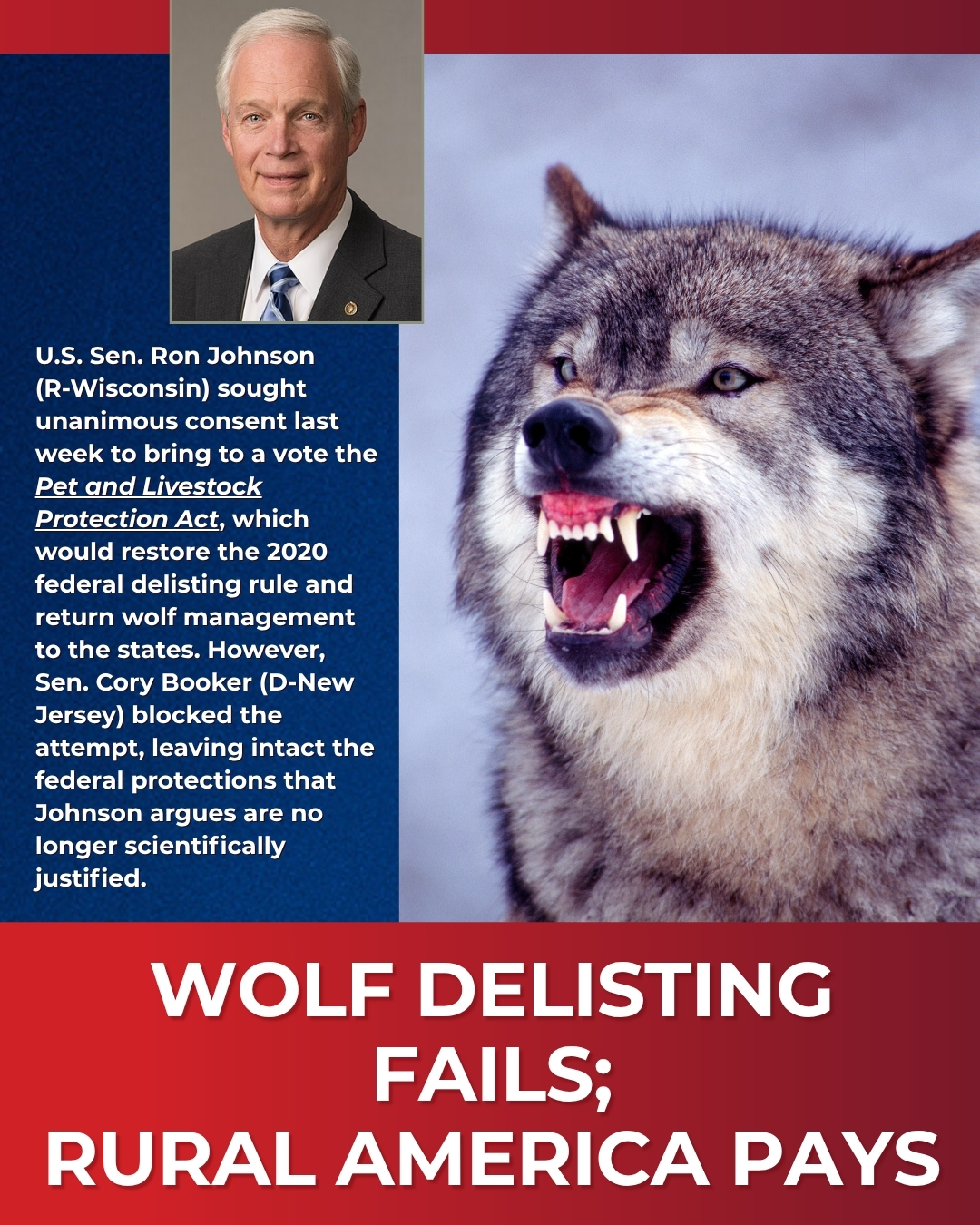
Johnson’s wolf delisting bill fails; ranchers, rural communities bear the costs
Gray wolves were protected under the Endangered Species Act so that they could recover to a sustainable population, and now, as reported from Wisconsin to Montana to Wyoming to Arizona and even in California, wolf populations have rebounded far beyond state management sustainability goals.
And yet the regulatory structure created to protect wolves prevents people from adequately responding to the negative consequences of that success. That was the message U.S. Senator Ron Johnson (R-Wisconsin) delivered on the floor of the Senate last week as he unsuccessfully sought unanimous consent to delist the gray wolf under the Endangered Species Act (ESA).
Specifically, Johnson’s Pet and Livestock Protection Act would restore the 2020 federal delisting rule and return wolf management to the states. However, Sen. Cory Booker (D-New Jersey) blocked the unanimous-consent attempt, leaving intact the federal protections that Johnson argues are no longer scientifically justified.
“Back in the ’80s and ’90s, we had an endangered wolf population problem, as most of the lower 48 states did,” Johnson told his colleagues. “So back in 1978, under the Endangered Species Act, the gray wolf was listed as one of those endangered species.”
The good news is, Johnson said, the listing worked.
“Our wolf population slowly started coming back to the point in 1999 that the Wisconsin DNR agreed that once we hit 250 gray wolves in Wisconsin, that would be the point at which we could delist the gray wolf,” he said. “Today, the gray wolf is no longer an endangered species.”
Wisconsin has about 1,250 wolves, according to Johnson, and yet, he said, courts have repeatedly overturned federal delistings.
“The population continued to grow and grow, and unfortunately, as much as we all value a healthy and sustainable gray wolf population, there’s a point at which it gets too large, and it starts threatening livestock, starts threatening people,” he said. “The U.S. Fish and Wildlife Service recognized that fact. And so in 2007, the gray wolf was actually delisted.”
The problem was, Johnson said, in 2008 a federal court in Washington, D.C., relisted it.
“So in 2009, we took action once again, and the Fish and Wildlife Service delisted the gray wolf,” he said. “That same year, that same court re-listed it. Three years later, again looking at the science, looking at the growing population, in 2012, the U.S. Fish and Wildlife Service delisted it.”
Then, three years later, Johnson recounted, the same D.C. court re-listed it, even though the state was starting to see an explosion in population.
“Our Wisconsin DNR states that about 1,250 is really the most population of gray wolf that the state can sustain, and we’ve already hit that level,” he said. “So, the U.S. Fish and Wildlife delisted again, only to be overturned in 2022 by a federal court decision in California.”
And thus the reason for bringing his bill, Johnson said: If recovery goals have been met, Congress should end an endless cycle of litigation. What’s more, Johnson told the Senate, rural Wisconsin and other rural states bear the brunt of the consequences of that litigation.
“We get report after report of families, farmers in Wisconsin who are bearing the burden of this back and forth of the fact that the gray wolf is protected and the populations are really at the maximum level right now,” he said. “It’s threatening livestock. Throughout Wisconsin, wolves are killing cows, horses, goats, sheep, cats, dogs. We have a sheep farm in Wisconsin where a multi-generation herd of sheep was all wiped out except for one sheep in one night.”
In Price County, Johnson said, a dairy farmer had to sell his entire herd because the wolves were killing his cows.
“Wisconsinites have to carry firearms just to walk their dogs,” he said. “A Wood County resident was forced to drive their children to school because the bus route changed because wolf tracks were there at the bus stop.”
There are fiscal consequences to the state as well, Johnson observed. The Wisconsin Department of Natural Resources’ board has approved a scope statement for an emergency rule to temporarily delay and potentially prorate wolf depredation payments because that fund is being depleted. Under the rule, farmers who have lost livestock would have to wait for compensation, as would hunters and pet owners affected by wolf attacks.
The truth is out there
Wisconsin is not alone, either in the rebounding numbers or in livestock losses and a corresponding inability to deal with depredation and threats.
California, for instance, is much earlier along in the timeline, but the wolf population is noticeably rebounding. After an 87-year absence, California now has 12 wolf packs with approximately 90 wolves primarily located in the northern third of the state, according to the California Department of Fish and Wildlife.
UC Davis researchers found that wolves from two packs in northeastern California were primarily eating cattle. According to UC Davis, researchers collected scat samples during the summer months of 2022 and 2023 and found that 72 percent of wolf scat contained cattle DNA. The research was published in PLOS One.
And California ranches are being attacked, right now mimicking Wisconsin’s problem in miniature. For instance, rancher Shirl Woodson, speaking to Spectrum News, says cattle on her ranch have become prey for the wolves on multiple occasions. She described run-ins with wolves even in the daytime: “I’m afraid now when I walk out in the daytime, out of the barn, in the house. I stop, and I listen,” she told the news outlet.
And so state representative Heather Hadwick (R-Alturas) has introduced two bills, one that would allow livestock producers to use pepper-ball deterrents to haze wolves and protect their animals and property, and another to protect Californians from penalties under the California Endangered Species Act (CESA) when acting in legitimate self-defense or protecting others from immediate harm.
“California asked communities to accept the return of wolves and the presence of other apex predators,” she wrote. “It is now the state’s responsibility to ensure those communities are not left alone to bear the consequences. California must invest meaningfully in wildlife coexistence.”
Back in the U.S. Senate, the argument roiled around what recovery was enough and who gets to decide that number—the people living alongside the wolves or those in urban areas far removed from any wolf populations.
In making his objection, Booker said to trust the “science.”
“And for species to be considered recovered, science must show that it’s returned to suitable habitats with durable populations that can persist safely and durably into the foreseeable future,” he said. “That’s the law. Today, wolves have returned to only 10 percent of their historic range and do not meet the Endangered Species Act requirements for delisting. That’s the law.”
Booker did not explain whether existing numbers were enough to sustain the population, even if smaller than historic populations when the nation was sparsely populated, and that teed up another question: Does recovery mean saving a species from extinction, or restoring it to some historically predetermined population regardless of how radically that landscape has changed?
Johnson argues the former: “We should have all agreed that delisting was successful,” he said. “We’re way past the delisting baseline established by the Wisconsin DNR. We’re at the maximum sustainable limit here. I’m asking consent to pass a bill that would simply delist it so that Wisconsin farmers, Wisconsin families, Wisconsin children can feel safe in their residences and walking about their properties.”
A House companion bill has already passed, and a cosponsor of that bill, Rep. Harriet Hageman (R-Wyoming), blasted what she described as “elitist East Coast politicians” overriding states that actually live with wolves.
“Before coming to Congress, I successfully sued to secure Wyoming’s right to manage its own gray wolf population and will continue to support legislative efforts to allow others to do the same,” Hageman said. “Elitist East Coast politicians’ continued objections to common-sense proposals to return wildlife management to the states are another case of those unburdened by predators attempting to dictate what other states are forced to survive.”