
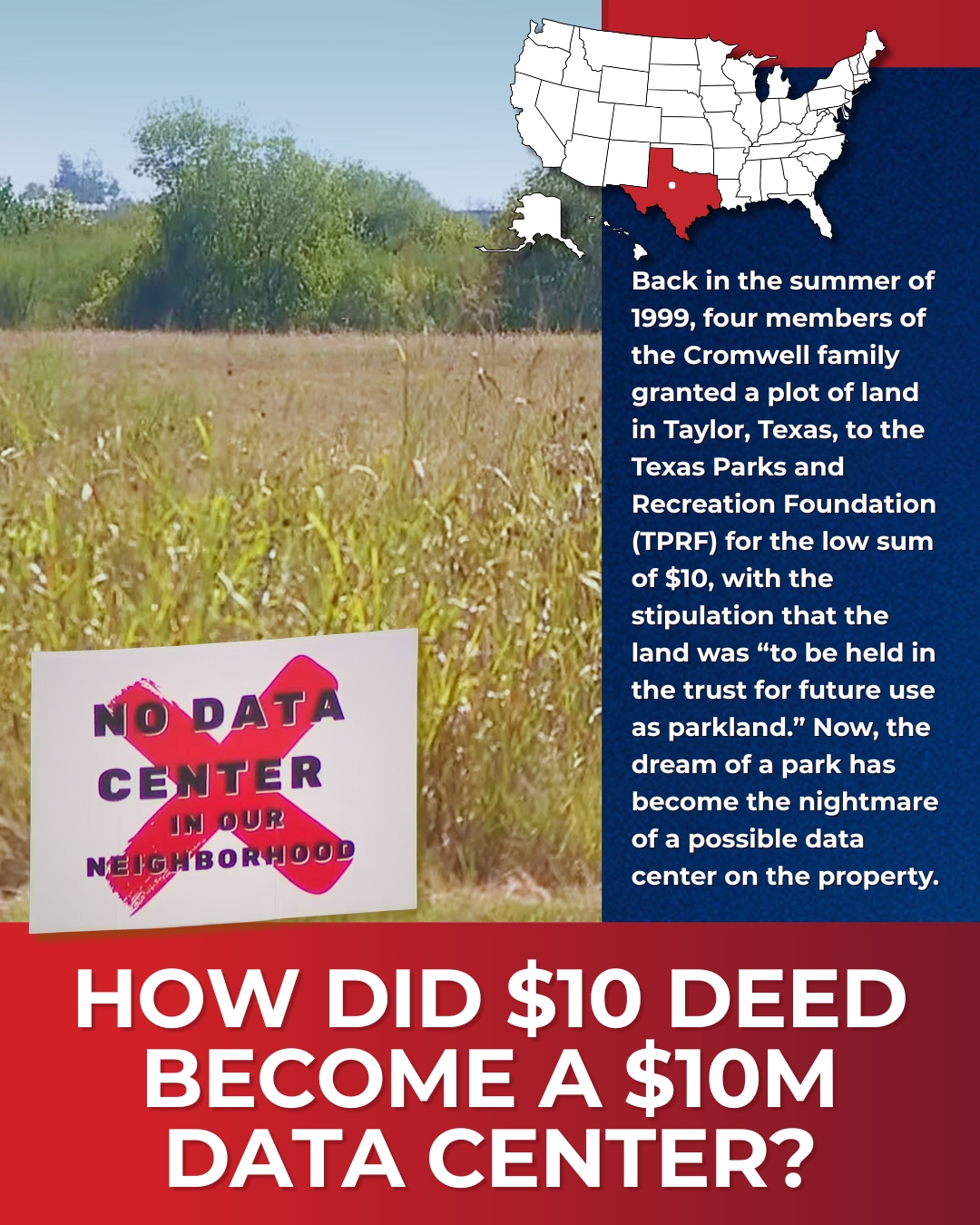
Three decades ago, a family conveyed land for future use as parkland, now residents are fighting a proposed data center
As the 20th century drew to a close, members of the Cromwell family in Taylor, Texas, conveyed nearly 88 acres of land for $10, not to the city but to the Texas Parks and Recreation Foundation.
The family’s wish was a simple one and simply stated on the deed. The property was to be reserved for use as a park. Now, more than a quarter century later, not only is it not a park, there’s an uphill fight to prevent the land from becoming a massive data center.
Back in the summer of 1999, four members of the Cromwell family granted a plot of land to the Texas Parks and Recreation Foundation (TPRF) for the low sum of a single Hamilton, with the stipulation that the land was “to be held in the trust for future use as parkland.”
Bonnibel Bland Cromwell had inherited the land, a farm her grandfather Howard Bland, Sr., had established in 1878. Neighbors say it was well known that Bland had wanted to do something for the local children.
Speaking to 404 media, Pamela Griffin said she used to play on the land growing up, and she told the news outlet she remembered Bland telling her own dad about his plans: “I see the kids don’t really have nowhere to play. I’m thinking about giving this land for parkland because these kids need somewhere to play.”
In 1999, Bonnibel Bland Cromwell and her husband, Frank Rhea Cromwell Jr., along with their two children, saw Bland’s wish through to the end with their conveyance. However, four years later, in 2003, the TPRF transferred the property to the Williamson County Park Foundation. Notably, the city property history observes that “there were no notes or restrictions in the deed about the use of the land.” The foundation then conveyed it to the city of Taylor that same year for $10, again with no stated use restriction.
In 2009, Taylor sold it to the Taylor Economic Development Corporation for $15,000 and 39 acres of land in another location. Those 39 acres include a 16-acre tract that would later act as a buffer between the now proposed data center and the nearest neighborhood, the city website states.
Sixteen years later, the property was on the move again, and this time what had been a $10 deed was on the verge of becoming really big business. On April 11, 2025, the Taylor Economic Development Corporation sold the land for $10 million to NCP Travis TPP Project LLC, which planned to place a data center on the property.
Prior to the closing, in 2024, Blueprint Data Centers, a subsidiary of NCP Travis TPP Project LLC, got approval from the city to build a 135,000-square-foot data center on the land. And just like that, $10 had ballooned into $10 million, and parkland had become a proposed data center tract.
Of course, once word got around, residents had rallied against the project, expressing concerns about air, water, electricity and noise. For its part, the city discussed various mitigation strategies, among them a barrier wall and closed-loop water cooling.
But the developer’s business with the city was just the beginning of the fight. In addition to protesting the permit, multiple residents, including Griffin, filed a lawsuit to stop its construction. That court action is still pending, but several factors could affect whether any lawsuit against the data center can succeed.
The fight turns
For one thing, there is the original 1999 deed. The city contends on its website that the parkland language in the original deed was not a deed restriction, and, in any event, further argues that the requirement that the land should be parkland was only featured in the Cromwells’ deed, not in later ones.
Opponents argue that the original deed nonetheless imposes an enforceable obligation concerning the land’s future use. The principle is simple, they argue: an enforceable restriction on property does not disappear merely because somebody omits it from a later deed. That’s why title searches exist. The question becomes, what legal obligation, if any, did the Cromwell deed create, and, if it did create a parkland obligation, did it survive subsequent transfers?
That is to say, if the Cromwells created an enforceable property interest that continued to burden the land, merely omitting the language from subsequent deeds wouldn’t necessarily extinguish it. But if “held in trust for future use as parkland” was only a statement of contemplated purpose, or created a trust obligation enforceable only by certain parties, or otherwise failed to create a covenant running with the land, the neighbors may be unable to enforce it.
This past October, judge Ryan Larson of the 395th state district court denied the residents’ request for an injunction and dismissed their lawsuit entirely, finding they lacked standing to challenge the development. Blueprint had argued, among other things, that their properties didn’t actually touch the data-center parcel because about 15 acres still owned by the economic development corporation—the same acreage obtained in the deal with the city in 2008—would serve as a buffer, separating the residences from the data center and thus severing their legal interests.
However, the ruling did not appear to resolve the underlying question of whether the 1999 provision directing that the property be held in trust for future use as parkland remained legally binding. The plaintiffs appealed, and Texas’ Fifteenth Court of Appeals is still considering the appeal at the time of the writing.
The larger Texas data-center fight
The fight unfolding in Texas isn’t happening in isolation. Taylor residents’ concerns about electricity and infrastructure are now being echoed, at a much larger scale, by the state government’s scrutiny of the extraordinary amount of new data-center demand seeking access to the Texas grid.
With explosive data-center growth and equally explosive demands placed on the state’s electric grid, on August 3, Texas Gov. Greg Abbott ordered an audit and pause on additional data-center grid connections while regulators determine what projects are real and what demands they would place on the system.
The governor said no additional data center connections would be approved or move forward until that process occurred. Specifically, Abbott directed the Public Utility Commission of Texas (PUCT) and the Electric Reliability Council of Texas (ERCOT) to conduct a comprehensive verification and audit of all data centers advancing through ERCOT’s interconnection process.
The PUCT and ERCOT must complete the audit before any data center project moves forward.
“Our top priority is to protect Texans’ safety and quality of life,” Abbott said. “Any project that fails to comply with the requirements set forth by the PUCT and ERCOT, and by state law, must be denied connection to the Texas grid. Simply put, Texans must come first.”
The governor’s office says ERCOT is currently considering approximately 474 gigawatts of requests to connect to the Texas grid, more than five times Texas’s record peak electricity demand for ERCOT. Approximately 90 percent of the new power requests are data centers, and the governor says the unprecedented load growth could endanger the reliability and stability of the Texas electric grid.
Abbott directed the PUCT and ERCOT to obtain the specific information from each data center project, including information detailing the extent to which data centers are paying their own way or depending on the state for financial assistance, including all state and local tax incentives, grants, abatements, or other public financial assistance received or expected to be received.
The state also wants to know the extent to which data centers are providing their own power or depending on the ERCOT grid for that power, as well as the extent to which data centers are bringing their own water and reusing their own water as opposed to using water needed by local communities.
Finally, Abbott says he wants data about the extent that data centers are using measures to reduce impacts on neighboring property owners and communities, including noise mitigation, light controls, setbacks, traffic improvements, emergency response coordination, and other community protection measures, understanding that each community is unique.
Finally, each applicant must provide information detailing the ownership and controlling interests in the project.