A homebuilder says a six-figure park fee had nothing to do with impact and everything to do with government power
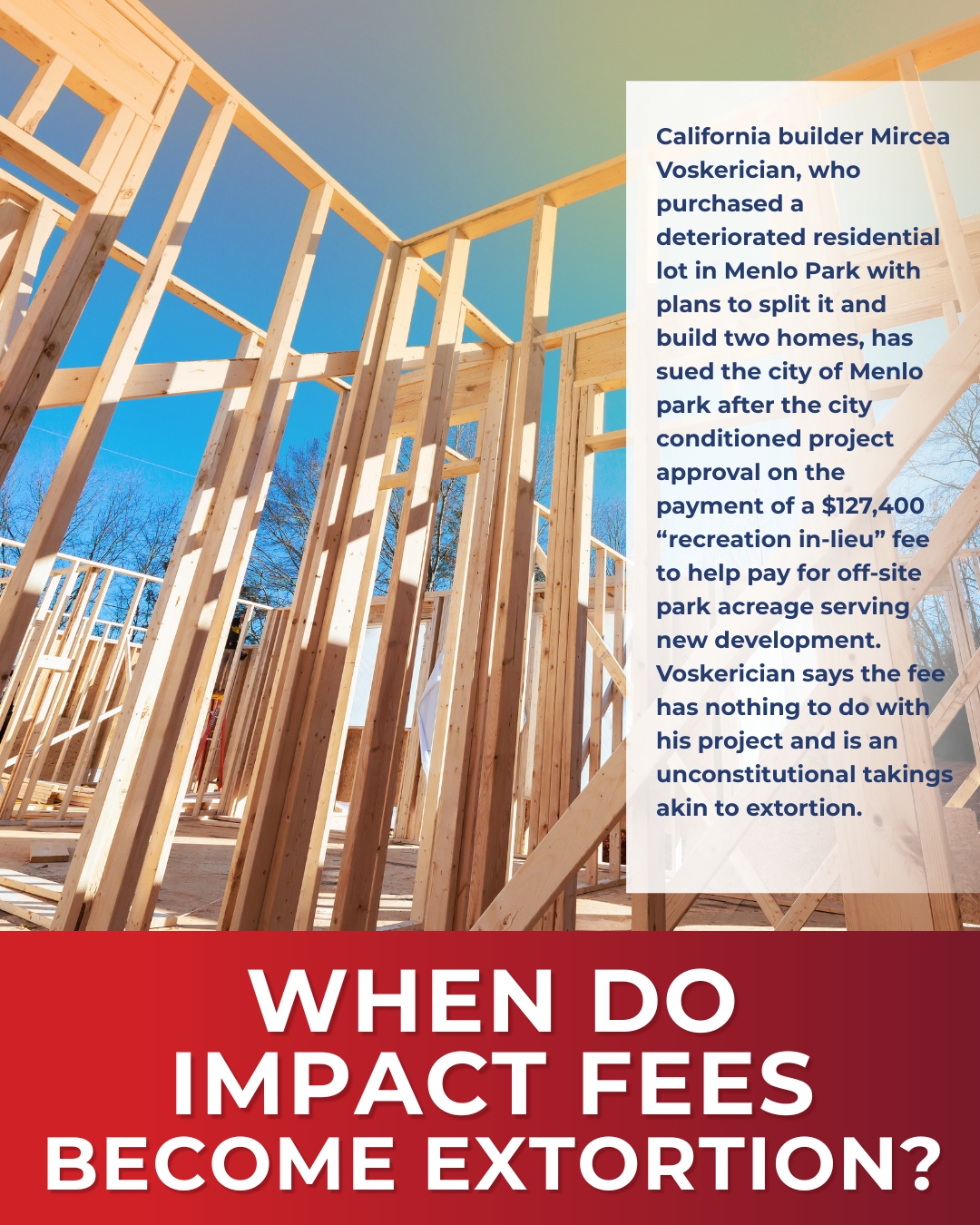
California builder Mircea Voskerician, who purchased a deteriorated residential lot in Menlo Park with plans to split it and build two homes, thought he was headed for smooth sailing because his proposed two-lot property division qualified for streamlined approval under state law.
Turns out, Voskerician was wrong. Instead of smooth sailing, he ran aground on the regulated shores of the city of Menlo Park, which refused to approve a final project map unless his company first paid a $127,400 “recreation-in-lieu” fee.
Ostensibly, the city wanted Voskerician to help pay for off-site park acreage serving new development under a state law that allows local governments to impose fees sufficient to provide between three and five acres of parks for every 1,000 residents.
Voskerician balked, as his legal complaint explains. He paid the fee under protest but argued that the fee wasn’t directly related to his proposed development and was, in fact, an inappropriately applied and thus unconstitutional exaction—which the Supreme Court has rejected in blunt terms. In 1987, in Nollan v. California Coastal Commission, the court ruled that government agencies cannot condition a building permit on a property owner giving up a public easement unless there is an “essential nexus” connecting the takings to the original regulatory purpose.
“The lack of nexus between the condition and the original purpose of the building restriction converts that purpose to something other than what it was,” the court ruled. “The purpose then becomes, quite simply, the obtaining of an easement to serve some valid governmental purpose, but without payment of compensation. Whatever may be the outer limits of ‘legitimate state interests’ in the takings and land use context, this is not one of them. In short, unless the permit condition serves the same governmental purpose as the development ban, the building restriction is not a valid regulation of land use, but ‘an out-and-out plan of extortion.’”
‘Extortion’ is, of course, the blunt part. In Voskerician’s case, he argues that the “recreation in lieu of” fee—in effect a similar permit condition, or exaction, as the easement in Nollan—does not serve any purpose to mitigate any impact created by his small subdivision.
Represented by Pacific Legal Foundation (PLF), Voskerician has sued the city seeking a refund and a declaration that the fee violates both California law and the U.S. Constitution.
“When the government exploits permitting processes to extract extortionate fees from builders, homebuyers pay the price,” said David J. Deerson, the PLF lead attorney on the case. “The Supreme Court has made it abundantly clear that cities cannot force property owners to foot the bill for problems they didn’t create. Menlo Park cannot ignore that precedent to demand a six-figure exaction for a routine subdivision.”
No nexus, no fee
The lawsuit exposed the lack of a significant nexus in several ways.
For instance, according to the complaint, Menlo Park never performed an individualized analysis showing that dividing one residential lot into two created more than $127,000 worth of demand for parks or recreation facilities.
What’s more, the complaint alleges, land values rather than development impacts drive the fee.
“The RIL fees are not calculated based on the market value of acquiring parkland,” the complaint states. “Rather, they are purportedly based on the average market value of land within the subdivision to which they are applied.”
Then, too, expensive land does not necessarily create greater demand for parks. Even worse, the complaint asserts, the city isn’t even following its own formula.
“In practice, the city does not perform an individualized determination of the average market value of land in any given subdivision,” the complaint states. “Rather, according to its 2025 and 2026 Master Fee Schedules, the city applies a flat fee of ‘$127,400 per unit’ (or more accurately in Plaintiffs’ case, per newly created lot) in single-family zones.”
Moreover, the complaint continues, RIL fee funds are not limited to expenditures for acquiring parkland. They may also be used for the construction and/or rehabilitation of recreation facilities and other improvements, but are not limited in practice to financing parks and recreational services that specifically serve the development in question.
“Rather, all RIL fees are deposited into a general parks and recreation fund that is spent on land acquisition and improvement throughout the city,” the complaint states. “For example, according to a City Staff Report, over $1.2 million in RIL fee funds were spent on the Belle Haven Community Campus project in fiscal year 2024–25. The Belle Haven project was built on land already owned by the city and was funded primarily through gifts from Meta Platforms, Inc. (then Facebook, Inc.). According to a press release from the city, construction of the project fulfilled a ‘long-desired wish of the [Belle Haven] neighborhood …’”
The lawsuit further observes that Menlo Park already exceeds the park acreage standards authorized under California law. Jurisdictions exceeding five acres of parkland per 1,000 residents can only impose fees that are necessary to maintain that statutory level.
Menlo is already well above that, the complaint argues.
“According to the city’s 2019 Parks and Recreation Facilities Master Plan Update, which is the most recent such update, the city enjoys 221.76 acres of city-owned parkland, resulting in 6.48 acres per 1,000 residents,” the complaint states. “This figure does not include the 21 acres of County-owned parkland located within the City’s borders. It also does not include the 124,685 square feet (i.e., nearly 3 acres’ worth) of recreational facilities maintained by the City. Neither does it include the several ‘joint use sites’ which are shared with school districts.”
In addition, the complaint states, California’s housing agency previously warned the city that state housing law prohibits requiring off-site improvements, including recreation fees to pay for them, as a condition of approving qualifying lot subdivisions.
Constitutional ramifications
The broader legal issue relies on the Supreme Court’s exactions doctrine, developed in Nollan, Dolan, Koontz, and, more recently, Sheetz, which hold that governments may not leverage their permitting power to obtain money or property unrelated to the actual effects of a proposed development.
“Under the Takings Clause of the Fifth Amendment to the United States Constitution, no arm of government may take private property for a public use without paying just compensation,” the complaint states. “The exactions doctrine is a corollary to that rule. It provides that a government agency imposing a land-use approval condition that requires the dedication of private property, including money, ‘must make some sort of individualized determination that the required dedication is related both in nature and extent to the impact of the proposed development.’”
Specifically, the complaint asserts, the agency must shoulder the burden of showing that the exaction bears an ‘essential nexus’ and ‘rough proportionality’ to the public impacts of the proposed project.
Voskerician argues that Menlo Park failed those constitutional tests and is asking the court not only to refund the $127,400 fee but also to declare the ordinance unconstitutional and prohibit its future enforcement against similar developments.
If the court agrees, the ruling could reinforce an important constitutional boundary: governments may require developers to pay for directly related impacts, but they may not use the permitting process as an excuse to compel property owners to pay for unrelated public projects and bureaucratic wish lists.
As the Supreme Court opined, that would be extortion.