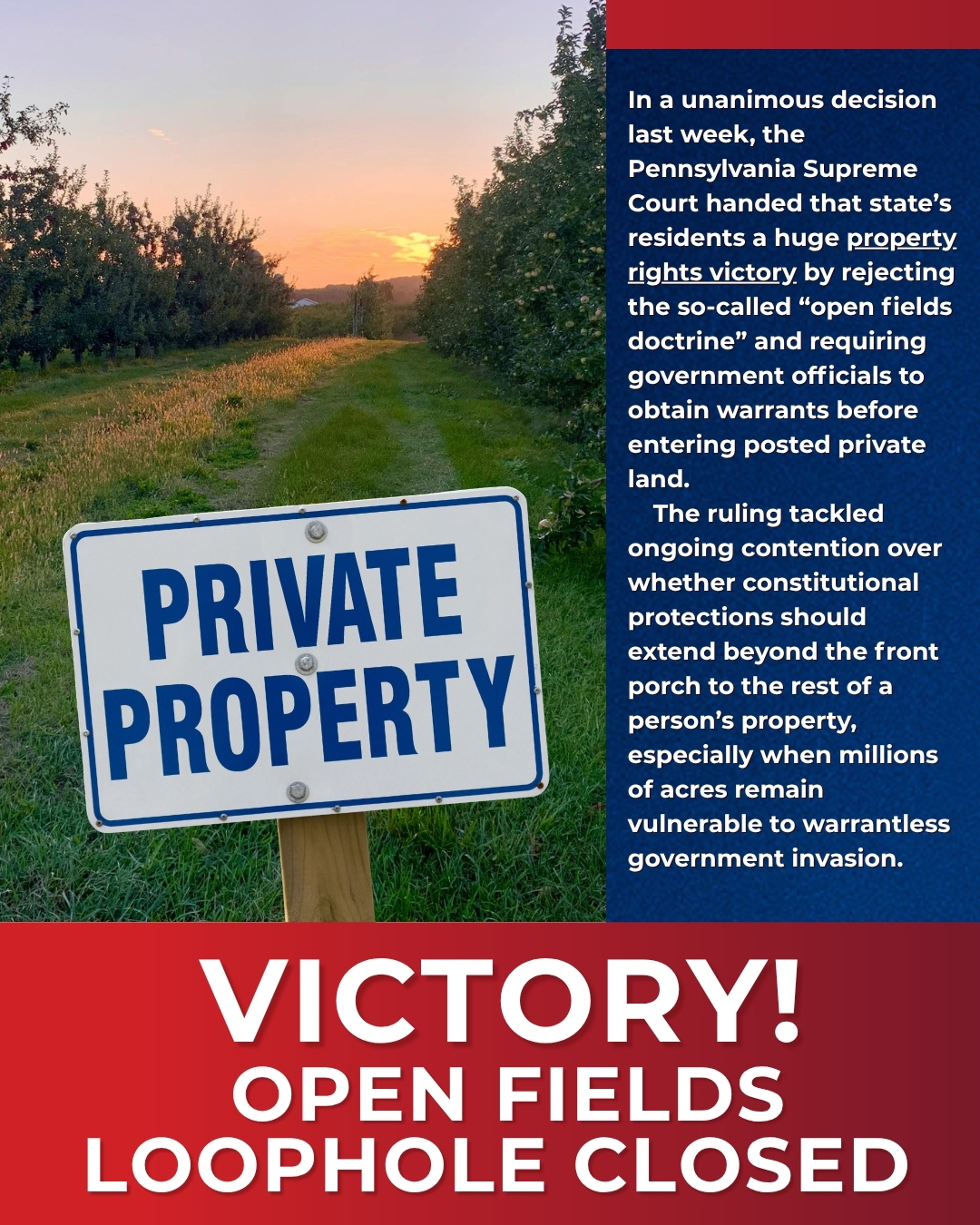
In a unanimous decision last week, the Pennsylvania Supreme Court handed that state’s residents a huge property rights victory by rejecting the so-called “open fields doctrine” and requiring government officials to obtain warrants before entering posted private land.
The ruling tackled ongoing contention over whether constitutional protections should extend beyond the front porch to the rest of a person’s property, especially when millions of acres remain vulnerable to warrantless government invasion.
With the decision, the Pennsylvania high court overturned decades of state precedent and rejected application of the federal open fields doctrine under Pennsylvania’s constitution. For Pennsylvanians who fence, gate, post signs, or otherwise exclude the public, private land once again means private land.
The case involved the Punxsutawney and Pitch Pine hunting clubs. For decades, the Pennsylvania Game Commission (PGC) had routinely sent agents onto the clubs’ private land without notice or warrants, using the open fields doctrine as justification. The hunting clubs challenged the policy under the Pennsylvania constitution and walked away with a victory that could reverberate through the states, given that ongoing and potential challenges are underway in multiple jurisdictions.
In Alabama, for example, landowners are actively appealing an April 2026 dismissal of a lawsuit that challenges state game wardens entering private, posted land without a warrant. In Tennessee, that state’s primary wildlife agency said it wouldn’t appeal an appeals court ruling that limited secret surveillance of private lands. That lower court decision could still be challenged, however.
The open fields doctrine became a colossal private property rights issue in 1924, when the U.S. Supreme Court, in Hester v. United States, held that Fourth Amendment protections generally do not extend beyond the home’s immediate surroundings, known as the curtilage. Because of that doctrine, government officials have long argued they may enter most private land without warrants.
In this decision, the Pennsylvania high court concluded that its own state constitution provides stronger protections than the federal baseline when landowners clearly demonstrate an expectation of privacy through posting, fencing, gates, purple paint, or similar measures. The justices overturned a previous state decision in doing so.
“Open fields are afforded no constitutional protection from warrantless searches and seizure under the Fourth Amendment to the United States Constitution,” wrote Pennsylvania justice Kevin Brobson for the court. “In Commonwealth v. Russo, this Court held that the protections afforded under Article I, Section 8 of the Pennsylvania Constitution also do not extend to open fields. In this appeal, we reexamine our decision in Russo in the context of a constitutional challenge to portions of the Game and Wildlife Code, which expressly empower officials of the Pennsylvania Game Commission to go upon or enter private property, posted or otherwise, in the exercise of their powers and duties under the Code.”
The Russo decision got it wrong, Brobson wrote.
“We conclude that slavish adherence to our decision in Russo must give way to the greater privacy and property protections afforded under Article I, Section 8 of our state charter,” he wrote. “As our jurisprudence in this area has evolved, the Court’s reasoning and result in Russo have not aged well. In short, we hold that: (a) Russo was wrongly decided; (b) Article I, Section 8 of the Pennsylvania Constitution affords greater protection to land beyond the curtilage of a home or building; and (c) most of the challenged Entry Statutes are, consequently, unconstitutional.”
An expectation of privacy
Over the years, Brobson wrote, the hunting clubs clearly demonstrated a subjective expectation of privacy in their land beyond the curtilage.
“They have posted their properties’ boundary lines with clearly visible ‘no trespassing’ signs and purple paint, installed locked gates at all public entrances, and fenced some of their properties’ boundaries with waist-high, metal wire, all in an effort to exclude non-members and intruders therefrom,” he wrote. “Additionally, Punxsutawney planted evergreen trees along the public road that runs through its land to create a ‘screen’ as a means to prevent non-members from looking or shooting into its property from the public road.”
Moreover, Brobson continued, the hunting clubs permit entry onto their properties only by members, their members’ guests, contractors who help maintain their properties, and a gas company that owns the subsurface mineral rights to the properties and accesses its well pad through a defined access trail.
“Collectively, these efforts demonstrate that the hunting clubs, at least subjectively, expect that the privacy of their members will be protected when those members are present on the hunting clubs’ private land, including their open fields,” he wrote.
But, Brobson continued, there was a more pertinent question to ask, and that was whether society is prepared to recognize the hunting clubs’ subjective expectation of privacy in their land as reasonable.
“To answer that question, we must first make an important distinction,” he wrote. “Truly open fields—i.e., private land that is unposted and unbounded—are fundamentally different in kind than private land conspicuously posted with ‘no trespassing’ signs and purple paint and/or bounded by fences, gates, and other structures. With respect to the former, the landowner has made absolutely no attempt to exclude intruders and/or to advise the public that the land is indeed private, whereas, with respect to the latter, the landowner has taken steps to notify the public that the land is private and that they should not intrude thereon without permission.”
Brobson wrote that the court believed that society was both prepared and willing to protect a landowner’s expectation of privacy in his or her affairs conducted on his or her private land located beyond the curtilage as reasonable and legitimate when the landowner had taken sufficient steps to notify members of the public that the land is private and that they should not trespass.
The decision means that government officials must obtain a warrant based upon probable cause or satisfy one of the recognized exceptions to the warrant requirement before entering the private land of any landowner that has taken such steps, the court concluded.
In one partial dissent and partial concurrence, however, justice David Wecht said the doctrine should be applied to all private land, not just posted land, writing that the Pennsylvania constitution “embraces a broader privacy entitlement” and that “[l]andowners reasonably may expect that their land is protected against arbitrary and warrantless government entries” irrespective of whether such landowners “adorn[] [their] land with flimsy paper signs or splatters [of] purple paint on a handful of trees.”
Nonetheless, said Joshua Windham, a senior attorney at the Institute for Justice (IJ), which represented the hunting clubs, the court had taken an important step forward by determining that private land is not public property.
“It’s yours, and that means you get to decide who enters it,” Windham said. “If government officials want to invade your posted land without your consent and spy on you, they need to get a warrant. By restoring that foundational protection, the court bolstered the property and privacy rights of millions of Pennsylvanians—and sent a warning to officials across the country who still believe they can invade private land at will: Watch your step.”
Dangers abound
Current cases aside, previous cases involving the open fields doctrine have brought not only the constitutional issue but public safety to the forefront. For years now, those opposing the open fields doctrine have warned of the perils of allowing government trespass on private property, especially when landowners do not immediately know whether the trespasser is a government agent.
For example, meet Robert Stietz of Wisconsin, whose case illustrates why the issue matters in practice as well as in theory. Stietz served a year in prison, thanks to the open fields doctrine.
It started as he was minding his own business on his own property as the sun set on the last day of the 2012 deer season. Suddenly, he was approached by two armed men wearing blaze orange, whom he says did not clearly identify themselves as DNR wardens.
Wardens Joseph Frost and Nick Webster—who were looking for illegal hunting activity after dark and who had entered the property after seeing a vehicle parked in a grassy area on the property—ordered Stietz to surrender his rifle.
Stietz, who had had significant trespass problems on his property, said he thought the wardens were the ones who were illegally hunting. He was out checking his fences and looking for vandalism, which had occurred before.
Now, with the men demanding his rifle, Stietz said he feared for his life. A scuffle followed as one warden and then both attempted to wrestle the rifle from him. After they seized the firearm, Stietz testified that he saw one warden reach for a handgun, prompting him to reach for his handgun. The second warden also drew his.
There was a stand-off—three men with handguns trained on each other, the court states—until one warden managed a radio call and deputies arrived and arrested Stietz. He was convicted, and an appeals court affirmed the conviction, leaving him behind bars for a year, but the state’s high court ordered a new trial because the circuit court refused to instruct the jury on self-defense as the defendant requested.
The court should have done so, the justices found, because there was sufficient evidence that a reasonable factfinder could have determined that Stietz reasonably believed that the two men who accosted him with weapons were not wardens but trespassers hunting illegally and that, because the two men forcibly wrested his rifle from him and then drew their handguns on him, the defendant reasonably feared for his life.
The use of force is justified when a person reasonably believes it is necessary for the defense of oneself, and the government must prove beyond a reasonable doubt that the defendant did not act in reasonable self-defense, the state Supreme Court concluded. Failure to so instruct a jury was reversible error, the court found. In a concurring opinion, justice Rebecca Bradley blistered the DNR for its legal position.
Bradley said she thought Stietz not only had a right to his self-defense jury instruction but that the evidence showed the DNR actually was trespassing. She hotly contested the agency’s interpretation of the “open fields” doctrine that the agency said allowed them to enter Stietz’s private property.
“I write separately because the circuit court also erred when it refused to allow Stietz to present a defense based on evidence that the DNR wardens were trespassers on private property, and I disagree with the majority’s assertion that ‘(w)e need not’ address this issue,’” Bradley wrote. “I also write to reaffirm that the Fourth Amendment prohibits the government from seizing a person on private property—including open fields—absent consent, a warrant, probable cause and exigent circumstances, or another lawful basis for interfering with a person’s right to be free from governmental intrusion.”
In Bradley’s view, the DNR wardens were the ones breaking the law, and, had they not been, the actions that led to Stietz’s imprisonment would never have happened. Bradley’s key point was that the open fields doctrine was never intended to transform private land into public property. It merely limits suppression of evidence, she wrote; it does not authorize government officials to roam private property at will or seize people without constitutional justification.
That wasn’t the end of the story. Despite being rebuked by the Wisconsin Supreme Court justice and despite the high court overturning the conviction of a man for intentionally pointing a firearm at DNR wardens after he spent a year in prison, the state still pressed forward in a prosecution, going through with a new trial in which Stietz was charged with obstruction, use of a dangerous weapon, recklessly endangering safety, and intentionally pointing a firearm at a law enforcement officer.
At retrial, this time with a jury, Stietz was acquitted of every serious charge and found guilty due to a no contest plea on one misdemeanor count of resisting or obstructing an officer. But because of the open fields doctrine, his life had been changed forever—endangered by armed government agents and subsequently spending a year in prison for a crime a jury later acquitted him of committing.
Plenty of “open fields” where the government can roam
As the Institute of Justice pointed out in a 2024 study, toppling the open fields doctrine is critical not least because it applies to so much private U.S. land.
In the report, the IJ estimated that some 96 percent of privately owned land in America has historically been vulnerable to warrantless searches because of the open fields doctrine. That’s about 1.2 billion acres. Rather than affecting only hunters or farmers, the doctrine potentially reaches nearly every rural landowner in America.
“Using sophisticated mapping software, IJ was able to analyze the number of acres of land in each state that is privately owned and not near a home or building,” the IJ report stated. “The study made generous assumptions about what areas would be protected by the Fourth Amendment, treating all structures and a 100-foot buffer around those structures as protected. The results show the massive scope of the open fields doctrine.”
Now, many Americans are waking up to the potential scope of government surveillance and trespass. The Pennsylvania case may draw even more eyes.
For a century, governments have argued that private property beyond the home’s immediate surroundings enjoys little Fourth Amendment protection. Pennsylvania has now declared otherwise, recognizing that when owners clearly mark land as private, constitutional protections should follow them beyond the front door. Whether other states will do the same may determine just how private private property really is.