Five Montana families become the face of America’s growing battle over environmental lawfare
In a court case that the U.S. Department of Agriculture has described as an example of agricultural lawfare, two environmental organizations are using the federal Endangered Species Act to challenge the exercise of nineteenth-century water rights belonging to five Montana ranching families.
The case is Save the Bull Trout and Alliance for the Wild Rockies v. U.S. Department of the Interior and West Side Ditch Company, filed on June 17, 2025, before U.S. district judge Brian Morris in Montana.
The five families are not individually named as defendants, but their interests are represented by the West Side Ditch Company, in which the ranchers own irrigation shares. The West Side Ditch Company serves the private farming and ranching families, along with the city of Deer Lodge and the federally operated Grant Kohrs Ranch National Historic Site.
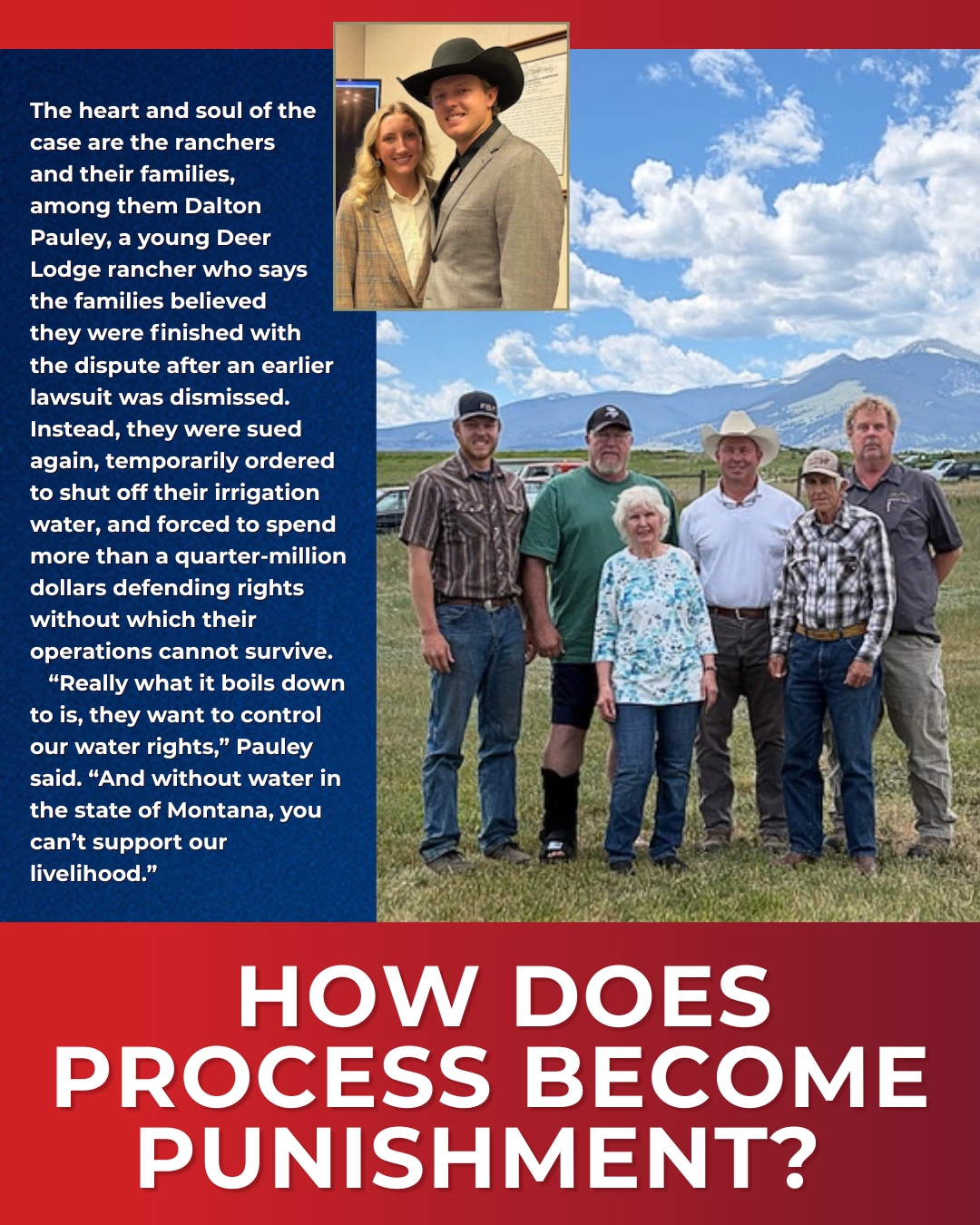
The private shareholders’ families include the Pauleys, Reistads, Verlanics, Kelleys, and Forsons.
In the lawsuit, the environmentalists want the ditch shut down when river flows fall below a 90-cfs [cubic feet per second] threshold, they say to protect the functionality of bull trout habitat. They also seek a fish screen, a fish-friendly diversion and other improvements that the families say could cost more than $1 million. The upper 62.8 miles of the Clark Fork were designated critical habitat for threatened bull trout by the U.S. Fish and Wildlife Service in 2010.
The ranching families and the U.S. Department of Agriculture (USDA) tell a vastly different story. For one thing, according to state surveys, there are no bull trout anywhere close to the diversion ditch. For another, the families’ water rights date back to the 1880s, at least 120 years before the bull trout’s critical habitat designation.
“Radical environmental groups have repeatedly sued Montana family farms and ranches, arguing that their longstanding irrigation practices might harm threatened bull trout, despite federal surveys finding no trout in the affected diversion,” the U.S. Department of Agriculture (USDA) stated in a recent lawfare roundtable in which American Stewards of Liberty’s executive director Margaret Byfield participated. “The lawsuits, enabled by federal law that reimburses attorney fees, create a financially unsustainable cycle for producers who must fund their own defense while facing court‑ordered irrigation shutdowns.”
The heart and soul of the case are the ranchers and their families, among them Dalton Pauley, a young Deer Lodge rancher who says the families believed they were finished with the dispute after an earlier lawsuit was dismissed. Instead, they were sued again, temporarily ordered to shut off their irrigation water, and forced to spend more than a quarter-million dollars defending rights without which their operations cannot survive.
And Pauley says that legal bill comes after spending about $90,000 on the first lawsuit. Speaking exclusively with Liberty Matters last week, Pauley said the lawsuit isn’t really about bull trout but about water rights and control.
“Really what it boils down to is, they want to control our water rights,” Pauley said. “And without water in the state of Montana, you can’t support our livelihood.”
The families run relatively small operations, Pauley says.
“Almost everybody on the ditch owns 500 acres or less,” he said. “My family’s pretty much a first-generation family. My father is there and lots of people are first or second generation. Maybe their parents started in the ’60s, and they worked their whole life just to have something, and now they’re fighting this lawsuit that’s really threatening their livelihoods because these properties just aren’t financially sustainable without our water rights.”
Saving not a single bull trout
The central conflict is whether environmental organizations can use potential habitat, federally subsidized litigation, and the bankrupting cost of legal defense to gain practical control over private water rights, even when recent state fish surveys found no bull trout near the diversion.
The fact is, the closest bull trout detected during recent surveys by the state was approximately 30 miles away. Pauley also says the river near Deer Lodge is not naturally suited to the cold-water species during the hottest part of the year.
“Bull trout are a high-mountain, cold-water fish that thrive below 54 degrees,” he said. “The Clark Fork River in the midsummer months is in the mid-70s at least. So it’s not very supportive of bull trout, but it’s still listed as potential habitat.”
So the central question in the case is one simply asked: How can five ranching families be subjected to irrigation shutdowns, enormous legal bills, and potentially million-dollar infrastructure demands based primarily on the possibility that bull trout might someday use the affected stretch of river?
The word ‘possibility’ is critical. The Endangered Species Act does not necessarily require the plaintiffs to produce an injured or dead fish beside the ditch. Habitat modification may, under some circumstances, constitute an unlawful take. The environmental groups argue that the diversion harms designated habitat and creates an unacceptable risk that fish will be entrained.
But, as Pauley points out, the harm to the families is neither potential nor theoretical. Their legal bills, lost water, and uncertainty are immediate and measurable. Pauley also says the environmental groups know this but have another goal in mind: not simply to win the court case but to harass and exhaust—mentally and financially—the families long before the lawsuit is ever decided.
Indeed, Pauley says the groups have not limited the pressure to arguments made before the judge. Discovery and mediation have consumed time and money while imposing document demands that the families found difficult, and in some cases impossible, to satisfy. Right from the get-go, Pauley said, the judge refused to rule on anything unless the parties went through mediation.
“Nothing got solved in mediation, which we expect is just a way for us to spend more money on our attorney,” he said. “Then when we’re in discovery, we got a 12-page document from them of questions, and they wanted us to produce records clear back to 2016 on decisions that the ditch made back then. They wanted our daily flow records, how much water we’re diverting out of the river, how much water each user uses on the ditch when their water’s on, when it’s off—you can’t produce that kind of evidence.”
It was an enormous amount of time and resources to be taken away from a small daily business, Pauley says.
“We had to spend a ton of time on it,” he said. “They wanted all of our email communications, anything about diversion or anything about the operations of the ditch.”
To add insult to injury, the environmental groups may be eligible to recover attorneys’ fees under the Equal Access to Justice Act or the Endangered Species Act’s fee provisions, while the ranchers must finance their own defense as the case proceeds.
“So the Equal Access to Justice Act was originally formed for individuals that were harmed by the federal government,” he said. “And in theory, it was a good concept. If you had an overreach of government or something, you could use money from the federal government to fight the federal government to help out with that.”
But over time corruption crept in, Pauley said.
“It was extorted and became a fraudulent deal, and these environmental groups claim that there’s harm being done,” he said. “So the original claim was that the federal government, the Department of Interior, was harming this species, and that’s what they used to sue. And the Alliance for the Wild Rockies, they listed on their website that they sue the federal government almost 50 percent of the time for all environmental cases brought against the federal government.
It is just a cash cow for them, Pauley said.
“They’re just suing to make money,” he said. “There was a logging project a half a mile from a stream, and they sued against it because it was going to damage the stream bank and damage the fish that were in there. They sue over logging projects if there are grizzly bears in the area because they claim they’re an endangered species.”
It all takes a huge toll, Pauley said.
“And I know for my family, for some of the other families, that they’re kind of at their retirement stage where they didn’t have a big retirement because they put it all into their property and their land to get it paid off and to have something,” he said. “And now they’re leasing it out, and lease rates aren’t very high. It’s not a big cash cow. But for them to sit there and write that check for that attorney, I mean it’s getting to the point where we’ve got to get help, or we have to settle because I think we’re over $80,000 grand in the hole right now that we owe them, and we just pay them a little bit every month.”
So one side can treat repeated federal litigation as an organizational tactic using taxpayer dollars, while the other must take money out of their own working farms, retirement income, and family savings.
Precedent setting
Pauley fears that an adverse ruling would establish a precedent reaching far beyond one Montana irrigation ditch. If environmental organizations can obtain sweeping restrictions based mainly on the possibility that endangered fish may someday occupy designated habitat, he believes similar lawsuits could be brought wherever irrigation systems intersect with federally protected species.
“It is a precedent-setting case,” he said. “If environmental groups win, it sets the precedent that NGOs can win on a possibility only. The NGOs will use this case to take other farmers’ and ranchers’ water in our area and across the state of Montana. There are hundreds of users of water on the Clark Fork River in our area that could potentially be harmed if West Side Ditch loses this case.”
Once they impose regulations based on a speculation that some species might exist in an area in the future even if it does not now and might not, Pauley said, the barn door is opened.
“And I think once they can do that, they can bring all sorts of lawsuits against all sorts of things, claiming that this possibly could happen in the future,” he said. “Meanwhile, what’s going on in your lives is happening right now.”
Recreational activity could be endangered, too, Pauley says.
“And I look at all the recreational activity or hunting, that side of things,” he said. “You have hunting districts that could potentially have an endangered species in it and they are going to shut down all access to that. They’re going to shut down all hunting and similar things. Even our state of Montana makes a ton of money off of those kind of things.”
And that’s why a case involving a handful of families is nationally significant.
“Just five little independent producers that don’t make that big of an impact on a large scale, but you set that precedent, and you start removing other people’s agricultural practices and everything else,” he said. “It’s a huge strain on the economy, for local, state, and the country. And it’s just us slowly losing our property rights, our freedoms, what we have in this country. So it gets to the point where everybody’s got a handout or waiting for a handout from the government because they’re [the government] going to own all this.”
Double jeopardy
The current litigation follows an earlier lawsuit over the same ditch that the ranchers believed had resolved the principal disputes.
According to Pauley, the shareholders agreed to measures addressing concerns over fish passage and believed they had reached a workable resolution. Instead, they soon found themselves defending another lawsuit advancing many of the same underlying issues. That experience left the shareholders questioning whether settlement would ever provide finality.
“The case was dismissed,” he said. “We thought we were done with it. And then last year at the end of June, we were re-sued for basically the exact same thing. And we didn’t understand how we could be re-sued for this again.”
Turns out that Grant Kohrs had settled outside of court, which Pauley said the families were never made aware of. And because Grant Kohrs and the West Side Ditch members allegedly didn’t follow through on the promises Grant Kohrs made in that settlement, everybody got sued again.
Beyond the specifics of the new lawsuit’s basis, the larger point is that the Endangered Species Act’s citizen-suit provisions allow repeated litigation when plaintiffs contend continuing violations remain. Pauley argues that the practical effect is to leave agricultural producers under continuing legal uncertainty even after earlier disputes have been resolved.
For the ranchers, each new lawsuit requires another round of legal expenses, engineering studies, and document production, making long-term planning increasingly difficult and expensive, without any real expectation of actually finding any bull trout.
The absurdity of it all is that there are many reasons there are no bull trout, Pauley said.
“The other thing about the Clark Fork River is in the 1800s and early 1900s, it was the headwaters of the Clark Fork River in Butte, and that was the largest producing copper mine in the world at one point,” he said. “They called it the richest hill on earth. And a lot of the mining waste got dumped down the river. And at one point we are the largest superfund site in the country, too, cleaning up the mining waste.”
Pauley says a lot of that has happened in the last 10 years, and since they have started doing the cleanup, fish numbers overall have declined dramatically.
“And there’s a lot of that,” he said. “To take all the cover away. When they’re doing that cleanup, I’m sure there’s mining waste that gets re-stirred up that floats down the river. So trying to pin the issues on the river on one diversion and five families and the government is pretty ridiculous.”
The consequences have not been ridiculous but harmful and painful. In September 2025, judge Brian Morris issued a temporary restraining order prohibiting West Side Ditch diversions when the Deer Lodge gauge fell below 90 cfs. Pauley says the ditch was shut off for approximately two weeks, from around September 10 through September 25. The shutdown came late in the season but still during a period when families needed water for crops and livestock.
“There were some people—their only stock water, the source of water for their stock, was that irrigation ditch,” he said. “So they had to move their livestock to a different area where they had water, or haul water in.”
Morris later withdrew the restraining order and denied the environmental organizations’ preliminary-injunction request, mainly because the irrigation season was ending and the alleged emergency was no longer sufficiently immediate.
That was a temporary victory, but not a final vindication. Morris also indicated that the plaintiffs might ultimately succeed on the merits of their Endangered Species Act claim. The families therefore escaped a continuing emergency shutdown but remain exposed to a potentially adverse final ruling.
For Dalton Pauley, however, the issue remains much simpler.
“I’m going to be straight up with you,” he said. “The stress and the tension that my father has is immense, and it’s very difficult, especially for him, with the finance side of things. And then it takes a toll on all your personal relationships, too. The president of our ditch company, I’m close with him. I mean, we’re all close on the ditch. We’re all neighbors, and we all work together. And he pays the largest amount because he owns the most shares, but I could tell he’s very frustrated, and he’s the one that has to produce all these documents. And it’s so frustrating because it’s such a common-sense, straightforward deal that it makes this case seem ridiculous. It should be over.”
A struggle though it is, Pauley says the families are hanging tough and will fight for their rights, and he says recent attention—especially from the USDA and Americans Stewards of Liberty—have given them renewed hope.
“Up until about the last month, it’s been basically the five of us and we have felt on an island,” he said. “But talking with the USDA since February has been nice and refreshing. And then being invited to their roundtable, that’s when we finally felt like we’ve been heard a little bit.”
Still, the finances and the legal expenses remain a difficult obstacle, Pauley says. To that end, the families have set up a GoFundMe, Stand with Montana Ranch Families, for anyone willing and able to help their cause, and would appreciate the support.