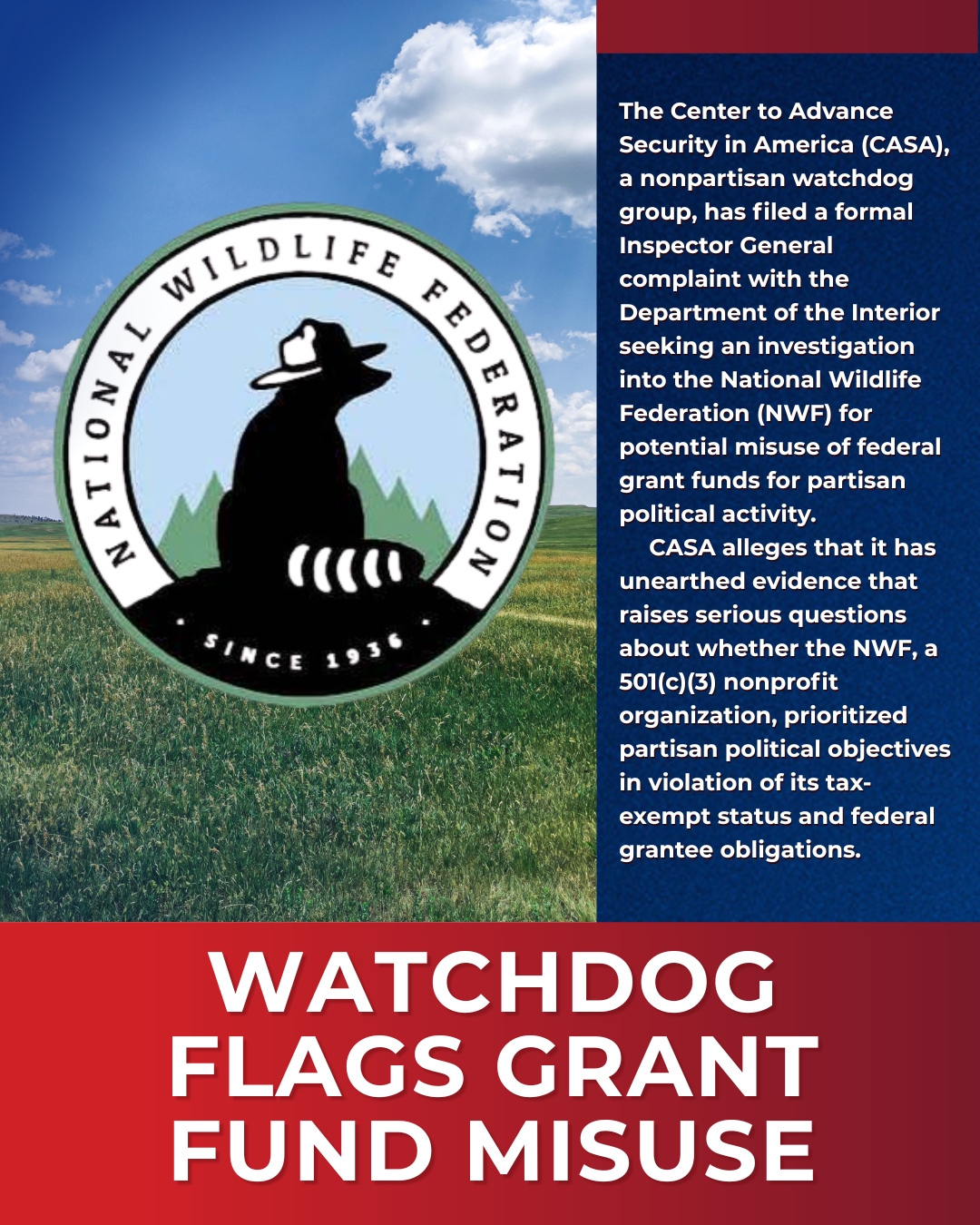
The Center to Advance Security in America (CASA), a nonpartisan watchdog group, has filed a formal Inspector General complaint with the Department of the Interior seeking an investigation into the National Wildlife Federation (NWF) for potential misuse of federal grant funds for partisan political activity.
CASA alleges that it has unearthed evidence that raises serious questions about whether the NWF, a 501(c)(3) nonprofit organization, prioritized partisan political objectives in violation of its tax-exempt status and federal grantee obligations.
In the June 25 complaint to U.S. Department of the Interior acting inspector general Caryl Brzymialkiewicz, CASA’s director James Fitzpatrick alleged that in September 2024, the DOI’s Bureau of Land Management (BLM) awarded $872,887.50 to the NWF for projects in Montana.
According to the complaint, NWF’s affiliated but legally separate National Wildlife Federation Action Fund—a 501(c)(4) organization that can engage in political advocacy—reported spending $299,985 on independent expenditures supporting Democrat Jon Tester’s U.S. Senate campaign in Montana a month after the grant was awarded.
“The NWF has an affiliated, but legally separate, 501(c)(4) social welfare organization, the National Wildlife Federation Action Fund (the Action Fund), through which it works to raise the visibility of key conservation issues with voters and elected officials and engages in partisan political activity,” the complaint states.
Fitzpatrick wrote that, in a 2026 audit report for the NWF, the NWF disclosed that in fiscal years ending in August 2024 and August 2025—time periods that fall within the window of and include the independent expenditure spending—it had provided $260,000 in grants to the National Wildlife Federation Action Fund.
The NWF also missed the mandatory filing of a year-end report for 2024, and on March 10 of 2025, the complaint continued, the FEC sent a letter to the Action Fund regarding its failure to disclose the donors for the independent expenditure’s spending.
“In a March 20, 2025, response to the FEC’s request, Karla Raettig stated on behalf of the Action Fund: ‘This letter is in response to the request for additional information dated March 10, 2025, related to National Wildlife Federation Action Fund’s Year-End Report. Based on a review of its receipts during the reporting period, the organization did not receive any additional contributions that were earmarked for any independent expenditure or political purpose as that term is defined under CREW v. FEC.’”
In summary, Fitzpatrick wrote, NWF received $872,887.50 on September 1, 2024, in DOI federal grant funds for work to be performed in Montana, and less than a month later the Action Fund spent $299,985 on an independent expenditure in Montana in support of Senator Jon Tester.
“NWF’s own audit showed that during that same time period, $260,000 was granted from NWF, a 501(c)(3), to the Action Fund, a 501(c)(4)—a nearly identical amount of money to the amount the Action Fund spent in Montana in their independent expenditure in support of Senator Jon Tester,” the complaint states.
The distinction between a 501(c)(3) and a 501(c)(4) is central, the complaint argues, because if charitable resources—including taxpayer-supported grant funds—were effectively used to subsidize political spending through the affiliated organization, both IRS rules and federal grant conditions could have been violated.
To be sure, Fitzpatrick wrote, a representative of the Action Fund stated in response to an FEC inquiry that the Action Fund’s independent expenditure in Montana in support of Tester was funded from their own bank account, and not from funds earmarked by a particular donor for that effort, but he wrote that questions remain.
For one thing, Fitzpatrick argues, while 501(c)(4) organizations may engage in some political activity, that protection may not apply if campaign expenditures are inappropriately funded.
“The aforementioned expenditures directly in support of Tester’s Senate candidacy, while typically permitted if they don’t represent the organization’s primary purpose, may be inappropriate and not permitted if they are drawing on funds from a related tax-exempt educational organization,” the complaint states.
What’s more, Fitzpatrick wrote, 501(c)(3) organizations like NWF are held to a more stringent standard.
“If the political activities of the Action Fund can be attributed to the NWF, that would violate the conditions of their tax-exempt status,” the complaint states. “When federal funds are involved, greater scrutiny is required to ensure taxpayers are not being tricked into funding partisan political efforts.”
Money is fungible, Fitzpatrick wrote, and there can be no possibility that federal funds were used for impermissible partisan political purposes.
“Federal funds can in no way be filtered through related social welfare organizations which engage in partisan political activity,” the complaint states. “If this occurred, the NWF, acting through the Action Fund, may have violated both the terms of its taxpayer grants and the IRS rules governing 501(c)(3) and (4) organizations.”
The complaint asks the Department of the Interior inspector general to investigate the facts and circumstances surrounding the NWF’s potential misuse of taxpayer federal grant funds.