American Stewards of Liberty executive director Margaret Byfield joined administration officials and other stakeholders at a lawfare roundtable last week in Washington, D.C., where the U.S. Department of Agriculture and the U.S. Small Business Administration announced a partnership to combat regulatory lawfare that targets farmers, ranchers, private property, and small businesses.
The Department of Agriculture (USDA) defines lawfare as the use of administrative, legal, and legislative government systems to adversely impact farmers, ranchers, and agricultural producers, usually motivated by extreme environmental and progressive agendas. In an agricultural context, it typically involves excessive red tape and permitting; unwarranted litigation by private and public entities to deter favorable outcomes for property owners; excessive civil and criminal penalties; and the use of eminent domain to inhibit agricultural production.
The Memorandum of Understanding (MOU) signed on July 2 between the two agencies gives producers a direct line portal to report regulations and enforcement actions they believe constitute lawfare. It also allows USDA and the Small Business Administration (SBA) to identify recurring regulatory patterns that could lead to broader deregulatory reforms. (The portal can be accessed here.)
In announcing the memorandum, USDA secretary Brooke Rollins said that, for years, farmers and ranchers who believed they were victims of abusive regulation often had only two choices: either absorb enormous legal costs or fight lengthy court battles against federal agencies. For too long, she said, a network of government agencies, radical environmentalist NGOs, and activist groups have targeted American farmers and ranchers, forcing producers to pay hundreds of thousands of dollars in fines, give up prime grazing land, and even sell and stop farming on generational properties.
That approach is changing, Rollins said.
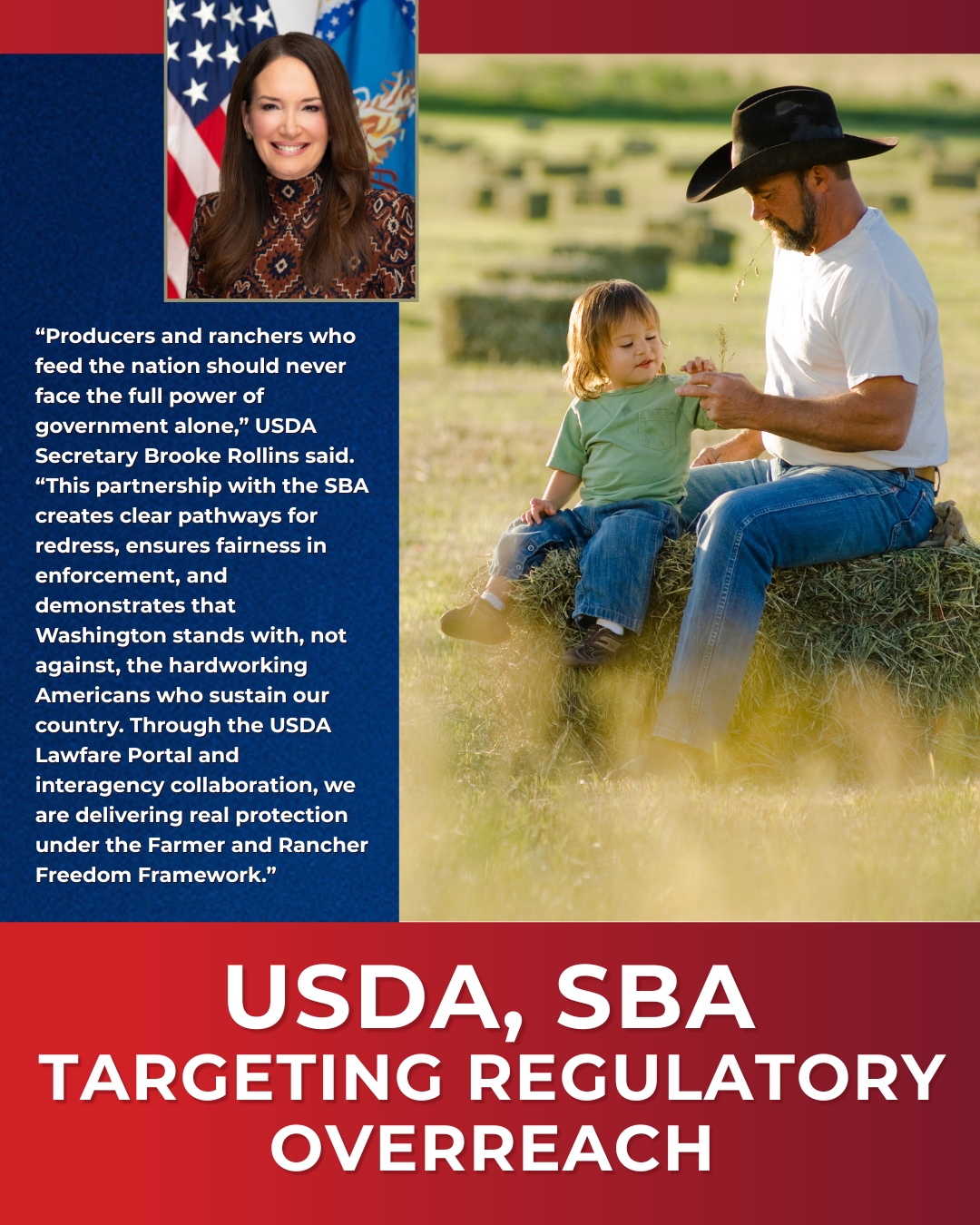
“Producers and ranchers who feed the nation should never face the full power of government alone,” she said. “This partnership with the SBA creates clear pathways for redress, ensures fairness in enforcement, and demonstrates that Washington stands with, not against, the hardworking Americans who sustain our country. Through the USDA Lawfare Portal and interagency collaboration, we are delivering real protection under the Farmer and Rancher Freedom Framework.”
The Farmer and Rancher Freedom Framework is a comprehensive, four-pillar plan to protect, preserve, and partner with American agriculture to end what the Trump administration calls onerous regulations and the weaponization of government against American farmers and ranchers. The partnership announced last week advances Pillar 4 of the framework by building a government-wide shield against lawfare.
Under the memorandum, USDA will oversee the portal, through which farmers and ranchers and small business owners can submit complaints against federal agencies. The agency will share those submissions with the SBA’s Office of the National Ombudsman for case management. Complaints involving USDA will be handled through that department, while the SBA will refer complaints against other agencies to the appropriate entities for resolution.
The MOU also authorizes SBA to analyze complaint data to identify recurring lawfare practices and enforcement or regulatory issues that may be disproportionate, inconsistent, or abusive, helping inform potential deregulatory action for broader reform. Rather than addressing each dispute independently, USDA and SBA officials say they are working to create a permanent infrastructure to serve as an early warning system for identifying systemic regulatory problems.
Byfield said American Stewards of Liberty (ASL) stands ready to help the administration find ways to help the Administration.
“This is the first time that Cabinet level officials have taken a personal interest in helping America’s small landowners when unjustly targeted,” she said. “Secretary Rollins and Administrator Loeffler are the courageous leaders we have needed to defend all American’s right to securely own and use their property.”
ASL has been spearheading a set of policies that would provide long term protections for landowners with other partner organizations, the USDA and the House Oversight Committee.
“This is something much bigger than an agreement between two agencies,” Byfield said. “It reflects an effort to build a government-wide response to regulatory lawfare, not only helping producers challenge alleged abuses, but also identifying recurring enforcement patterns that can drive broader reforms.”
SBA administrator Kelly Loeffler also lauded the pact, saying farmers and ranchers do some of the hardest and most essential work in America while facing a growing burden from costly federal regulations. Those regulations, Loeffler says, have crushed multi-generational family businesses that often lack the time, money, and legal resources to fight back.
“With our MOU, the SBA and USDA now offer America’s producers a direct line to report lawfare, with a new infrastructure to deliver lasting regulatory reform,” she said.
Another key administration official involved in the effort is John Rich, Trump’s Special Envoy for American Landowners, whom Trump tapped to serve as a leading advocate for America’s farmers, ranchers, and private landowners.
Rich said the cumulative effect of over-regulation and zealous prosecution—from grazing permits to irrigation to endangered species litigation to federal easements, and more—has been to place extraordinary financial and legal burdens on America’s agricultural producers.
“For too many ranching families, lawfare has become just another cost of doing business—except it’s one no hardworking producer should ever have to bear,” Rich said. “I’ve traveled across this country and met families who have spent years fighting bureaucrats instead of tending their cattle, working their land, or passing their operations on to the next generation. This partnership sends a clear message: the federal government is done standing on the sidelines while producers are buried in red tape and abusive enforcement. We’re standing up for the people who feed America.”
Early successes
The administration points to several examples it considers evidence that the initiative is already producing results.
One of the earliest successes halted the federal prosecution of Charles and Heather Maude, a South Dakota family with a small cattle and hog operation. The family endured what Rollins says was a senseless and politically motivated prosecution waged by the Biden administration over 25 acres of federal land.
The dispute began when U.S. Forest Service alerted the Maudes that fencing on their property blocked access to the Buffalo Gap National Grasslands, and, in good faith, the family agreed to a survey of the property lines. After the survey, what had been a routine property dispute escalated into what the administration characterizes as an unnecessary criminal prosecution, which the Trump administration dropped.
Government resources for prosecution should be focused on true criminals, not a family farm trying to make ends meet, Rollins said.
“The Maudes are not criminals,” she said. “They have worked their land since the early 1900s, and something that should have been a minor civil land dispute that was over and done with quickly turned into an overzealous criminal prosecution on a hardworking family that was close to losing their home, children, and livelihood. Not in this America, not under President Trump.”
The USDA has also protected a family farm in New Jersey from condemnation, ended a disputed Forest Service easement claim in Tennessee, challenged California proposals involving agricultural land redistribution, opposed ESG demands affecting dairy producers, and halted federal funding for solar projects on productive farmland.
At the roundtable last week, the USDA highlighted numerous cases involving families still facing administrative delays and land-management disputes, as well as the arbitrary application of environmental laws and potential due process violations. Attendees told heart-felt stories about their struggles, ranging from litigation over irrigation practices in Montana to grazing permit delays in Arizona to proposed solar developments replacing prime farmland in New York.
While each dispute is unique, Byfield says they embody a common theme: the government has increasingly laid down a gauntlet of regulatory and legal obstacles that threaten multigenerational agricultural operations and private property. USDA officials also say disputes often originate not only in the federal bureaucracy but in aggressive lawsuits brought by environmental groups to pressure landowners into costly settlements or operational changes.
Over the coming weeks, Liberty Matters will examine those cases and stories, exploring both the regulatory disputes and the broader questions they raise about the relationship between government and the people who work the land.
The MOU agreement builds on earlier administration initiatives, including right-to-repair reforms for agricultural equipment and the elimination of certain diesel emissions requirements, in addition to dozens of regulatory rollbacks and revisions to agency guidance intended to reduce administrative burdens on agricultural producers.
In addition to Byfield and ASL, administration officials, and affected producers and ranchers, U.S. Rep. Harriet Hageman (R-Wyoming) also attended the roundtable, representatives from leading legal organizations, including the America First Policy Institute, Institute for Justice, Texas Public Policy Foundation, Pacific Legal Foundation, and Mountain States Legal Foundation.