
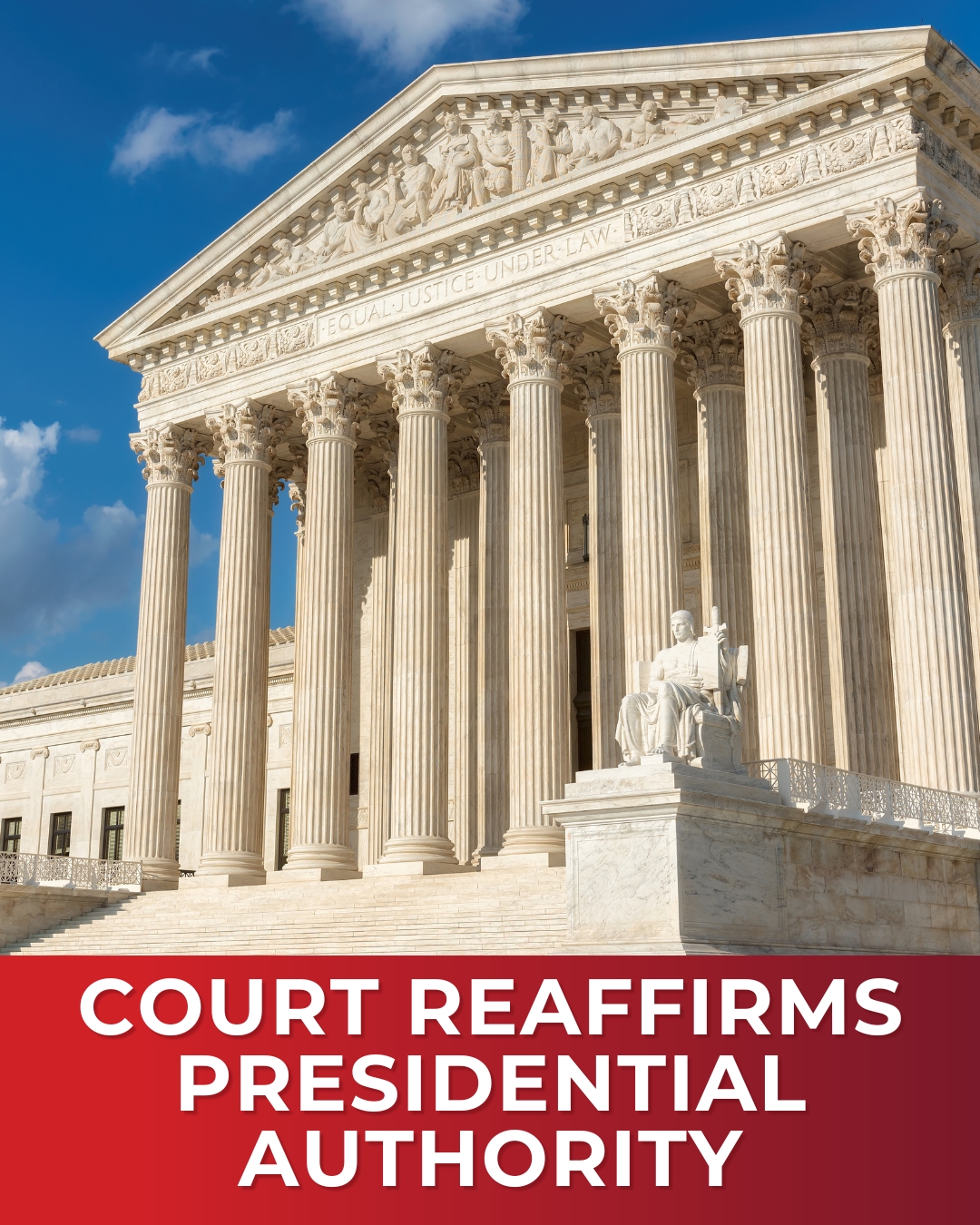
In a 6-3 ruling last week, the U.S. Supreme Court overturned the nearly century-old precedent established in Humphrey’s Executor v. United States, returning what the court says is accountability to the executive branch by allowing the president to fire at will the heads of most independent regulatory agencies.
The ruling in Trump v. Slaughter restores presidential authority over all officials who exercise executive power, in this specific case the president’s authority to remove Federal Trade Commission (FTC) commissioners. Writing for the majority, chief justice John Roberts anchored the opinion in the Founders’ deliberate decision to vest executive authority in a single president rather than a committee or council.
“Nearly 250 years ago, the Framers decided to vest ‘[t]he executive Power’ in one person—‘a President of the United States of America,’” Roberts wrote. “The choice was not made lightly. Within living memory were the ‘long train of abuses and usurpations’ of a King who reigned as ‘a Tyrant.’”
Indeed, Roberts observed that several delegates to the Constitutional Convention pushed for a multimember council rather than “unity in the Executive magistracy,” which they feared would serve as “the foetus of monarchy.”
“But unity won out,” the decision stated. “Our Constitution’s drafters knew from experience that a ‘plurality in the executive’—the model in use by most states at the time—not only ‘diminishe[s]’ the ‘activity, secrecy, and dispatch’ necessary to ensure ‘good government’ but ‘tends to conceal faults and destroy responsibility.’ With just one President in charge, they reasoned, there would be no doubt ‘on whom the blame or the punishment of a pernicious measure . . . ought really to fall.’”
And so, drawing heavily on the Constitutional Convention, early American practice, and the writings of Alexander Hamilton and James Madison, the opinion argues that accountability requires executive officers to remain subordinate to—and removable by—the president.
In the case at hand, Roberts wrote, the court was addressing one of several regulatory agencies that deviate from the model of presidential supervision—the Federal Trade Commission, or FTC.
“Since its creation in 1914, the FTC has accumulated vast rulemaking, enforcement, and adjudicatory powers under more than 80 statutes,” he wrote. “Not only does it promulgate rules that carry the force of law, but it also enforces those rules against private parties, collecting civil penalties in the billions of dollars.”
And yet, Roberts continued, its powers do not belong to the President or his appointees alone but to five commissioners, each of whom serves for seven years and may be removed by the president only “for inefficiency, neglect of duty, or malfeasance in office.”
“We hold that such protection from removal is contrary to the separation of powers enshrined in the Constitution,” Roberts wrote for the court.
Long overdue
Roberts spent a fair amount of time in the opinion explaining why Humphrey’s Executor was overruled. Decided in 1935, Humphrey’s Executor upheld statutory protections that prevented the president from removing members of the Federal Trade Commission at will. The Court reasoned that the FTC performed quasi-legislative and quasi-judicial functions rather than purely executive ones, allowing Congress to insulate its commissioners from direct presidential control.
But, Roberts argued, the 1935 court’s distinction between “quasi-legislative” and “quasi-judicial” agencies no longer reflected the reality of modern government, if it ever did. Roberts wrote that the decision was tethered from the start to a highly circumscribed and almost fictional view of the FTC’s role.
“Humphrey’s has been difficult to make sense of from the start,” he wrote. “‘[O]nly by blind feats of definition’ could the Court transform powers that are quintessentially executive—investigative and prosecutorial alike—into nonexecutive ‘quasi-legislative’ and ‘quasi-judicial’ functions.”
Indeed, Roberts asserted, the FTC writes regulations, investigates violations, prosecutes cases, and imposes substantial penalties—all unmistakably executive functions.
“At this point, all that is left of Humphrey’s is its observation that an agency that ‘exercises no part of the executive power’ need not fall within the rule of Presidential removal,” he wrote. “If Congress wishes to establish independent agencies to assist it with its functions, it may do so. But it may not foist those agencies upon the president and thus deprive him of ‘the executive power vested [in him] by the Constitution’—something Humphrey’s itself never purported to permit. If anything more is left of Humphrey’s, we overrule it.”
Humphrey’s has for decades been a result in search of a rationale, Roberts wrote.
Practical consequences
The immediate consequence of the decision is that commissioners of the FTC and similar independent agencies may now be removed by the president without satisfying statutory “for cause” requirements.
More broadly, the decision shifts responsibility for executive agencies back to elected officials. On the one hand, presidents can no longer distance themselves from agency actions by throwing hands up and blaming out-of-control independent commissions, while Congress can no longer pass the buck on tough decisions by delegating—i.e., surrendering—their authority to independent agencies.
Perhaps most important, the decision begins the long road to rerouting power away from the administrative state.
“The overruling of Humphrey’s Executor is a necessary step in quelling the spiral of administrative despotism,” Competitive Enterprise Institute (CEI) research fellow Alex Reinauer said. “Rather than the end of agency independence, this marks the beginning of restoring America’s founding principle: the separation of powers. There is no greater birthday present for our nation as she turns 250.”
Likewise, CEI senior fellow Wayne Crews said the decision restored an important constitutional principle: those who exercise executive power are ultimately accountable to the president, who is, in turn, accountable to the voters.
“This high-profile FTC Commissioner removal case wasn’t about antitrust, consumer protection policy, or controversial non-compete agreements,” Crews said. “It was about who controls officials exercising that kind of sweeping executive power.”
Crews also warned that no one should mistake the Supreme Court decision for the end of the administrative state.
“The constitutional defect of Humphrey’s Executor doctrine was agency independence without accountability,” he said. “The remaining defect—especially evident since Covid—is power without meaningful limits.”
Margaret Byfield, executive director of American Stewards of Liberty, praised the decision as a step towards agency accountability. “One of the key elements to stopping lawfare against landowners is holding federal employees accountable when they deliberately misuse federal power. Today, it is difficult to fire or punish federal employees. Most often they are transferred to another part of the country where they become another landowner’s problem. We hope this cracks open the door to hold rogue federal agents accountable.”
Finally, Roberts challenged the reasoning of the dissenting progressive justices in the case, arguing that they minimized the historical understanding shared by figures such as George Washington, Thomas Jefferson, Madison, and Hamilton that presidential removal authority was an inherent component of executive power.
Rather than viewing the decision as an expansion of presidential authority, Roberts wrote, the decision represented a restoration of the constitutional structure originally adopted by the Framers.