This week we have Georgia on our minds, and railroads, too, but don’t think we’re heading out for a nice lunch of Fried Green Tomatoes at the WhistleStop Cafe.
Instead, we’re headed to another part of rural Georgia, Sandersville to be exact, where property owners are on the verge of literally being railroaded in a huge land grab. That is, unless the Georgia Supreme Court steps in, as the affected property owners are asking it to do.
The case started in March 2023, when, as the Institute for Justice (IJ) reports, Sandersville Railroad asked the Georgia Public Service Commission (PSC) for permission to condemn and take land owned by Don and Sally Garrett, land that has been in Don’s family since just after the Civil War.
Two months later, other property owners—the Smith, Reed, and Briggs families—teamed up with IJ to join a challenge to the condemnations, which would mostly orphan the back halves of the families’ parcels.
The thing is, the Sandersville Railroad is seeking authority—and won it in the state court of appeals—to condemn the properties not for a highway, school, or public utility but for a rail spur intended primarily to serve a private quarry.
The dispute raises a larger question: When does a taking cease being for the public and become a transfer of property from one private owner to another? That question has haunted the courts—and private property owners—since 2005, when the U.S. Supreme Court, in Kelo v City of New London, ruled 5-4 that the government can take private property and transfer it to private developers for purposes of economic development, with the caveat that the seizure must provide a public benefit.
It was a horrible decision, but, as long as it stands, it begs a second question: What qualifies as economic development that provides a public benefit for purposes of eminent domain, or is the inquiry entirely tautological—treating economic development as a public benefit simply because it is economic development?
You can see the problem, and it’s more than relevant in Sandersville.
Specifically, Sandersville Railroad wants authority to condemn the Hancock County land to build a 4.5-mile rail spur connecting the quarry to a larger rail network. The Georgia Public Service Commission approved the condemnation, and the lower courts affirmed.
The argument of the Garretts et al is straightforward: Georgia’s constitution allows eminent domain only for genuine public uses, not for private economic development—the General Assembly enacted reforms in the wake of the Kelo ruling to prevent just such a circumvention—and the Sandersville rail line is not open to the public as a common carrier but instead serves only customers the railroad chooses to contract with.
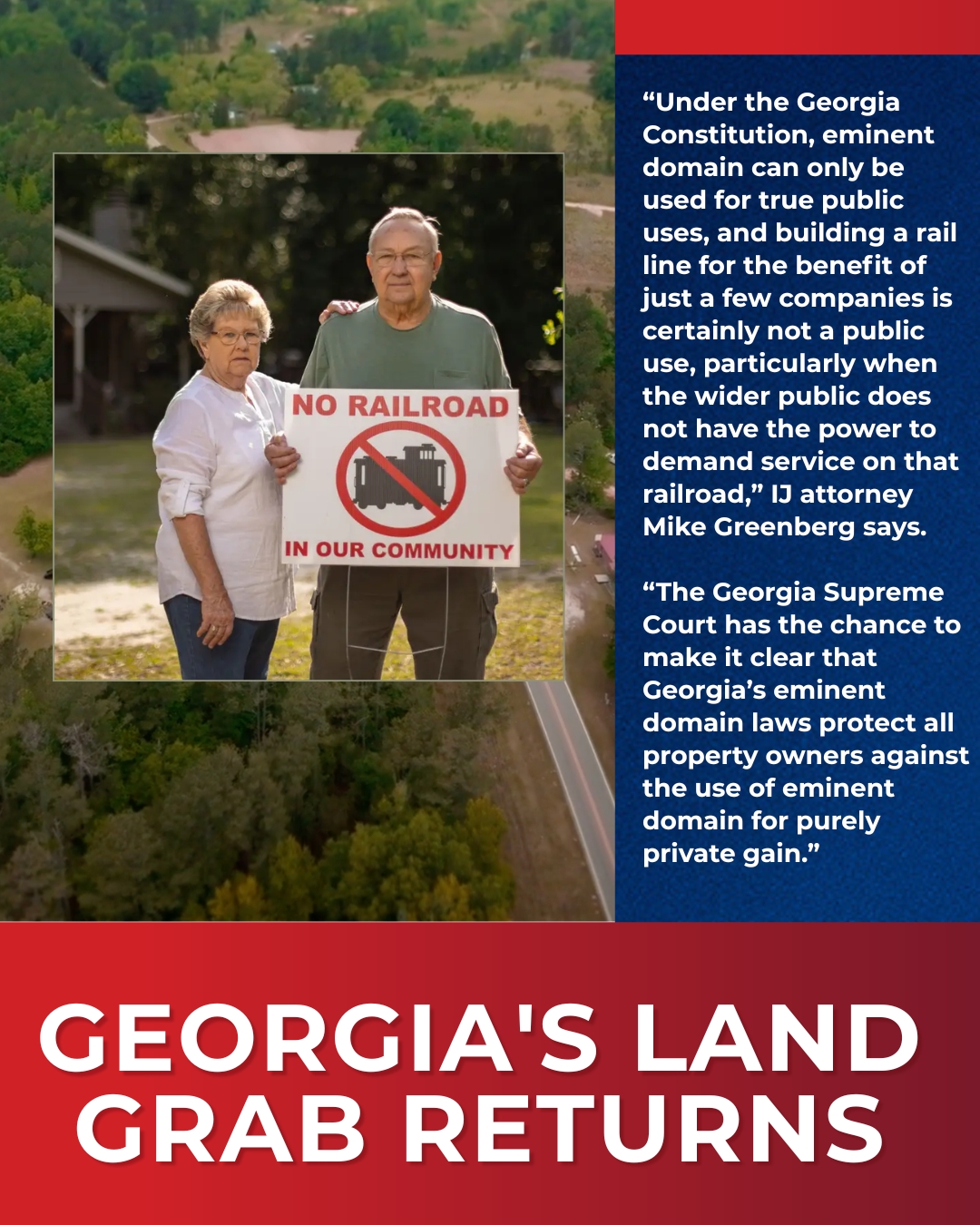
“Under the Georgia Constitution, eminent domain can only be used for true public uses, and building a rail line for the benefit of just a few companies is certainly not a public use, particularly when the wider public does not have the power to demand service on that railroad,” IJ attorney Mike Greenberg says. “The Georgia Supreme Court has the chance to make it clear that Georgia’s eminent domain laws protect all property owners against the use of eminent domain for purely private gain.”
In the petition to the state’s high court, IJ contends that, for a full century, Georgia courts have defined the standard of eminent domain for rail lines as requiring any track opened to the public to be “used on equal terms by all who may at any time have occasion to use it.”
“For over a century, Georgia courts have conditioned a railroad’s exercise of eminent domain on the resulting line being open to everyone as of right,” the petition states. “A railroad that can exclude customers, refuse certain cargo, and pick its shippers serves a private use, not a public one. The Court of Appeals abandoned that requirement. This Court should grant review to protect the long-cherished right to hold land free from a private company’s seizure for purely private gain.”
The IJ attorneys—led in the petition by Grant McBride and IJ’s William Maurer—observed that the PSC’s own hearing officer found as fact that Sandersville would not be offering its services as a common carrier: “That makes its line a private use. … That finding should have been fatal. The test demands ‘that everybody who has occasion to use it may lawfully and of right do so.’”
And the court shouldn’t get caught up on labels, either, IJ argued. Indeed, the railroad argues that the line really isn’t promoting economic development but providing a public use, both as an aid in the functioning of a public utility and as a channel of trade.
“Whether courts phrase it as ‘common carriage’ or otherwise, the core question is the public’s right of use—‘one of the essential and constituent obligations upon the part of the individual who attempts to exercise the right of eminent domain,’” the petition states.
Of course, as the IJ attorneys wrote in the petition, the court of appeals exercised its own peculiar logic.
“The court below nonetheless affirmed the PSC’s public-use finding on evidence that Sandersville ‘would allow anyone who contracts with it to use the Spur,’” the petition states.
That logic simply doesn’t pass constitutional muster, the attorneys argued.
“But Sandersville’s inclusion of only those parties with whom it chooses to contract is different from being open to all as of right,” the petition states. “The latter would let customers ‘demand that they be served without discrimination, not merely by permission.’ Here, instead, Sandersville keeps the right to accept or reject customers, set case-by-case rates and terms, and discriminate freely among shippers.”
That is not a use as of right, open to the public, and that means the taking is not a public use, the IJ attorneys concluded: “In holding that it was, the Court of Appeals broke not just with this Court’s precedent but its own.”
Back to Kelo
The property owners believe the court of appeals’ ruling extends beyond a single railroad and a single case, and it refocuses on the Kelo decision, in which the Supreme Court majority determined that the federal Takings Clause gives only “limited protections” against takings “by private industry.”
“That ruling ‘sparked widespread concern throughout the nation’ over ‘the misuse of eminent domain,’ including ‘in Georgia,’” the IJ petition states. “Georgia answered that alarm with a ‘statutory scheme’ built ‘to protect property owners from abuse of the power of eminent domain.’ Against that backdrop, it defies belief that the legislature meant to push public-use protection below the historical norm Georgia’s courts have always enforced.”
To say it another way, the Kelo decision held that the constitution does not prohibit a state from using eminent domain for economic development if the taking is part of a comprehensive redevelopment plan. But it also did not prohibit states from providing greater protection. Georgia did so, and so did 42 other states.
The court of appeals’ decision would effectively overturn those protections the state enacted. Georgia’s legislature responded to Kelo by restoring a meaningful limitation on eminent domain for economic development, but the property owners argue that the court of appeals has effectively undone that reform—not by repealing the statute, but by interpreting “public use” so broadly that the Kelo rationale is resurrected under a different name.
“Petitioners’ remedy should not be to trek back to the legislature to ask for protection that body—in response to public outcry—has already enacted,” the petition concludes. “Instead, this Court should intervene to enforce the protections the law already provides.”
There are other complex issues in this case—whether regulators or the courts can decide on their own whether a taking is truly for public use—but the real issue becomes government taking for private economic development. The latest Georgia court decision reflects a national trend that has continued even after the backlash to the Kelo decision. While many states enacted reforms, governments and private developers have increasingly relied on other legal theories—including expansive interpretations of “public use” and “channels of trade,” as here—to accomplish similar transfers of private property.
Whatever the Georgia Supreme Court ultimately decides, the case asks an increasingly important question: if a private company may invoke the government’s eminent domain power to build infrastructure serving only selected commercial customers, where should courts draw the line between legitimate public use and private economic benefit?
Meanwhile, the property owners are continuing their fight. One of them, Blaine Smith, warns of the consequences if the court can simply take away their constitutional and statutory protections.
“We hope the Georgia Supreme Court hears our case, because if this type of thing can happen to my family and my neighbors, it can happen to anyone in Georgia,” Smith said. “Nobody should have to worry about the government taking their land and giving it to a private company.”