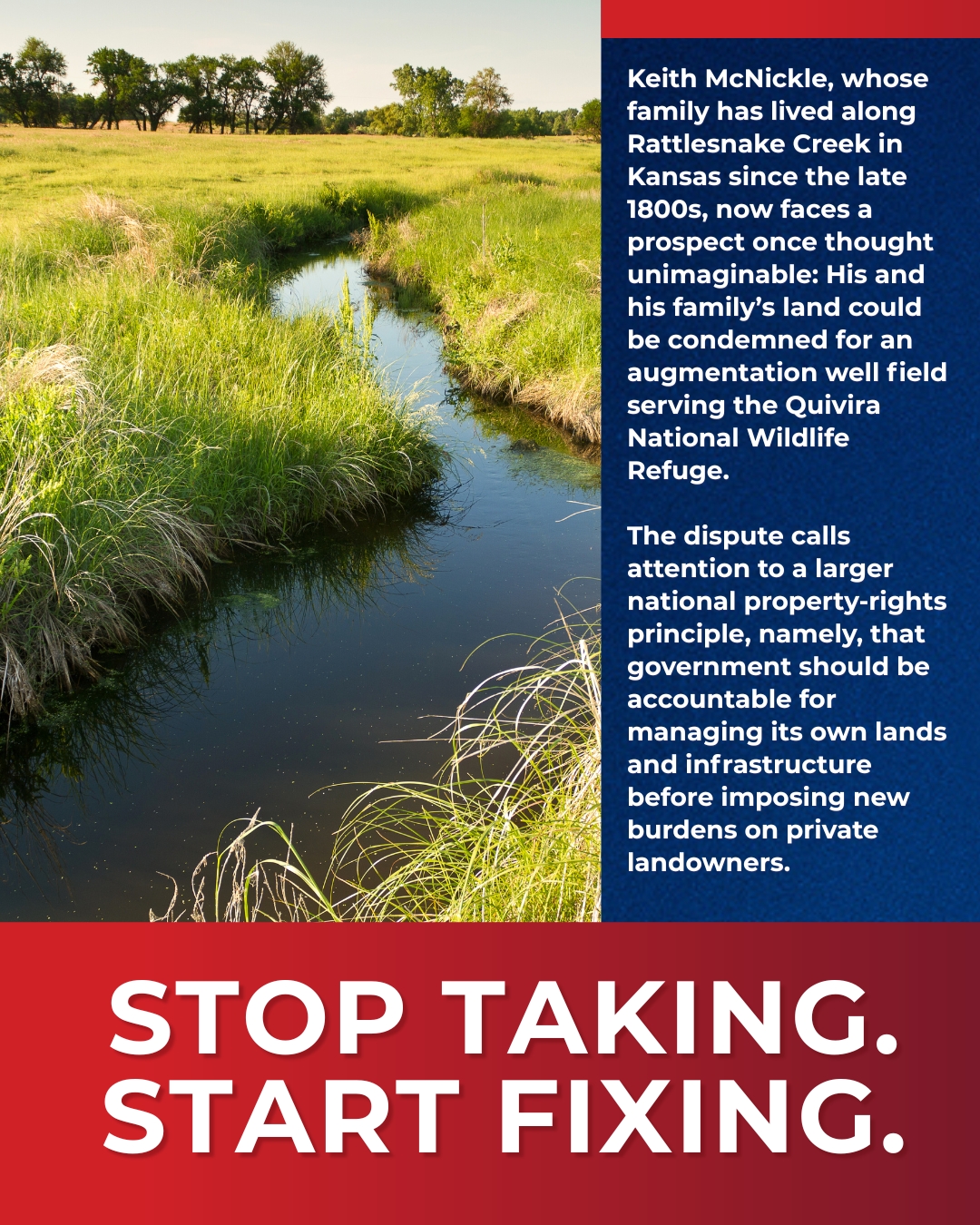
Keith McNickle, whose family has lived along Rattlesnake Creek in Kansas since the late 1800s, now faces a prospect once thought unimaginable: His and his family’s land could be condemned for an augmentation well field serving the Quivira National Wildlife Refuge.
An augmentation well field is a group of groundwater wells built to pump water into a river, creek, or wetland to increase the available water supply.
McNickle is not alone in facing a government takings. In this case, the Kansas Natural Resource Coalition (KNRC), with American Stewards of Liberty (ASL) consulting on the project, is challenging a federal decision approving a $40-$60 million project to pump approximately 5,800 acre-feet of water annually into the Quivira National Wildlife Refuge. The project is intended to alleviate alleged impairment of the refuge’s water supply.
The KNRC is an association of counties that serves as a conduit between local, state, and federal governments to promote effective administrative policymaking through government-to-government coordination.
Specifically, the Natural Resources Conservation Service, the USDA agency overseeing the project, issued a decision on May 1 approving a 21,000-acre man-made wetland system sustained by 30-plus water-control structures, ditches, and canals. In sum, the federal government wants to drill multiple high-capacity wells in the groundwater aquifer, pump about 1.9 billion gallons of water a year, and send it through pipelines into the refuge or Rattlesnake Creek watershed.
The goal, according to the US Fish & Wildlife Service (USFWS), which owns and manages the refuge, is to raise water levels to provide for long-term, sustainable agricultural water management within the Rattlesnake Creek subbasin.
But KNRC and ASL argue that the federal government has skipped an essential question: whether the USFWS has properly maintained the refuge’s own water-control infrastructure over the years.
For starters, the underlying impairment determination relied on modeling rather than verifying whether the refuge was maximizing the water it already receives, KNRC maintains: “The 2016 report used retrospective modeling but never verified whether USFWS is maximizing hydroperiods,” wrote Tracey Barton, the executive director of KNRC, in comments submitted to the USFWS and to the Kansas congressional delegation. “The entire $60M project is built on that flawed foundation.”
Barton also contends that USFWS may be causing its own impairment.
“Photographic evidence documents severe vegetative encroachment, degraded water-control structures, and a failure to remove woody vegetation—all in violation of the Refuge’s own Comprehensive Conservation Plan, and all factors that reduce the water it can store and use,” she wrote. “That neglected infrastructure has never been audited. Kansas irrigators are expected to maintain their own systems before blaming neighbors for shortages; the same standard must apply to a federal refuge.”
In addition, Barton added, the project may not even resolve the impairment.
“USFWS has also signaled that even after the well-field and 2,500 acre-feet-per-year water-right retirements, further curtailment may still be required,” she wrote. “Committing $60 million with no guarantee of resolution—and no audit of the Refuge’s own management—is fiscally indefensible.”
Beyond infrastructure concerns, there are property-rights issues, Barton maintains.
“The Final EIS relies on a conceptual well-field layout with no final well locations or pipeline alignments,” she wrote. “Construction requires land access, easements, and acquisition from private landowners whose consent has not been secured—leaving the door open to eminent domain, which USFWS itself says it does not support. The required takings assessment under the Kansas Private Property Protection Act does not appear in the record.”
What’s more, Barton contends, the watershed cannot guarantee an annual supply.
“Central and western Kansas streams are intermittent,” she wrote. “Quivira was designed to divert and store water during available hydroperiods, not to receive a static flow every year. Even KDA-DWR (Kansas Department of Agriculture-Division of Water Resources) has acknowledged that large water-right holders should not expect to fully exercise their maximum authorized quantity annually.”
And then there’s the issue of process. Barton says affected counties were not meaningfully coordinated with: “The federal process did not adequately address KNRC’s comments or coordinate with county governments whose economies, agriculture, and landowners are directly affected.”
KNRC is asking the USFWS to conduct a deferred maintenance audit under an existing director’s order before construction proceeds and to agree to a 20-year moratorium on further calls for water or curtailment of junior water-right holders while the project is evaluated.
“Committing $40–$60 million in federal funds to augment water into a system that has not been verified as functional and properly maintained is not responsible stewardship of public resources or of the Refuge itself,” she wrote. “KNRC stands ready to provide our full evidentiary record in support of this request.”
Barton says the request for a moratorium is consistent with a January 8, 2026, U.S. Forest Service–State of Utah cooperative management agreement, a 20-year framework covering more than 8 million acres of national forest land. This would allow the Refuge to come into compliance with the Comprehensive Plan and likely show that the augmentation field is not necessary.
Finally, Barton wrote that the Final Environmental Impact Statement pushes a costly federal project forward while the core problems remain unresolved.
“The project may not solve the impairment, the refuge’s own management has never been audited, junior water users still face curtailment and further retirement demands, and Kansas landowners are not protected from eminent domain or uncompensated property impacts,” she wrote. “Kansas water users have carried this fight for decades, and it will continue indefinitely unless it is settled now. It is time to solve it once and for all.”
Similar conflicts are emerging across the West as federal conservation goals increasingly collide with long-established agricultural water rights, making the Quivira dispute a test case for broader questions about government accountability and private property.
Not least, the dispute calls attention to a larger national property-rights principle, namely, that government should be accountable for managing its own lands and infrastructure before imposing new burdens on private landowners.