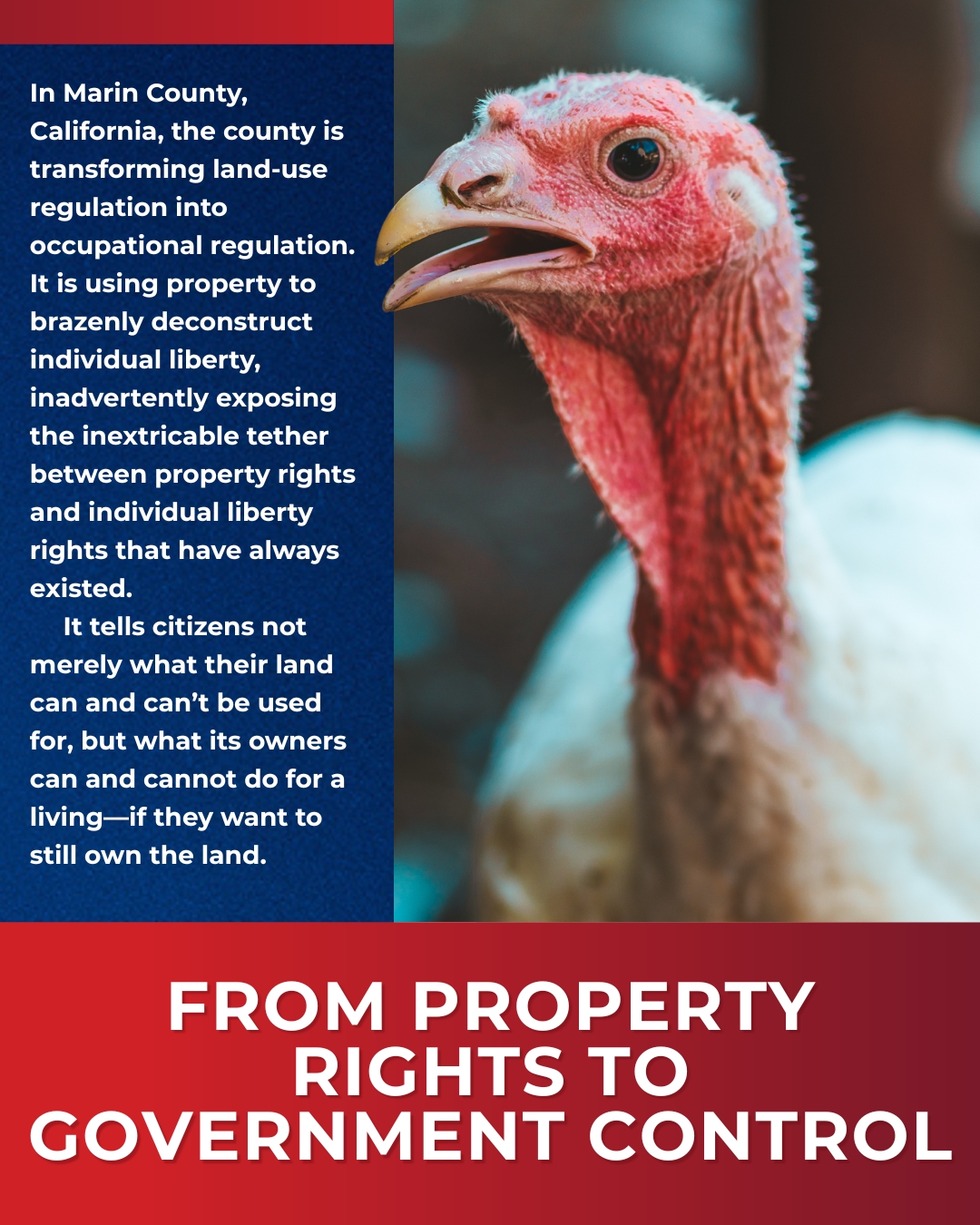
Out in Marin County, California, along the rich ranch land of the coast, Willie Benedetti spent four-and-a-half decades building and running his pride and joy—an iconic ranch-to-table gourmet enterprise called Willie Bird Turkeys. His turkeys found their way to dining tables coast-to-coast, from the White House to urban enclaves to suburban and rural America.
Of course, as Pacific Legal Foundation (PLF) tells the above story, all good things must come to an end, and so did Willie Bird Turkeys. But Willie had planned well for his future: Upon his death, his two sons inherited the property, two contiguous parcels totaling 267 acres. One brother, Arron, lives in the house he shared with his father; the other, Arthur, wanted to build his own house.
There was just one problem: the government. Seems the Benedetti brothers didn’t want to continue to operate an agricultural enterprise; in fact, they were plumbers. And that ran afoul, so to speak, of the powers that be in Marin County.
In an extraordinary move, and applying an equally extraordinary regulatory burden, as PLF describes it in a petition urging the U.S. Supreme Court to take the case, the county demanded that the brothers sign a perpetual covenant requiring every owner of the property to remain engaged in commercial agriculture forever:
“In 2021, Marin County amended its Local Coastal Program (LCP) to prohibit construction of an additional dwelling unit on properties in the Coastal Agricultural Production Zone (C-APZ), where the Benedetti land is located, unless the landowner records a restrictive covenant that runs with the land and obligates the owner (and every future owner) to remain ‘actively and directly engaged’ in commercial agriculture,” PLF attorneys Jeremy Talcott, Johanna Talcott, and Deborah La Ferrari wrote in the petition. “Under the LCP, the only alternative is to lease the land to a commercial agricultural producer. Either way, the Benedettis are forced into either active farming or managing farmers and farmland, occupations for which they have no training, no expertise, and no interest.”
What’s more, the petition states, the requirements apply whether or not farming is commercially feasible and even if the land is not agriculturally viable. It’s either sign the covenant or get no permit.
The biggest anomaly is the fact that the proposed house complies with all zoning and land use regulations, except for the newly passed LCP, the attorneys wrote.
“It does not affect surrounding land uses or interfere with any agricultural activity—the land is already zoned exclusively for agriculture and agricultural accessory structures and activities,” the petition states. “The ‘agriculture zone’ authorizes dwellings for the landowner, ‘intergenerational family,’ and farm workers, as well as other related structures such as processing facilities and airstrips.”
Nonetheless, the attorneys observe, the county says the restriction is necessary to preserve the area’s agricultural character by deterring any development that contributes to a market for residential real estate in agricultural areas.
However, if that rationale is accepted, the attorneys assert, the county would be applying an unprecedented exercise of regulatory land-use authority, namely, land use rules that are directed not at the land but at the landowner himself.
How’s that for government overreach?
An expositional moment
In other words, the county is transforming land-use regulation into occupational regulation. It is using property to brazenly deconstruct individual liberty, inadvertently exposing the inextricable tether between property rights and individual liberty rights that have always existed.
It tells citizens not merely what their land can and can’t be used for, but what its owners can and cannot do for a living—if they want to still own the land. It is a cautionary tale for the ages about surrendering to the siren song of government land-use planning and regulation. That essential bond between personal freedom and private property is in fact central to the case, and the PLF attorneys point out that the high court has repeatedly recognized that connection in its past cases, especially in occupational situations:
“This Court’s property and occupational liberty jurisprudence operates on the core assumption that individuals are able to voluntarily enter—or exit—a regulated market or occupation,” the petition states. “The Court relies on that individual right to justify applying the deferential rational basis standard to intrusive regulation of commercial enterprises. For example, in Yee v. City of Escondido, the Court upheld financially burdensome regulation on the grounds that the property owner voluntarily chose to enter the rental market and could leave it at will. This Court’s decisions thus rest on the principle that if individual liberty and autonomy mean anything, then the government cannot coerce you into practicing a certain trade or business.”
But the ability to control the person through the land can extend far beyond occupational interests, as PLF observes. While conservation easements already raise serious concerns because they permanently restrict future land uses, as American Stewards of Liberty has long demonstrated, even traditional easements generally regulate the property, not the owner. Marin County appears to have crossed that line by conditioning ownership itself upon participation in a government-preferred business, and that opens the door to ever more government obligations on the person.
“Marin County appears to be the first jurisdiction to leverage its power to place conditions on development by making personal demands on the landowner,” the petition states. “The underlying C-APZ zoning already restricts the Benedettis’ land to agricultural and supporting uses, with residential dwellings as a principal permitted use. The covenant does not change any of that. What it adds is a personal obligation on the human being who holds title. Even the most extensive understanding of the police power cannot extend this far.”
This case thus takes government control to its logical but absurd extreme: It effectively slaps an easement on the property owner himself or herself. The government takes control of both the land and the person, and PLF attorneys argue that that is the most troubling feature of the ruling. What’s more, they argue, further encroachment on individual liberty [unreasonable restrictions on the use of property are already an encroachment] are especially ripe given that states and local governments are increasingly asserting broad police powers to strong-arm citizens to enter trades and occupations they do not wish to enter or restricting their ability to leave certain businesses.
“These aggressive and novel uses of the police power require a reevaluation of the Court’s foundational assumption of free entry and exit,” the petition asserts. “California leads the way. For example, San Francisco taxes property owners who allow their property to remain vacant—that is, they chose not to become or remain landlords. And cities increasingly limit property owners’ right of alienation by requiring the owner first offer it for sale to tenants.”
Put simply, the attorneys assert, “if Marin County can require plumbers who inherit farmland to become commercial farmers as the price of a building permit, nothing in the court’s analysis would prevent a municipality from conditioning residential building permits on commitments to operate other favored businesses, provide community services, or engage in any other commercial activity government might deem beneficial to the surrounding area. The police power has never extended so far, and this Court should say so.”
The bottom line is, a law-abiding citizen’s choice of occupation, as well as what he or she chooses to do with their property, should not be prescribed by the government. Regulations, whether from administrative agencies or county governments, should not undermine the constitution. In the specific constitutional context, PLF observes that the Benedettis are asking the U.S. Supreme Court to take up two constitutional questions the court has never directly answered: whether the police power extends to conscripting private citizens into a government-chosen occupation, and whether the Fourteenth Amendment protects the right not to be forced into such an occupation.
Citizens should watch closely, especially this week as we celebrate out nation’s 250 years of independence. It’s a worthy reminder of just how fundamental private property rights undergird and make possible individual liberty, for property rights lose all meaning when citizens must surrender control over their livelihoods simply to exercise ownership of their own land.
At that point, property bondage has become explicit human bondage.