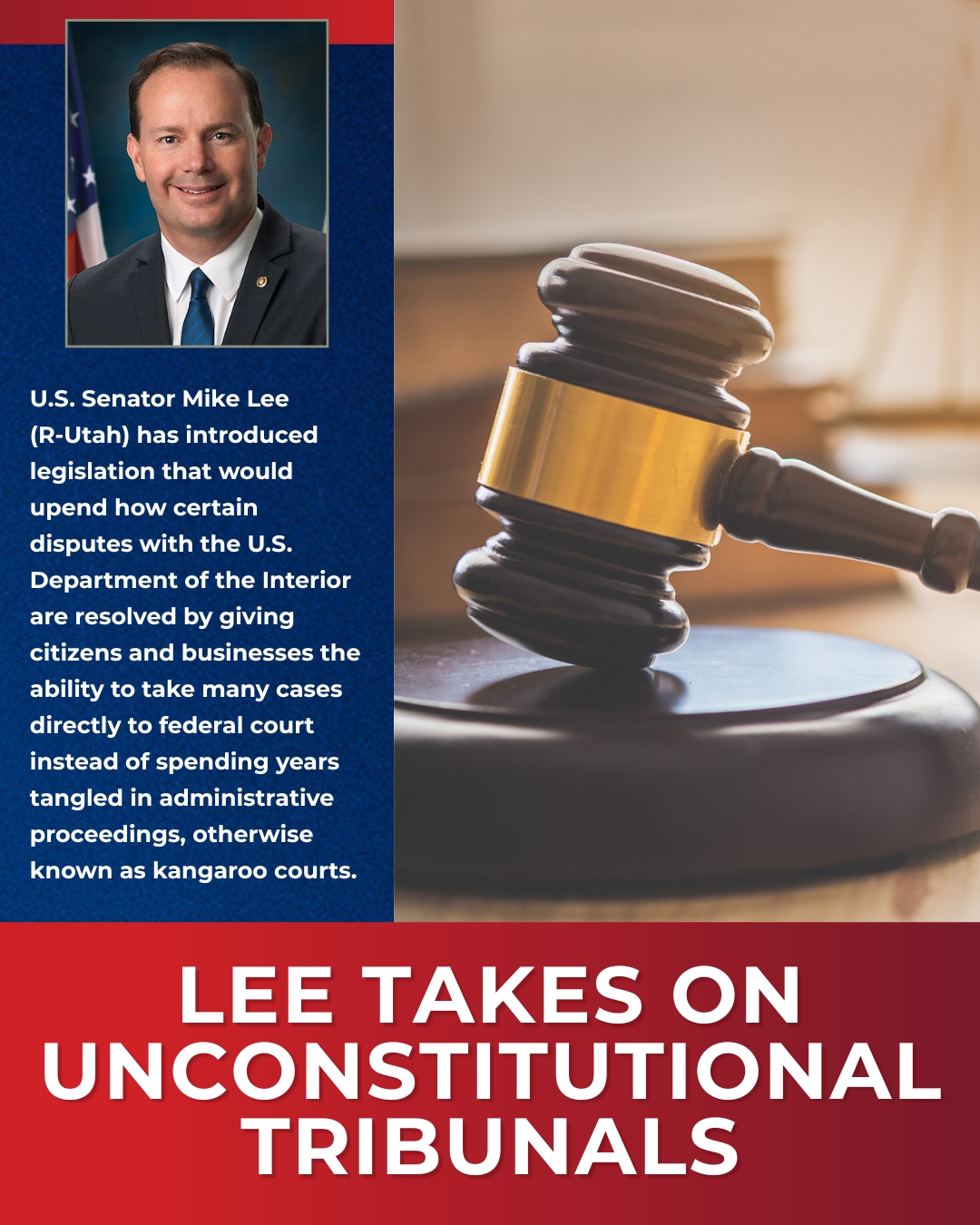
U.S. Senator Mike Lee (R-Utah) has introduced legislation that would upend how certain disputes with the U.S. Department of the Interior are resolved by giving citizens and businesses the ability to take many cases directly to federal court instead of spending years tangled in administrative proceedings.
The Free to Exit Administrative Tribunals (FEAT) Act builds on the Supreme Court’s 2024 decision in SEC v. Jarkesy, which held that many agency adjudications imposing civil penalties violate the Seventh Amendment’s guarantee of a jury trial. Lee argues that Americans should not have to endure a lengthy internal tribunal before receiving legitimate judicial review.
“Americans should not be forced to navigate administrative tribunals for years before they can have their day in court,” Lee, the chairman of the Senate Committee on Energy and Natural Resources, said. “The Supreme Court made clear in Jarkesy that the Constitution protects the right to a jury trial when the government seeks to impose penalties. This bill restores that right and gives citizens and businesses a faster path to justice.”
Sen. Cynthia Lummis (R-Wyoming) is also an author of the bill.
“In Wyoming, decisions about grazing permits, mineral leases and energy projects can make or break a family operation, yet appeals are often stuck in agency tribunals for years,” Lummis said. “Our bill gives people the choice to bring their case before an independent federal judge from the start, rather than at the end of a long administrative road. Faster answers mean more certainty for the people who live and work on our public lands.”
Under current law, the lawmakers say, many disputes before the Department of the Interior’s Office of Hearings and Appeals must first slog through administrative law judges and agency appeals boards before reaching federal court. That process can take years, even when judicial review is inevitable.
The FEAT Act allows parties involved in certain proceedings before the Department of the Interior to remove their cases directly to federal district court within 60 days of the action being initiated. More specifically, the bill would allow applicants challenging Department of the Interior decisions regarding permits and approvals to remove their cases directly to federal district court, and individuals and businesses facing department-imposed sanctions or civil penalties could also seek immediate review in an Article III court as well.
Lee, Lummis, and other sponsors of the bill say it eliminates unnecessary delays and duplicative administrative proceedings. Most important, they say it would end the bureaucracy’s ability to obliterate the constitutional separation of powers by giving the administrative state not only enforcement powers but prosecutorial discretion, judicial authority, and sentencing jurisdiction—in other words, the authority to act as law enforcement, prosecutor, judge, and jury.
What’s more, in administrative proceedings, standard judicial rules, such as rules of evidence and pretrial discovery, often don’t apply, and, though decisions can be appealed, regular courts often defer to agency administrative decisions. Overall, the proceedings can frustrate the process and discourage those seeking justice, often to the point of giving up.
Lee says the legislation is especially important with regard to the Department of the Interior, where grazing permits, mineral leases, energy projects, and agency sanctions are often ensnared in Interior’s internal hearing system. Supporters also say the legislation would provide greater certainty for businesses and landowners whose livelihoods depend on timely decisions.
The measure fits within Lee’s broader campaign against what he characterizes as administrative lawfare and the expanding power of unelected agencies, in particular progressives’ increasing use of legal action primarily intended to harass, cripple, silence, or politically damage an opponent.
Certainly, the use of internal administrative kangaroo courts is a prop used to bypass the constitutional courts, and so are lawsuits intended to stop activists from bringing enforcement lawsuits for no reason other than their own ideological bent, rather than based on any violation of the law. Late last year, Lee took on that element of lawfare by introducing a bill to protect Americans from climate extremists’ lawfare.
His Fair Air Enforcement Act would stop the weaponization of the judicial system by outlawing citizen suits under the Clean Air Act, which the senator says has been used by political groups to hurt Americans and their businesses.
“Climate extremists are weaponizing our judicial system against Americans and their small businesses,” he said. “It’s time for this to stop. Americans deserve the freedom to do as they please with their own property without fearing crushing regulations. The Fair Air Enforcement Act will prevent partisan political groups from abusing the legal process to drag private citizens and industries through frivolous lawsuits.”
The Fair Air Enforcement Act would amend the Clean Air Act to prohibit lawsuits by private citizens alleging violations of its provisions and to require that such enforcement lawsuits be brought by state governments and relevant agencies. It also makes conforming changes to other sections of the U.S. Code that reference the amended provision.
These bills are well worth watching as the resistance to lawfare becomes more widespread. The expanding use of lawfare has also become a particular concern for American Stewards of Liberty, as ASL executive director Margaret Byfield explained in a congressional roundtable held before the House Committee on Oversight and Government Reform in April. At the roundtable, Byfield related her own compelling personal story as the panel discussed how growing lawfare against the nation’s farmers and ranchers is being waged through the administrative state.