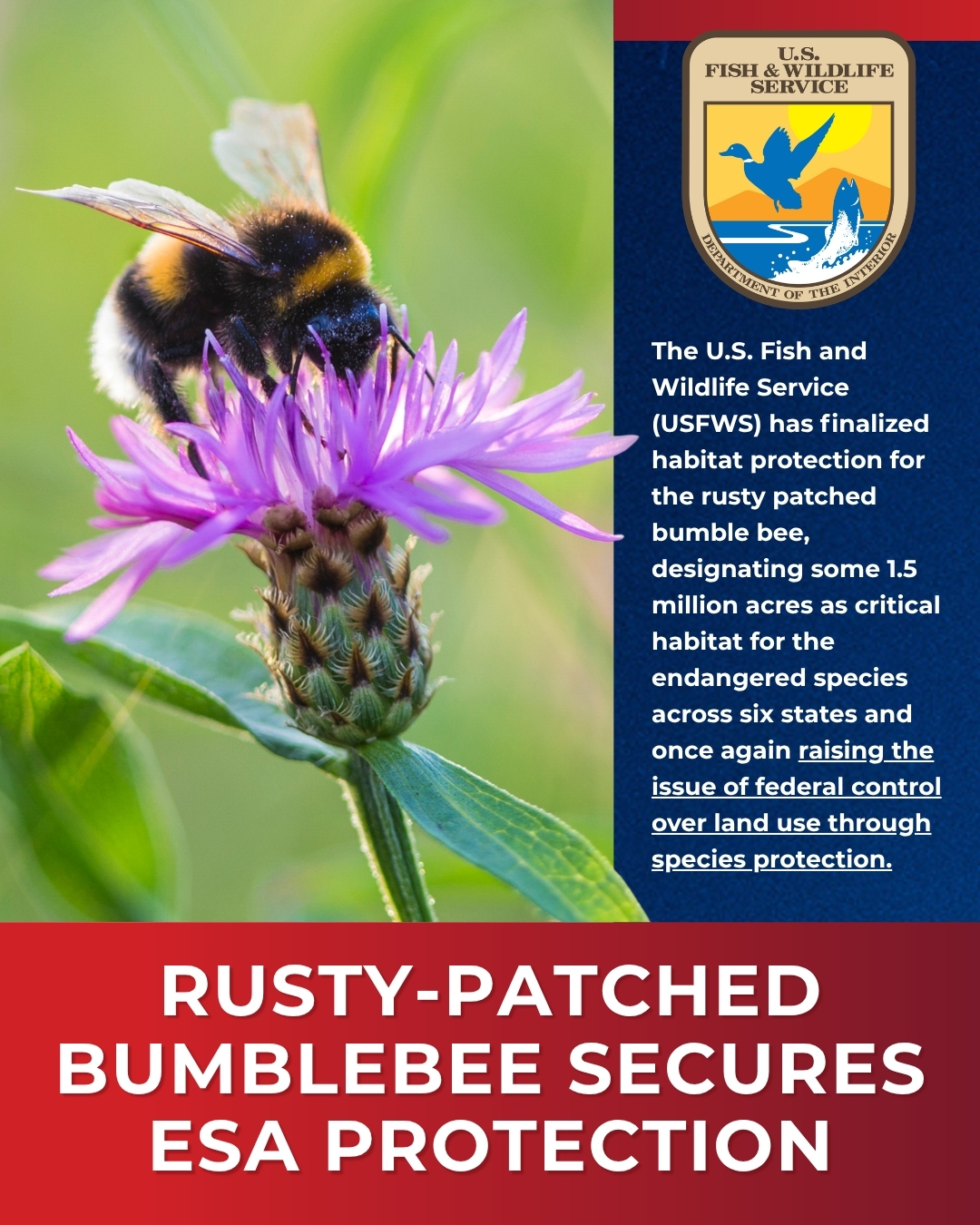
The U.S. Fish and Wildlife Service (USFWS) has finalized habitat protection for the rusty patched bumble bee, designating some 1.5 million acres as critical habitat for the endangered species across six states and once again raising the issue of federal control over land use through species protection.
The designation, published May 29, covers 33 counties in Illinois, Iowa, Minnesota, Virginia, West Virginia, and Wisconsin and represents one of the largest recent critical habitat actions undertaken under the Endangered Species Act (ESA).
In announcing the designation, the agency said it does not create wildlife refuges, does not authorize public access to private property, and does not directly regulate ordinary activities on private land. Rather, officials described it as a conservation tool intended to aid recovery of the first federally listed bumble bee species.
But for property owners, the announcement raises a different question: If so little will change, why designate 1.5 million acres in the first place? And why shouldn’t Congress have a greater role to play in approving large-scale critical habitat (CH) designations?
In fact, while the Fish and Wildlife Service is technically correct that the designation does not automatically regulate private land, significant consequences arise when a federal agency becomes involved in a project.
Whenever federal permits, funding, or approvals are required, agencies must evaluate whether their actions could adversely affect designated critical habitat, evaluations that will most assuredly affect projects on private lands or on lands essential to their use. Army Corps wetlands permits, federally funded highways, USDA programs, EPA permits—all these federally connected activities and more could trigger critical habitat evaluation.
The result is not necessarily a prohibition, but in many if not most cases it means additional mitigation measures, project redesigns, or costly and extended reviews. The developmental impacts could be decisive, given that USFWS say threats include insecticides and fungicides, the effects of drought and extreme temperatures, and challenges associated with small population size.
All that could add up to de facto denial, given that a CH designation can also trigger a calculation of cumulative effects, which can alter infrastructure planning, economic development, and local land-use decisions.
Governance reforms
Such large-scale administrative designations have intensified the need for governance reform, and in that vein a package of ESA measures is now before Congress, led by House Natural Resources Committee chairman Bruce Westerman (R-Arkansas), which addresses the concentration of too much authority within federal agencies.
As part of the package, an amendment offered by Rep. Paul Gosar (R-Arizona) and recommended by American Stewards of Liberty (ASL) would require congressional approval for any critical habitat designation exceeding 50,000 acres. The newly announced rusty patched bumble bee designation is about thirty times larger than that proposed limit.
More broadly, ASL has been at the forefront of organizations actively urging Congress to adopt reforms to the Endangered Species Act. ASL recently joined 19 other national organizations and the Pacific Legal Foundation in a letter supporting Westerman’s H.R. 1897, the ESA Amendments Act of 2025.
According to the coalition, the legislation would strengthen protections for private property owners while preserving responsible stewardship, and the Gosar amendment was one of two that ASL recommended that were ultimately incorporated into the bill.
Besides the proposal requiring congressional approval for critical habitat designations larger than 50,000 acres, the other ASL-recommended amendment, offered by Rep. Pete Stauber (R-Minnesota), would require species determination analyses to be prepared in coordination with states, local governments, and tribal governments.
ASL argues that giving those entities a formal role in the process would provide communities with a stronger voice before decisions carrying significant economic and land-use consequences become final.
In announcing its support for the legislation, ASL thanked Westerman as well as Reps. Harriet Hageman, Stauber, and Gosar for advancing reforms the organization says would give landowners “an enormous voice to landowners nationwide who have had to shoulder the burden of a listed species found on their private property.”
Back to the bumble bee, though, according to the USFWS, the rusty-patched bumble bee is found primarily in urban and suburban settings, and the designated habitat includes counties associated with major metropolitan areas rather than vast expanses of agricultural land.
Consequently, the entities most likely to get ensnared in the designation may be transportation projects, municipalities, urban and suburban developers, utilities, and local governments pursuing projects involving federal funding or permits. That means new government bramble to entangle development projects.
Even so, infrastructure networks and permitting decisions often migrate beyond metropolitan boundaries, meaning rural communities could still experience the sting of the designation’s indirect effects.