
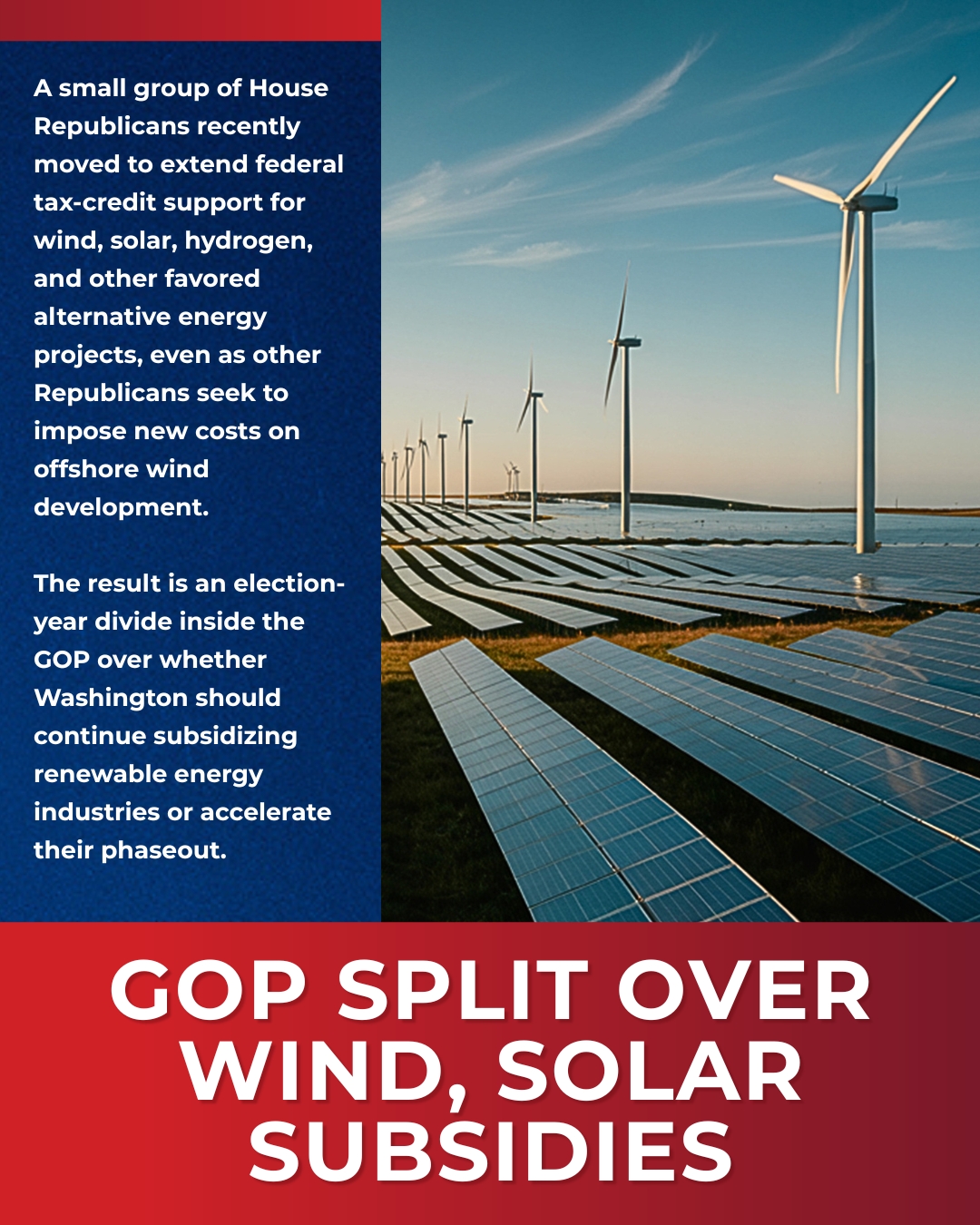
A small group of House Republicans recently moved to extend federal tax-credit support for wind, solar, hydrogen, and other favored alternative energy projects, even as other Republicans seek to impose new costs on offshore wind development.
The result is an election-year divide inside the GOP over whether Washington should continue subsidizing renewable energy industries or accelerate their phaseout.
The American Energy Dominance Act, introduced by Rep. Brian Fitzpatrick (R-Pennsylvania), would remove deadlines placed on renewable energy tax credits under the One Big Beautiful Bill Act, including the 45Y production tax credit and 48E investment tax credit. Co-authors of the bill are Reps. Mike Lawler of New York, Max Miller of Ohio, and Mike Carey of Ohio.
Fitzpatrick says the bill is a pro-worker, pro-growth measure developed with North America’s Building Trades Unions (NABTU).
“If America wants to lower costs, strengthen its energy supply, and build with confidence for the future, then we need a policy framework strong enough to support the scale of that work,” Fitzpatrick said. “That means certainty. When the rules are unstable, projects stall, hiring slows, investment hesitates, and the people counting on progress pay the price. The men and women of NABTU understand that better than anyone because they are the ones building America’s future with their hands, skill, and grit.”
But free-market energy advocates blasted the move as a bait-and-switch by Republicans who had previously backed legislation to curtail those same subsidies. American Energy Alliance president Tom Pyle said the continued reliance on clean energy tax credits is a political crutch forcing taxpayers to subsidize technologies that are not sustainable on their own.
“Those who have introduced this legislation—many of whom voted to pass the OBBB—should be working to phase out these subsidies more quickly, not doubling down on them,” Pyle said.
Pyle was especially blunt about the timing.
“With all of these Members facing a battle for reelection, it’s surprising that subsidizing large corporations is their number one priority,” he said. “Introducing legislation now to eliminate the tax credit deadlines is the obvious bait-and-switch we warned about a year ago, as these members push to revive preferential treatment for their favored industries. As I have said before, extending green giveaways on the backs of taxpayers is shortsighted and neglectful. The American people deserve better than the fast one these Members are trying to pull.”
A Capstone analyst said Fitzpatrick’s bill is not expected to gain traction in this Congress, though it could find new life if Democrats win control of the House or Senate in the 2026 elections. For now, the fight exposes an old Washington habit in a new green wrapper: promise to end the subsidies, then quietly try to extend them.
At the same time, as reported by Politico, moving in the opposite direction, House Republicans advanced a fiscal 2027 Interior Department spending bill that would impose new fees on offshore wind projects, including $7,300 for an onshore inspection visit, $15,400 for a visual turbine inspection, and $72,800 for further physical inspections of a turbine or substation.
Analysts say the fee structure could exceed those paid by offshore oil companies because the charges would apply per turbine.
Meanwhile, the Trump administration has taken its own tack in ending offshore projects. In March, the Department of the Interior announced a landmark agreement with TotalEnergies for the company to redirect capital from what the department called expensive, unreliable offshore wind leases toward affordable, reliable natural gas projects.
Specifically, TotalEnergies has committed to invest approximately $1 billion—the value of its renounced offshore wind leases—in oil and natural gas and LNG production in the United States. Following that investment, Interior officials say, the United States will reimburse the company dollar-for-dollar, up to the amount they paid in lease purchases for offshore wind, ending what Trump has deemed “ideological subsidies that benefited only the unreliable and costly offshore wind industry.”
In addition, TotalEnergies pledged not to develop any new offshore wind projects in the United States.
“This agreement is yet another win for President Trump’s commitment to affordable and reliable energy for all Americans,” Secretary of the Interior Doug Burgum said. “Offshore wind is one of the most expensive, unreliable, environmentally disruptive, and subsidy-dependent schemes ever forced on American ratepayers and taxpayers. We welcome TotalEnergies’ commitment to developing projects that produce dependable, affordable power to lower Americans’ monthly bills while providing secure U.S. baseload power today—and in the future.”
Taken together, the two developments depict a tug-of-war between those wanting to keep taxpayer-backed incentives flowing to wind and solar developers, while others want to force those industries to pay their own way.
For rural communities, the question is whether politically favored industries should be allowed to rely on federal subsidies, special tax treatment, and regulatory preferences while landowners and ratepayers shoulder the consequences.