
A new Trump administration energy emergency determination designed to fast-track critical infrastructure projects primarily because of the war in Iran is raising concerns among some property rights advocates and state lawmakers, who fear that the federal directive could preempt state protections against CO2 pipelines and eminent domain abuse.
To cite one example, in South Dakota, which last year enacted legislation prohibiting carbon dioxide pipeline developers from using eminent domain to acquire private land, some state legislators are warning that Washington may be moving toward centralized federal siting authority.
On April 20, President Trump signed a presidential determination issued under the Defense Production Act of 1950. The memorandum declares that the “development, manufacturing, and deployment of large-scale energy and energy-related infrastructure” is essential to national defense and authorizes federal action to accelerate projects hindered by “regulatory delays and market barriers.”
“I hereby determine, pursuant to the [Defense Production Act], that development, manufacturing, and deployment of large-scale energy and energy-related infrastructure, including engineering, site acquisition and preparation, permitting, early-stage risk mitigation financing instruments, domestic manufacturing capacity, and enabling infrastructure, are industrial resources, materials, and critical technology items essential to the national defense,” the order states.
Without presidential action, the memorandum continues, United States industry cannot reasonably be expected to provide those capabilities in a timely manner. Critics worry that the language is broad enough to federalize ongoing infrastructure decisions traditionally handled by states and local governments, particularly when it comes to siting authority.
Republican South Dakota Sen. Mark Lapka said the order deserves close scrutiny.
“I don’t intend to alarm anybody,” Lapka told Beth Warden of Dakota News Now in a recent interview. “I don’t think that everything will come to pass here, but it’s just something that we need to remain vigilant on.”
Lapka said the concern over property rights is not limited to carbon pipelines: “You’re talking about data centers, any energy infrastructure, windmills, solar panels,” he said.
In South Dakota, the specific concern is over Summit Carbon Solutions’ proposed $9 billion carbon capture pipeline, which would transport compressed carbon dioxide from ethanol plants across several Midwestern states to underground storage sites in North Dakota.
Initially, Lapka said, many landowners assumed the project resembled traditional energy infrastructure such as natural gas pipelines. But he said opposition intensified as residents learned the pipelines were designed largely to secure federal tax credits tied to carbon sequestration programs.
“Normal pipelines exist for transporting a commodity to an end user at a cheaper rate of transportation, that there’s a benefit to the general public,” he said. “Whereas here this was only going to have a benefit for private companies.”
Lapka said the turning point came when landowners realized pipeline companies could invoke eminent domain.
“And it was believed at the beginning that eminent domain would not be allowable for that type of project only to in fact find that it was,” he said. “And you know that’s what’s played out over the state of South Dakota over throughout the last five years. South Dakotans are very proud of and hold their property rights very strong. It’s led to a change in the makeup of our legislature.”
When South Dakota Gov. Larry Rhoden signed the bill prohibiting eminent domain for CO2 pipelines last year, he said the measure was meant to protect landowners from involuntary easements.
“South Dakota landowners feel strongly that the threat of involuntary easements for the proposed carbon dioxide pipeline infringes on their freedoms and their property rights,” Rhoden wrote in a letter after he signed the bill, emphasizing that the law did not prohibit pipeline development altogether.
“Rather than viewing this legislation as an obstacle to the proposed project, I encourage Summit and others to view it as an opportunity for a needed reset,” Rhoden wrote. “Voluntary easements for this proposed project will still be able to move forward and are not impacted by HB 1052. ln fact, without the threat of eminent domain, the opportunity might finally be available for trust to be rebuilt and for more productive conversations to occur between Summit and South Dakota landowners.”
Lapka underscored the law’s intent in his April interview: “It’s just the right of ways had to be procured through a good-faith negotiation instead of utilizing the heavy hand of the government.”
Even before Trump’s April memorandum, South Dakota lawmakers believed federal officials were already exploring ways to override state authority. Lapka said an early version of congressional budget legislation—the One Big Beautiful Bill—contained provisions that would have centralized siting authority for CO₂ pipelines at the federal level. According to Lapka, a delegation of South Dakota lawmakers and advocates traveled to Washington to oppose the measure and successfully pushed for its removal.
Still, he warned that the effort revealed a broader push toward federal preemption: “We were successful on that attempt, but we knew that that was a threat that was going to continue to come.”
Now, with the administration invoking national emergency powers under the Defense Production Act, some lawmakers fear the same concept could re-emerge administratively rather than legislatively. The memorandum itself repeatedly references the need to overcome “regulatory delays” and accelerate permitting and deployment of energy infrastructure.
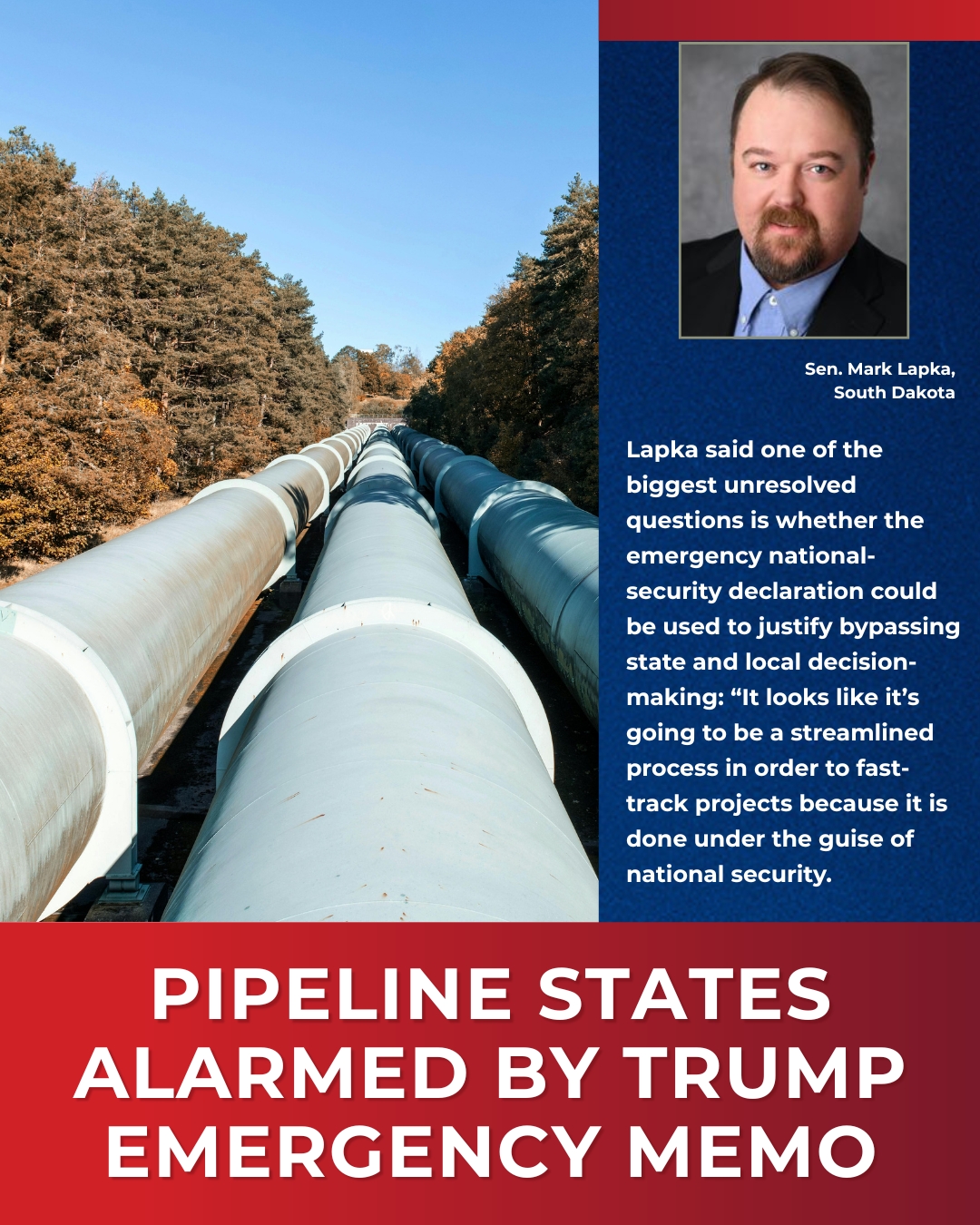
Lapka said one of the biggest unresolved questions is whether the emergency national-security declaration could be used to justify bypassing state and local decision-making: “It looks like it’s going to be a streamlined process in order to fast-track projects because it is done under the guise of national security. And obviously while nobody wants to make our nation any less secure, one has to wonder, we haven’t been in this conflict very long and are we in a crisis yet?”
The constitutional integrity of the order needs to be scrutinized, Lapka said, adding that the broader constitutional concern is that the federal government could increasingly treat local land-use disputes as national policy matters.
“There’s nobody that knows better than the people themselves who live there, how things can take place in a responsible manner,” he said. “Whereas if you would federalize everything, it’s more a top-down system.”
It’s important to note that the administration’s order does not explicitly mention eminent domain or override state property-rights laws. Still, the Defense Production Act has most often been used during wartime or acute supply-chain emergencies, and the Trump administration’s April 20 memo was unusually expansive.
Finally, the latest concerns again underscore tensions inside conservative politics.
For decades, Republicans have championed local control and property rights while criticizing centralized federal planning. However, the Trump administration’s push for domestic energy dominance, grid expansion, data centers, and carbon infrastructure—and efforts to limit states’ ability to regulate such things as artificial intelligence—increasingly collides with local property rights and local control movements, especially in rural states.
“It’s no secret that a lot of these companies have desired what they refer to as regulatory certainty,” Lapka said. “And that’s something that is opposite of what local control establishes.”
Lapka said fighting for property rights protection is as old as the nation itself.
“That’s how our country was founded in the beginning because we weren’t able to own property when we were under the control of the king and that’s something that led to the revolutionary war establishing America,” he said. “So property rights is one of the most important inherent rights that we need to protect.”