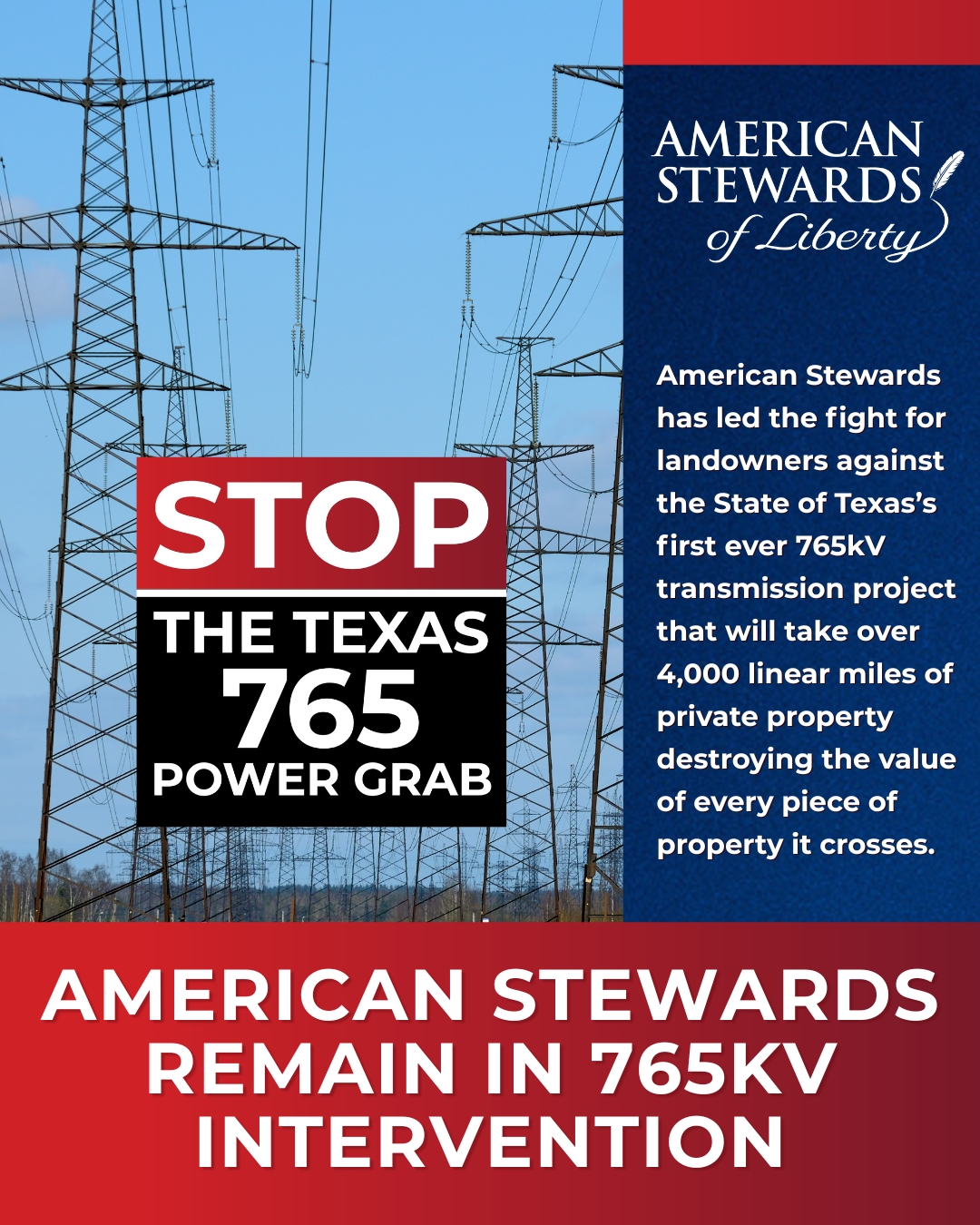
American Stewards is leading the fight on multiple fronts against the State of Texas first ever 765kV transmission line project defending the private property rights of thousands of Texas landowners.
There are three major lines crossing west to east with a total of five individual segments. ASL has intervened in four of the segments and will be filing in the fifth with the Public Utility Commission of Texas (PUCT), the state agency that approves any new utility construction in the state.
Intervention is the statutory process that allows anyone with a legal interest to protest the lines. American Stewards has “associational standing” because we have members whose land will be directly affected by these new lines.
The unprecedented project will take a 200-foot easement across 4,000 linear miles of Texan’s private property affecting over 5,000,000+ acres with an uncompensated loss of over $10 billion.
The construction company known as ONCOR is guaranteed a 9.6% yield on their capital investment building the infrastructure of these transmission lines. With their $10 billion investment, ONCOR is guaranteed a nearly $1 billion return annually for the next 30 years.
The landowners, who will have 15-story tall towers erected on their land will be paid pennies for the 200-foot easement and will lose millions in uncompensated loss of value on the rest of their land.
ONCOR has objected to two of our interventions attempting to have us thrown out. However, the PUCT has denied ONCOR’s requests and upheld our intervention status. In fact, the administrative law judges stated in their order against ONCOR:
“American Stewards of Liberty has shown, through associational standing, a justiciable interest to participate in this proceeding. An association has standing to sue on behalf of its members when: (1) its members would otherwise have standing to sue in their own right; (2) the interests the association seeks to protect are germane to its purpose; and (3) neither the claim asserted nor the relief requested requires the participation of individual members in the lawsuit. American Stewards of Liberty has shown that it has members who own property that may be directly affected by one or more of the routes for Oncor’s proposed…transmission line in this proceeding. The association states that it seeks to intervene “to advance its organizational mission of defending property rights and challenging infrastructure and land-use policies that unnecessarily burden private land without serving a legitimate public necessity.” And American Stewards of Liberty distinguished this objective from its individual members’ because the primary objective of ASL’s individual members is narrower: to avoid the routing of the transmission line across their respective properties. Therefore, the Commission…upholds the ALJ’s (Administrative Law Judges) decision to grant American Stewards of Liberty’s motion to intervene.”
Our interventions have been unique in that we are arguing ONCOR’s application should be denied by the PUC because they have not complied with the Public Utility Regulatory Act and have relied on “general assumptions, incomplete information, or future determinations that have yet to occur.”
Before ONCOR can have their Certificate of Convenience and Necessity (CCN) approved, they must evaluate the impacts on community values, landowners, the environment, recreational and park areas, and the effects on historical and aesthetic resources.
ONCOR has done none of these evaluations. In fact, they have said once their CCN is approved and the final routes have been chosen, property condemned, and construction begun, they will perform these statutory determinations.
ASL has not only intervened in the statutory process, we have helped multiple counties and municipalities form 391 planning commissions on all three lines. Counties directly affected by power lines crossing their jurisdiction have realized forming a 391 is the most powerful tool they have to fight back.
Under Texas’ Local Government Code 391.009(c) state agencies are required to coordinate their plans and policies, to the greatest extent feasible, with local planning commission’s plans and policies.
Coordination is a game changer. It gives the 391 commissions “equal, not subordinate” standing with the state agencies. This gives local governments tremendous power and leverage to directly impact how the state’s plans will affect their jurisdiction. It requires the agencies to resolve any conflicts in their plans and policies with the plans and policies of the local governments before they can take any action in their jurisdiction.
One of the 391 commissions has already set meetings with the U.S. Fish and Wildlife Service later this month. These meetings will give local communities the authority and power to defend their citizens, landowners, and general welfare of their community from overzealous bureaucrats who care nothing about the effects their plans will have on local landowner’s private property.
All anyone needs to do is follow the money to totally understand the drive these entities have to move forward without any concern for the citizens of this state.